Electron won the desktop app wars — and its challengers are now reshaping how developers build apps
In 2013, GitHub released Atom, a text editor built on a framework that embedded a full Chromium browser and Node.js runtime into a desktop application. The framework, later spun out as Electron, seemed absurd to performance-minded developers: why bundle an entire web browser to run a text editor?
Thirteen years later, Electron powers the most widely used developer tool on earth. Visual Studio Code, Slack, Discord, Figma's desktop client, Notion, 1Password, and dozens of other category-defining applications are all built on Electron. Whatever the theoretical objections, Electron won. The question now is whether it can hold onto that dominance as a new generation of frameworks attacks its weaknesses.
Why Electron won
Electron's core value proposition is simple: write once in HTML, CSS, and JavaScript, and deploy to Windows, macOS, and Linux without maintaining separate codebases. For teams already building web apps, the skillset transfer is nearly zero. The npm ecosystem provides millions of packages. Chrome's DevTools work for debugging. The rendering behavior is completely predictable across platforms because it's always the same browser engine.
The business case closed itself. Compared to hiring native platform specialists for macOS (Swift/Objective-C) and Windows (C#/WinRT) separately, a single JavaScript team maintaining one codebase was dramatically cheaper. Slack famously rebuilt its macOS client from a native app to Electron and reduced its engineering headcount for the desktop team. The trade-off in performance was judged acceptable given the reduction in complexity.
The real costs
The complaints about Electron are real and well-documented. A typical Electron application bundles roughly 150–200 MB of Chromium and Node.js, meaning every Electron app ships its own copy of a browser. Discord's installer is over 90 MB. VS Code is around 100 MB. Multiply this across the 15 or 20 Electron apps a typical developer runs, and you've added gigabytes of redundant browser installations to your machine.
Memory usage is the more immediate problem. Discord routinely uses 600–900 MB of RAM at idle. Slack has historically consumed similar amounts. On a MacBook with 8 GB of unified memory, running three Electron apps simultaneously means dedicating a meaningful fraction of your available RAM to applications that are essentially waiting for you to look at them.
Startup time is slower than native equivalents. The time to launch VS Code on a cold start is noticeably longer than launching a native editor. For power users who run apps all day, this is a minor annoyance. For users who habitually close and reopen applications, it adds up.
Tauri: the lightweight challenger
Tauri, first released in 2021 and reaching version 2.0 in 2024, takes a different architectural approach. Instead of bundling Chromium, it uses the operating system's built-in WebView — WebKit on macOS and Linux, WebView2 (Edge's rendering engine) on Windows. The backend runs on Rust rather than Node.js.
The result is dramatically smaller applications. A minimal Tauri app produces an installer under 4 MB. Memory usage at idle can be below 50 MB for simple applications. Rust's safety guarantees and performance characteristics make the backend more efficient than Node.js for CPU-intensive operations.
The trade-off is rendering consistency. Because Tauri uses the system WebView, rendering can vary between platforms — WebKit behaves differently from WebView2 in edge cases. Developers used to Electron's "it always looks like Chrome" guarantee have to do more cross-platform testing. The CSS or JavaScript that works perfectly on macOS may have subtle differences on Windows.
Despite this, Tauri has attracted serious adoption. Bitwarden migrated its desktop client from Electron to Tauri in 2023, reporting dramatic reductions in memory usage and installer size. Security-conscious applications particularly benefit: Tauri's smaller attack surface — no bundled Node.js runtime, no full browser engine — is meaningful for apps that handle sensitive data.
Other contenders
Wails brings Go to the same WebView-based architecture that Tauri pioneered, appealing to teams already invested in Go's ecosystem. Flutter, originally a mobile framework, has reached production quality on desktop and offers a completely custom rendering engine — no WebView at all — with pixel-perfect consistency across platforms but at the cost of a larger learning curve.
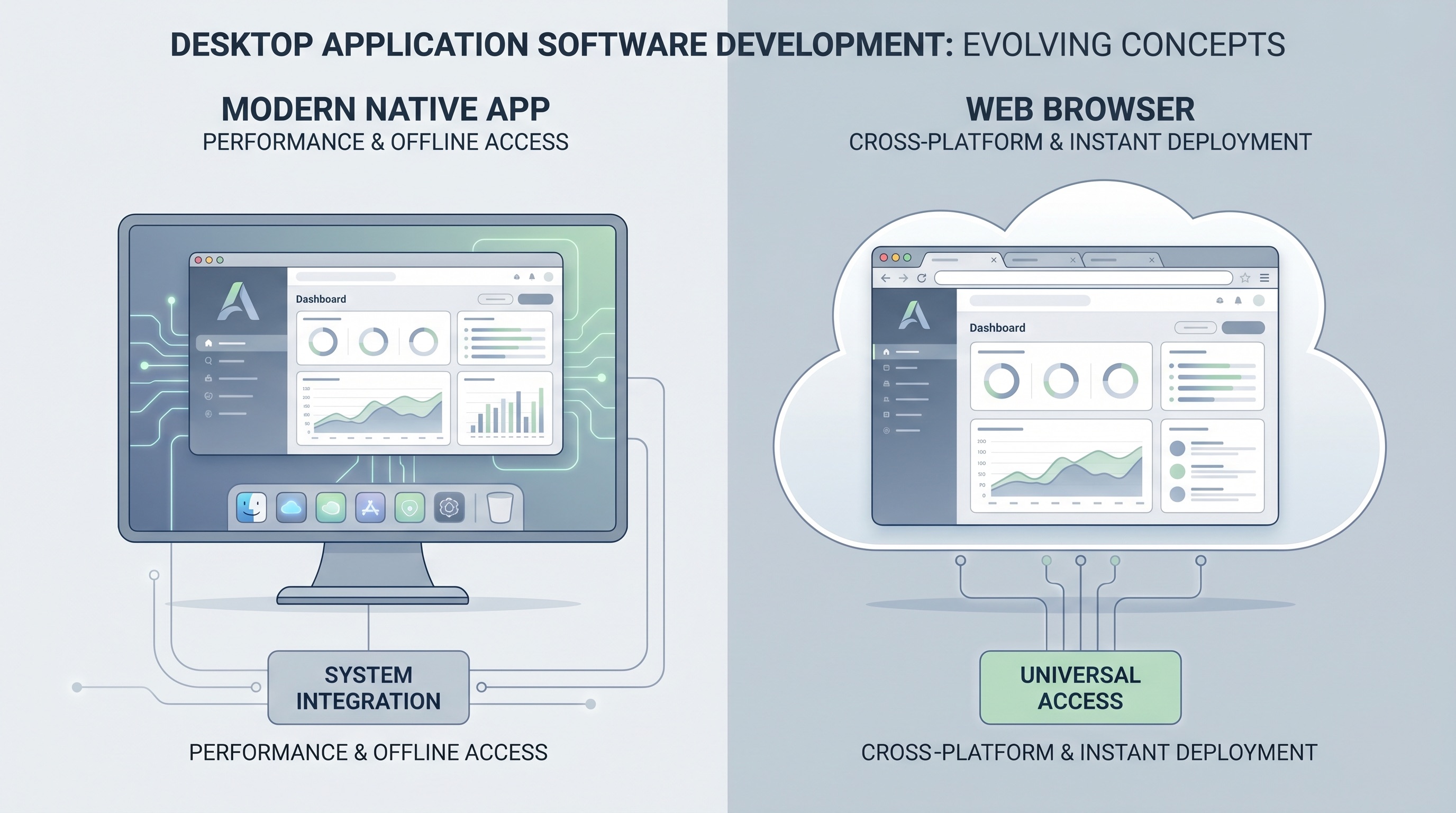
Progressive Web Apps (PWAs) remain viable for applications that don't need deep system integration. Chrome and Edge both support installing PWAs as desktop applications, and the gap in functionality between PWAs and Electron apps has narrowed significantly over the past several years. For apps that primarily display content and don't need access to the file system, local ports, or system notifications, PWAs are often the sensible choice.
Why Electron isn't going anywhere
Despite its challengers, Electron's moat is deep. The ecosystem of Electron-compatible packages, tooling, and tutorials is enormous. Teams with existing Electron codebases have little incentive to rewrite applications that are working. The performance complaints, while legitimate, have proven tolerable enough that users keep installing Electron apps by the tens of millions.
Microsoft's continued investment in VS Code — the world's most used IDE, built on Electron — signals that the framework will be actively maintained for the foreseeable future. Electron's core team has also improved performance meaningfully over the years: V8's JavaScript engine is dramatically faster than it was in 2013, and Chromium's memory management has improved.
The 2026 landscape
The desktop app ecosystem in 2026 looks more diverse than at any point in Electron's history. Electron still dominates for applications where rendering consistency, broad npm compatibility, and developer familiarity matter most. Tauri is winning for applications where security, binary size, or startup performance are critical constraints. Flutter is carving out space for apps with custom UI requirements. PWAs continue chipping away at use cases that don't need system integration.
The real shift is in how new applications get built. Teams starting desktop projects in 2026 think harder about the trade-offs than they did in 2018. Electron is no longer the default — it's one option among several, each with a different performance and complexity profile. That's a healthier ecosystem than the era when "build a desktop app" meant "build an Electron app," whether or not it fit.