Matter Promised to Fix the Broken Smart Home. Two Years In, It's a Partial Fix.
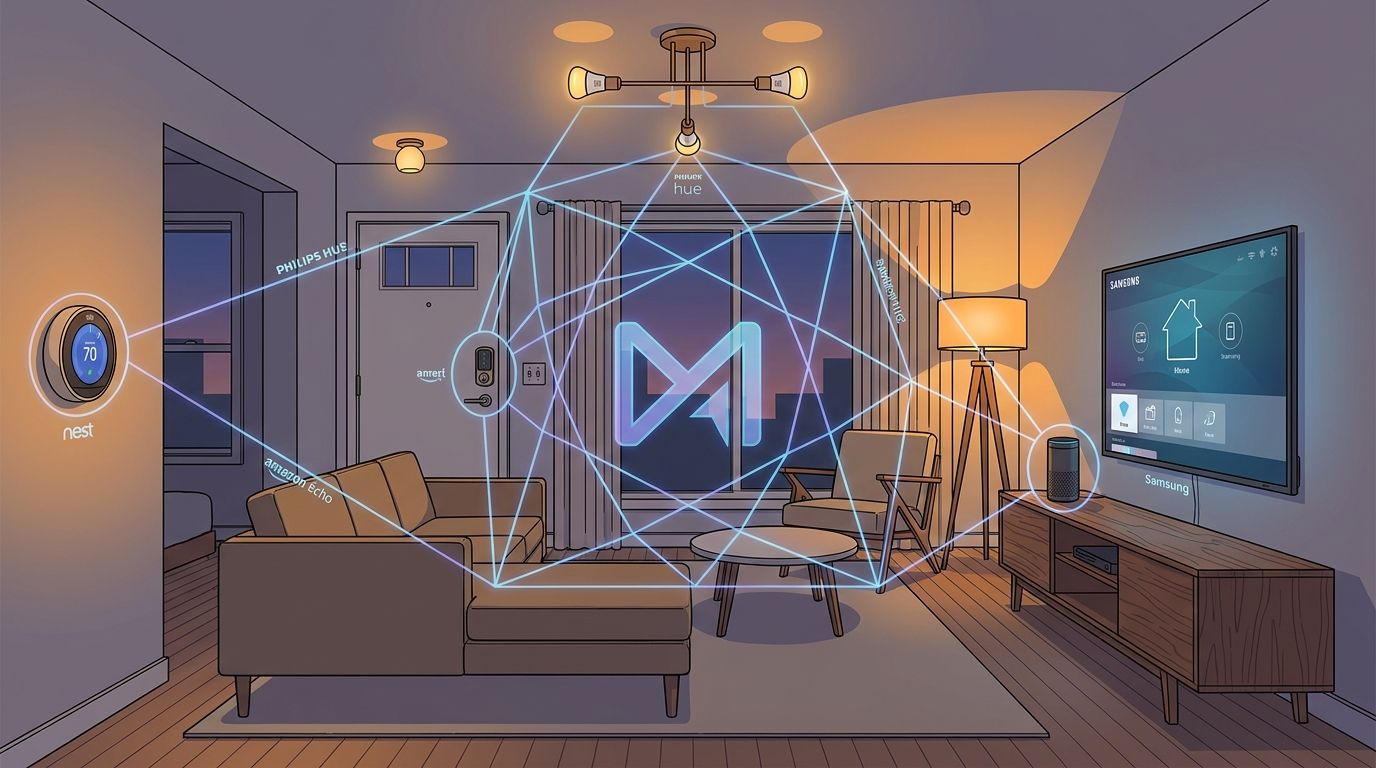
The smart home has been failing at the same problem for fifteen years: buy a bulb from one company, a thermostat from another, and a lock from a third, and they refuse to talk to each other unless every device shares the same brand's ecosystem. In October 2022, a coalition of more than 550 companies released Matter — a new connectivity standard backed by Apple, Google, Amazon, Samsung, and dozens of device makers — designed to finally solve this.
It's mid-2026. The question worth asking now is: how much of that promise actually came true?
What Matter Is (and Isn't)
Matter is an application-layer protocol. It runs on top of existing network infrastructure — Wi-Fi or Thread (a low-power mesh networking protocol), with Bluetooth Low Energy used for device commissioning. What Matter standardizes is how devices identify themselves to controllers, how they advertise their capabilities, and how those capabilities are controlled.
Critically, Matter is not a cloud protocol. A Matter-enabled device on your network can be controlled locally, without talking to any company's server. This matters for reliability (your lights don't stop working if the company's cloud goes down) and for privacy (your thermostat schedule stays on your local network).
The Connectivity Standards Alliance (CSA), which governs Matter, has certified over 4,000 devices as of mid-2026. That number sounds large. In practice, the picture is more complicated.
Where It Works
For the most common device categories — smart bulbs, smart plugs, smart switches — Matter works reliably across ecosystems. A Nanoleaf bulb added via an iPhone will appear in Google Home and Amazon Alexa without any extra steps. This was genuinely impossible before Matter, and it's now routine.
Thread, the mesh networking protocol that Matter uses for battery-powered devices, has had a meaningful impact on reliability for sensors and small accessories. Thread devices don't need a dedicated hub — any Thread border router (built into most recent Apple HomePod, Apple TV, Google Nest Hub, and Amazon Eero devices) can connect Thread devices to your IP network. The result is a low-power mesh that extends through walls more reliably than Zigbee without being tied to a single vendor's hub.
The commissioning experience — the actual process of adding a device to your network — has also improved substantially. Scanning a QR code and having a device appear in three different apps simultaneously is now routine. For first-time smart home users, this is a genuine quality-of-life improvement over the pre-Matter era.
Where It Falls Short
The most common frustration among users who switched to Matter devices: advanced features often don't work across ecosystems. A Philips Hue bulb controlled via Apple HomeKit exposes basic on/off and brightness through Matter. But Philips Hue's dynamic scenes, gradient light effects, and entertainment mode exist only inside the Hue app or the Hue bridge's proprietary integration. Matter doesn't have a specification for these — it standardizes a common baseline, not a full feature set.
This was a deliberate trade-off: a standard ambitious enough to cover every feature of every device category would have taken a decade to ratify. The CSA chose to standardize core operations and add features through specification updates. The consequence is that anyone who bought Matter devices expecting seamless cross-app access to everything their device can do is frequently disappointed.
Security cameras and video doorbells are the most painful gap. Matter 1.3 added camera support, but real-time video streaming across different controllers remains inconsistent. Most major camera manufacturers have not implemented Matter for their cameras, citing the spec's limitations for professional-grade video. Until Matter can reliably stream video to any controller app, the smart home's most purchased category remains siloed.
Robot vacuums, lawnmowers, and most smart appliances are either absent from the spec or only partially implemented by manufacturers. A handful of brands have shipped Matter-certified washing machines and refrigerators, but the selection is narrow.
The Multi-Admin Problem
Matter's multi-admin model — the idea that the same device can be added to multiple ecosystems simultaneously — works, but with a catch that most consumers don't discover until they're frustrated: not all device makers enable it. Some manufacturers have implemented Matter in single-admin mode, where the device can only belong to one controller ecosystem. The Matter certification process doesn't require multi-admin, so certified devices can still be effectively siloed.
Amazon's approach has also frustrated developers. Amazon initially committed to Matter as both a controller (Alexa) and a device ecosystem. In practice, Amazon has moved slowly on Matter device certification for its own products (Echo, Ring) and has quietly pushed its proprietary "Frustration-Free Setup" protocol as an alternative path. Several Ring cameras still don't support Matter as of 2026.
The Fabric Fragmentation That Remains
Each major ecosystem maintains its own "fabric" — the network of trust that allows devices to communicate. Apple HomeKit, Google Home, Amazon Alexa, and Samsung SmartThings fabrics are nominally Matter-compatible but have different cloud sync behaviors, automation trigger systems, and data collection policies. A Matter device is portable in theory but still entangled with one ecosystem's cloud for features like remote access and automation.
The practical experience for most users is still: pick one primary ecosystem and accept that other apps will show your devices but with reduced functionality. This is better than pre-Matter, where other apps showed nothing. But it's not the unified smart home the marketing promised.
What's Actually Worth Doing in 2026
Matter is now mature enough that buying Matter-certified devices is the right default for most people — but with realistic expectations. The value proposition is concrete: your device won't become a brick if the company discontinues its app, you can control it locally without internet, and you can move it to a new ecosystem if you switch platforms.
For anyone building a new smart home setup: Thread-based sensors and bulbs with Matter are solid. Matter-enabled hubs (Apple HomePod Mini, Google Nest Hub 2nd gen) handle most common automation reliably. For cameras, video doorbells, and appliances, check whether Matter is actually implemented before buying — and accept that you may still need the manufacturer's app for advanced features.
The standard is real, it's improving, and it's better than what came before. The fully unified smart home it promised is still a few years out.