PC RAM prices have jumped 40 percent since January — supply constraints and AI server demand are both responsible
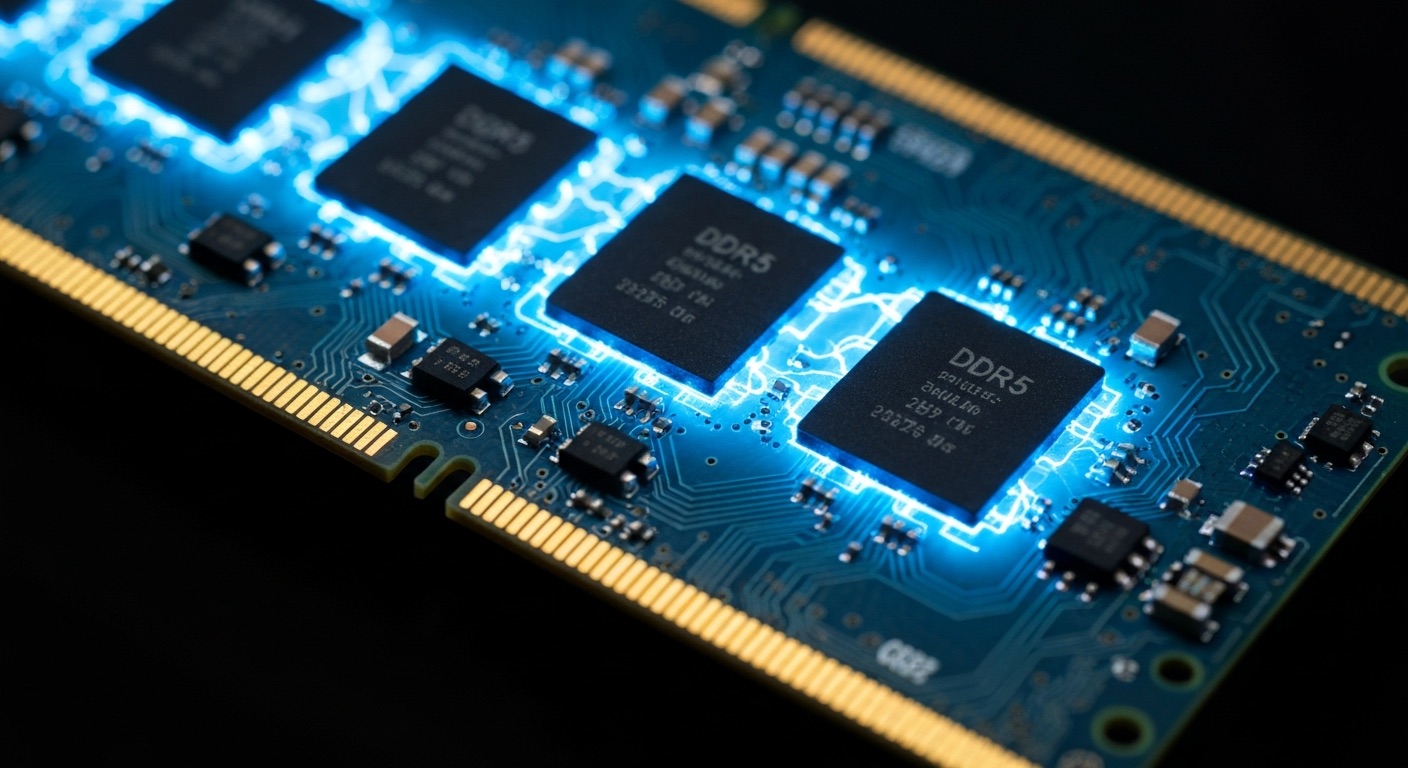
A 32 GB DDR5-6000 dual-channel kit that cost around $75 in December 2025 now lists for $105 or more at major US retailers. 16 GB kits have climbed proportionally. The price increase — roughly 35–40% in five months — is the sharpest consumer DRAM move since the post-pandemic correction in 2021, and it's being driven by a combination of constrained supply and demand patterns that look nothing like prior cycles.
Unlike the 2017–2018 DRAM shortage, which was primarily a cartel-like discipline by Samsung, SK Hynix, and Micron to limit supply, the current situation has multiple independent causes. Some of them will resolve quickly; others are structural. Knowing which is which matters for anyone planning a PC build or enterprise server refresh in the next six months.
The supply side: wafer allocation shifted toward HBM
High-bandwidth memory (HBM) — the stacked DRAM that feeds AI accelerators like NVIDIA's H100, H200, and B200 — is manufactured on the same DRAM fabrication lines as standard DDR5. It requires more wafer area per gigabyte because of the 3D stacking process and tighter yield requirements. When hyperscalers commit to multi-year HBM supply agreements, they're effectively pre-purchasing fab time that would otherwise produce DDR5 and LPDDR5.
Samsung, SK Hynix, and Micron have all publicly reported that HBM allocation has increased as a share of total DRAM output. SK Hynix, the current HBM market leader, said in its Q1 2026 earnings call that HBM represents over 40% of its total DRAM revenue despite being a much smaller share of volume. The margin profile on HBM is dramatically better than commodity DDR5, so there's no financial incentive for manufacturers to shift capacity back.
Additionally, the industry transition from DDR4 to DDR5 production required retooling that temporarily reduced output. That transition is largely complete, but the retooling period created an inventory gap that's only partially refilled.
The demand side: AI servers buy a lot of standard DDR memory too
An NVIDIA GB200 NVL72 server rack — one of the most-ordered AI training configurations right now — uses HBM for the GPU accelerators, but it still requires substantial standard DDR5 ECC RAM for its CPU host nodes. Each rack contains 72 Grace CPUs, and Grace Hopper Superchips use LPDDR5X. But the server management infrastructure, storage controllers, and networking hardware surrounding GPU clusters all use standard DDR modules.
More significantly, AI inference deployments at scale use CPU-based servers for pre- and post-processing, model orchestration, and serving layers that don't require GPU acceleration. These servers consume standard DDR5 at the same rate as any other workload. The volume of new server deployments globally — from hyperscalers, colocation providers, and enterprise on-premise AI buildouts — has created sustained incremental demand that the consumer market is now competing against.
What hasn't changed: tariffs and the China supply picture
The US tariff regime introduced in 2025 on Chinese semiconductor imports added roughly 10–15% to effective import costs for certain memory components routed through Chinese packaging facilities. CXMT (Changxin Memory Technologies), China's primary DRAM manufacturer, has grown rapidly but has not yet qualified DDR5 at volume, and US tariff restrictions limit its role in the American supply chain.
The net effect: the supply buffer that Chinese commodity DRAM provided in prior cycles isn't available for the current DDR5 market. This makes the current shortage less self-correcting than past cycles were.
Prices by module type and what to expect
DDR5 desktop modules (DIMM) have seen the largest absolute price increases because they're the most directly in competition with server ECC UDIMM procurement. A 32 GB ECC UDIMM and a 32 GB consumer DIMM use nearly identical die, so server buyers bidding up ECC supply pulls up the entire market.
DDR4 — still widely used in older platforms and budget builds — has actually held flat or even decreased slightly, because demand has shifted decisively toward DDR5 for new server builds. If you're building on an older AM4 or LGA1200 platform, pricing pressure is minimal.
LPDDR5X for laptops is the tightest tier. It's used in both premium consumer ultrabooks and mobile AI accelerators. Laptop memory upgrades on systems that support them have seen 20–30% increases.
What builders and IT buyers should do now
For consumer PC builders planning a system in the next 30–60 days: buy DDR5 now rather than waiting for prices to drop. The supply constraints driving current pricing won't resolve before Q3 2026 at the earliest, and the summer AI server buying season typically sees additional upward pressure in June and July. The 40% increase from December to now is likely the steepest portion of the increase, but prices are more likely to stay flat or creep upward than to reverse meaningfully.
For enterprise buyers procuring DDR5 ECC for server refreshes: consider locking in pricing via distributor contracts rather than spot-buying. Distributors like Ingram Micro and TD SYNNEX typically offer 60–90 day price locks for volume purchases, and current spot pricing in the channel is already 15–20% above contract prices from Q4 2025.
For anyone who can delay: the picture improves in late 2026. Samsung has announced it will add DDR5 capacity at its Taylor, Texas fab (partially funded by CHIPS Act grants) by Q4 2026. Micron's Idaho expansion adds capacity on a similar timeline. These additions won't immediately translate to retail price drops — there's a lag between fab capacity and retail shelf availability — but the structural supply situation should ease by Q1 2027.
The longer view: memory as AI infrastructure constraint
The 2026 DRAM market is an early signal of a tension that will recur. AI training and inference at scale are memory-intensive in ways that were not true of prior datacenter workloads. Every generation of AI accelerators has demanded more bandwidth and more capacity per chip. HBM4, which enters volume production in 2027, will consume even more DRAM fab capacity per memory bandwidth unit delivered.
Consumer and enterprise PC buyers are now competing for DRAM with an application — AI training — that is willing to pay significantly higher prices. That's a structural demand shift, not a temporary spike. Memory will become a more expensive, more strategically important component category over the next several years.