AI's Electricity Problem: How Data Centers Are Rewriting the Rules of Energy Markets
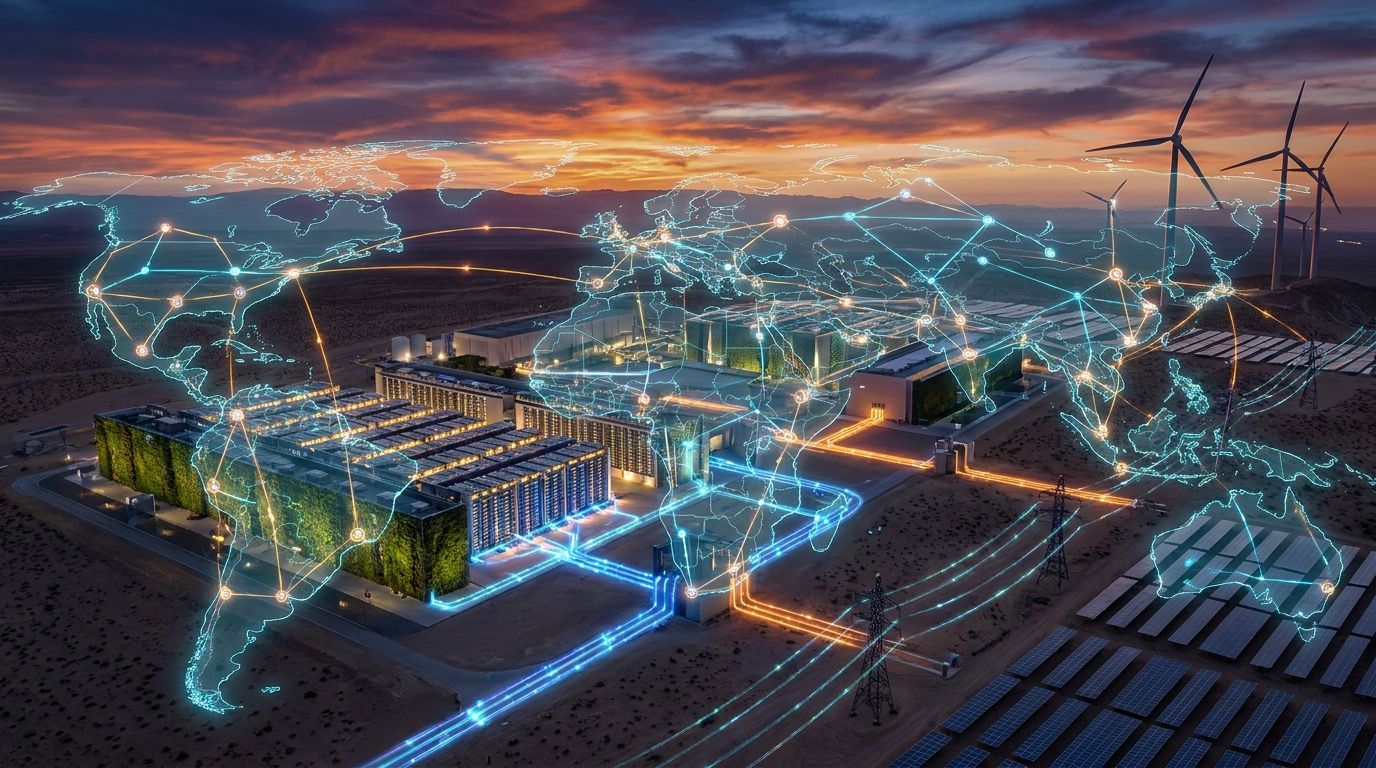
In 2020, data centers consumed approximately 200 terawatt-hours of electricity globally — about 1% of worldwide electricity demand. The IEA's latest estimates put data center consumption on track for 945 TWh by 2026, driven almost entirely by AI workloads. To put that in context: the entire country of Germany uses roughly 550 TWh per year. The electricity required to train and run the AI models shaping 2026 is, by itself, comparable to powering one of the world's largest industrial economies.
This is not a future concern. It is a present operational reality for grid operators, energy markets, and the companies building the infrastructure.
Where the power goes
AI workloads are substantially more power-intensive than traditional cloud computing. A standard cloud VM doing web serving might draw 100 watts. A dense GPU cluster running large model inference draws 400 to 500 watts per GPU card, with modern AI accelerator clusters packing thousands of chips into a single rack. An H100 GPU, the most widely deployed AI accelerator through 2024, has a thermal design power of 700W. NVIDIA's Blackwell B200 raised that to 1,000W per GPU in its air-cooled configuration. A 10,000-GPU cluster consumes roughly 10 megawatts continuously — enough to power a small town.
The Power Usage Effectiveness (PUE) metric — which measures how efficiently a data center uses the electricity it receives — has improved across the industry, but diminishing returns are setting in. The hyperscalers (Google, Microsoft, Amazon, Meta) now routinely achieve PUEs between 1.1 and 1.2 for new facilities, meaning roughly 10–20% overhead for cooling, lighting, and power distribution. At these efficiencies, the bottleneck is no longer cooling: it's simply the raw amount of electricity the facility needs to draw from the grid.
The nuclear pivot
The most significant energy story in the tech industry over the last two years has been the pivot toward nuclear power. In 2023, this would have seemed fringe. By mid-2026, it has become an explicit strategy for every major hyperscaler.
Microsoft signed a 20-year agreement in September 2023 to restart the Three Mile Island Unit 1 reactor in Pennsylvania, providing 835 MW dedicated to data centers. Google signed a deal for power from Kairos Power's small modular reactors in 2023, with delivery expected from 2030. Amazon purchased a nuclear-powered data campus from Talen Energy, securing 960 MW of near-zero-carbon power. Constellation Energy — the US's largest nuclear operator — has seen its stock triple as tech demand has resurrected commercial interest in assets the market had written off.
The appeal of nuclear for AI data centers is specific: it provides firm, 24/7 power with a very high energy density per unit of land. Solar and wind are cheaper per kWh but intermittent — you cannot run a 100 MW GPU cluster on intermittent power without either massive battery storage (expensive and land-intensive) or a backup grid connection that essentially requires fossil fuel capacity to exist somewhere in the system.
Renewables: the honest accounting
All major hyperscalers publish carbon-neutral or renewable energy commitments. These commitments are real, but their relationship to actual operational emissions is more complicated than the marketing suggests. The key instrument is the Renewable Energy Certificate (REC) or Power Purchase Agreement (PPA): a company contracts with a renewable energy facility, receives certificates representing that amount of renewable generation, and claims it against their consumption on paper.
The problem is temporal and geographic mismatch. A Google data center drawing 500 MW in Virginia at 2 AM on a winter night is not actually being powered by a solar farm in Texas that generates its certificates during summer afternoons. The electrons the data center is consuming come from whatever is on the Virginia grid at 2 AM — which, in winter, is primarily gas and nuclear. The renewable certificates offset this on an annual accounting basis, but the actual operational emissions are higher than the certificate-based accounting implies.
24/7 carbon-free energy (CFE) matching — where consumption is matched to generation hour by hour, location by location — is the more meaningful metric, and Google has been the most aggressive in pursuing it. Their 2025 CFE score was 76% globally, which they've called insufficient. The honest assessment of the industry's renewables position is: significant investment in renewable capacity, partial offset of actual emissions, and a gap that is closing but has not yet closed.
Efficiency as the other lever
The dramatic improvement in AI model efficiency over the last three years is the least-discussed part of the energy story. GPT-3 in 2020 required approximately 1,300 MWh to train. Equivalent-capability models trained in 2025 required a fraction of that, as algorithmic improvements (better architectures, more efficient training techniques, distillation) compounded with hardware gains.
The same dynamic applies to inference: a query to a state-of-the-art AI assistant in 2026 uses substantially less energy per query than an equivalent query in 2023, because the models have become more efficient and the hardware that runs them has improved. Inference efficiency has improved by roughly 10× over three years on a per-query basis.
The problem is that demand growth has swamped efficiency gains. The number of AI queries, the size of the models being deployed, and the breadth of applications using AI have all grown faster than the efficiency improvements. This is the classic Jevons paradox: making a resource cheaper to use increases total consumption rather than reducing it.
What the grid operators see
For electricity grid operators, hyperscale AI data center expansion represents a planning challenge unlike anything they've handled before. A single large data center project may require 500 MW to 1,000 MW of new generation capacity — as much as building a new city. Grid interconnection queues in Virginia, Texas, Georgia, and Arizona — the primary US data center markets — are backlogged for years. PJM, the largest US grid operator, reported 1,200 data center applications in its interconnection queue in 2025, representing over 200 GW of requested capacity.
The capital investment required to build the transmission infrastructure to serve this demand is estimated in the hundreds of billions of dollars across the US alone. Rate cases before public utility commissions across the country are now grappling with the question of who pays for grid upgrades required by data center growth: the data centers themselves, all electricity ratepayers, or some combination.
The energy story of AI in 2026 is not a crisis — the lights have stayed on, and the facilities are being built. But it is a profound reshaping of where electricity comes from, who pays for it, and how grids operate. Those consequences will extend well beyond any AI product cycle.