AMD Zen 6 and Intel Nova Lake Are Both Targeting Late 2026 — Here Is What the Specs Actually Mean
The Setup: Two Architectures, One Launch Window
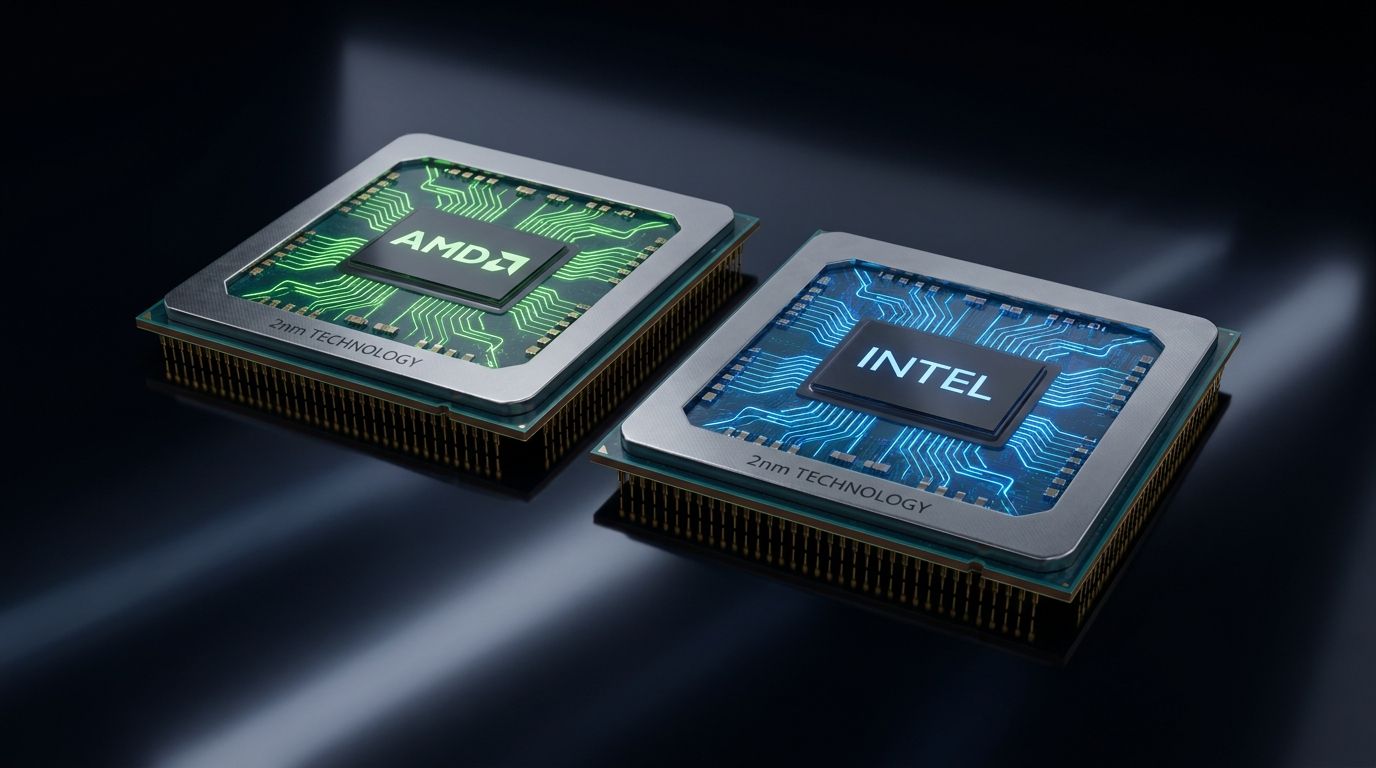
The second half of 2026 is shaping up to be the most competitive CPU launch season in recent memory. AMD has confirmed Zen 6 desktop processors — codenamed Powderhorn — are on track for late 2026 or early 2027, built on TSMC's 2nm process. Intel is racing to meet it with Nova Lake, also rumored for Q3 2026, featuring up to 52 cores on a hybrid architecture. Both chips represent generational leaps, and buyers who understand the differences now will make significantly better purchasing decisions when reviews land.
This is not a situation where one chip will obviously dominate. AMD and Intel have different architectural philosophies, different target workloads, and different strategies for how to use the efficiency gains that 2nm manufacturing provides. Let's break down what each side is doing and what it means in practice.
AMD Zen 6: What We Know About Powderhorn
Zen 6 represents a significant redesign of AMD's core layout. Each Core Complex Die (CCD) will feature 12 cores — up from 8 in Zen 4 and Zen 5 — with 48MB of L3 cache per CCD. This is a meaningful architectural choice: rather than chasing raw clock speeds, AMD is prioritizing cache-rich designs that reduce memory latency penalties in compute-intensive workloads.
The 2nm TSMC process brings a 15-20% power efficiency improvement over 3nm, which AMD is expected to translate into either higher sustained clocks or lower thermal envelopes — likely a combination of both. For desktop Powderhorn chips, a 16-core mainstream configuration seems probable, combining two 8-core CCDs, though AMD has not confirmed final die configurations.
On the AI acceleration front, Zen 6 is confirmed to include expanded AI features at the processor level. AMD's enterprise EPYC Venice variant — the server-class Zen 6 — already confirmed this direction, and desktop Ryzen variants will inherit similar capabilities. The NPU (Neural Processing Unit) integrated into Zen 6 chips will support the Windows Copilot+ certification requirements, making Ryzen AI 400 and Ryzen desktop chips eligible for Microsoft's AI PC program.
Intel Nova Lake: The 52-Core Hybrid Play
Intel's Nova Lake desktop is rumored to feature up to 52 cores on a hybrid P-core/E-core architecture — continuing the approach Intel began with Alder Lake in 2021 but dramatically scaled. The exact split between performance cores (P-cores) and efficiency cores (E-cores) has not been confirmed, but Intel's pattern suggests something like 12-16 P-cores paired with 36-40 E-cores.
This architecture makes Intel's chips particularly strong in multithreaded workloads that can distribute tasks across many cores — video rendering, code compilation, virtualization — while the P-cores handle latency-sensitive single-threaded tasks. The risk is that software must be well-threaded and scheduler-aware to use all 52 cores effectively. Applications that cannot spread load will see middling improvements.
Intel is building Nova Lake on its own 18A process node, which is Intel's first in-house fabrication at sub-2nm equivalent gate density. Intel's 18A has already been validated through Panther Lake (the mobile-first Core Ultra Series 3), which launched in January 2026. Nova Lake will be the first desktop chip on this process, making it a significant manufacturing milestone for Intel's fab recovery narrative.
The Manufacturing Variable: TSMC 2nm vs. Intel 18A
Both process nodes are pushing the edge of what is commercially manufacturable, but they take different approaches. TSMC's 2nm uses Gate-All-Around (GAA) nanosheet transistors, which provide better electrostatic control and lower leakage than the FinFET transistors used in 3nm. Intel's 18A also uses RibbonFET (Intel's variant of GAA) and adds PowerVia, a backside power delivery network that reduces resistance by routing power rails away from signal wiring.
On paper, Intel's 18A has structural advantages: PowerVia is genuinely novel and should improve performance-per-watt. The question is yield. TSMC has been manufacturing at scale for decades and has deep experience ramping new nodes. Intel's 18A is a new internal process that has not yet seen desktop-class chip volumes. Yield rates will determine whether Nova Lake's theoretical advantages translate into competitive pricing and availability.
What This Means for Different Buyers
For creative professionals — video editors, 3D artists, software developers — the core-count race benefits them directly. Both Zen 6 and Nova Lake will deliver meaningful improvements in throughput-heavy tasks. Zen 6's larger L3 cache will help in workloads with large working data sets (machine learning inference, large code compilation). Nova Lake's higher total core count will win in fully-parallelized renders.
For gamers, the picture is more nuanced. Gaming performance in 2026 is increasingly bottlenecked by GPU throughput, not CPU core count. Both Zen 6 and Nova Lake will have more than enough single-threaded performance to feed any current GPU without throttling frame rates. The decision for gamers should be made on price-to-performance, platform stability, and the ecosystem features they value — not peak core counts.
For workstation users running scientific simulation, financial modeling, or EDA (electronic design automation), the choice will come down to benchmark data once chips ship. Zen 6's EPYC Venice — the server sibling — offers up to 256 cores per socket for enterprise deployments, and the architectural lessons from Venice will flow into desktop Powderhorn.
Platform Considerations: AM5 vs. Intel's Next Socket
AMD's Zen 6 desktop CPUs are expected to use the AM5 socket, which AMD has committed to supporting through at least 2027. This means existing AM5 motherboard owners may be able to upgrade to Zen 6 with a firmware update — a significant cost advantage. Intel's Nova Lake will require a new socket, continuing Intel's pattern of more frequent platform transitions. Early adopters of Nova Lake will be buying into a new ecosystem without legacy hardware reuse.
The Bottom Line on Timing
Both chips are targeting the same launch window, which means the competitive pressure will be intense. AMD's track record with Zen 5 showed that the company can deliver on performance claims; Zen 6's larger CCDs and 2nm node suggest another substantial generational gain. Intel's Nova Lake needs 18A to yield well and its hybrid architecture to be well-supported by software schedulers.
If you are building a new system in the first half of 2026, current-generation hardware remains excellent value. If you can wait until Q4 2026 or Q1 2027, you will be choosing between two legitimately competitive 2nm platforms — and that competitive pressure will keep prices reasonable. Watch for early engineering sample leaks and independent benchmark data; they will tell you which architectural bet paid off.