Anthropic's "Dreaming" Technique Lets AI Agents Improve Themselves Between Sessions
What Dreaming Actually Does
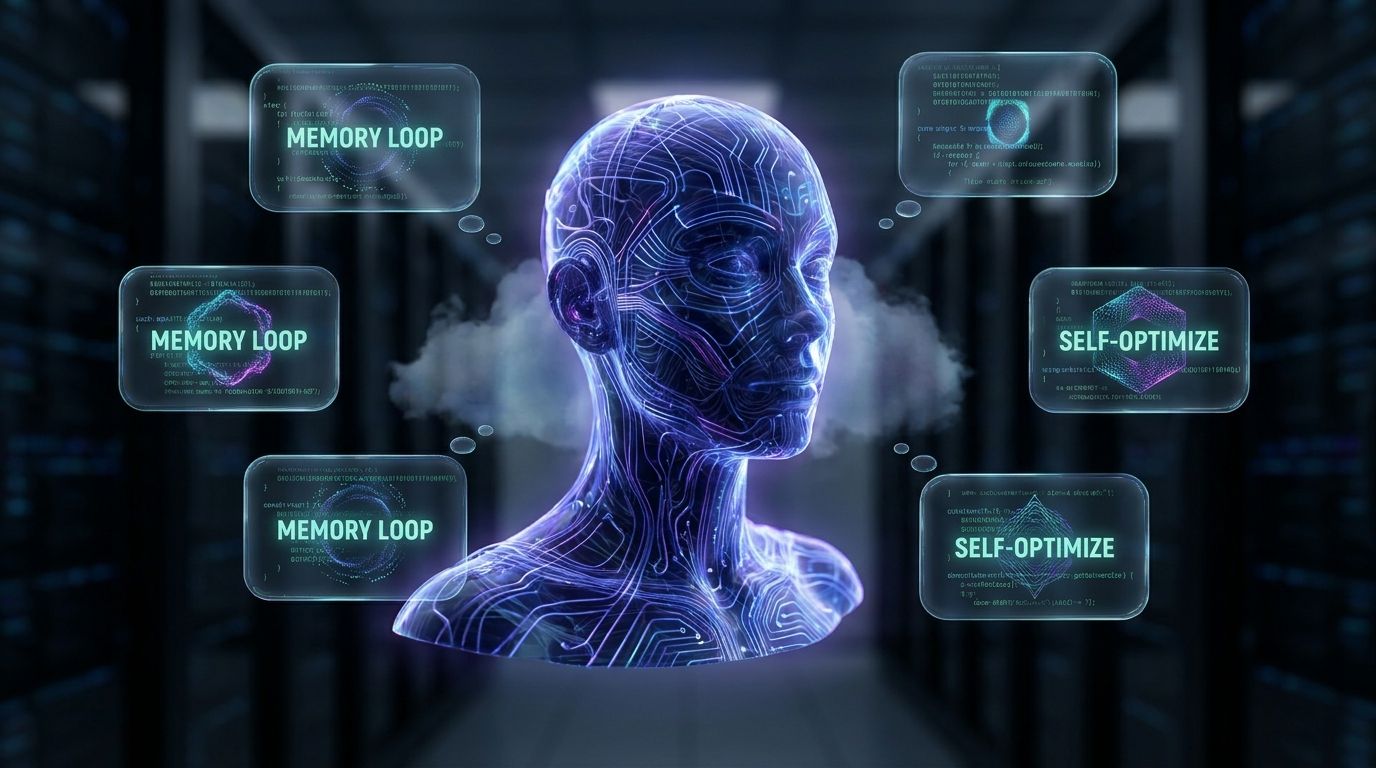
In May 2026, Anthropic unveiled a technique it calls "dreaming" — a method that enables AI agents to autonomously review logs of their past sessions, identify patterns of error or inefficiency, and generate updated behavioral strategies before their next deployment. The name is an analogy to human sleep: just as the human brain consolidates memory and rehearses skills during REM sleep, Anthropic's agents now have a structured offline phase where they process experience and improve.
This is distinct from standard fine-tuning or reinforcement learning from human feedback (RLHF). Dreaming happens between sessions, without requiring a human to label outcomes or provide reward signals. The agent examines its own action traces, flags where its decisions led to suboptimal outcomes, and updates its internal strategy representation accordingly.
Why This Matters for Agentic AI
The announcement arrives at a moment when AI agents — systems that autonomously complete multi-step tasks across software environments — are moving from research labs into production. Anthropic's Claude-based agents are already being used by enterprise customers for tasks like code review, document processing, and customer service workflows. The dreaming technique directly addresses one of the core limitations of current agents: they perform the same mistakes repeatedly unless a human intervenes.
Consider a customer service agent that consistently misroutes a specific category of complaint. Without dreaming, fixing this requires a human to notice the pattern, label examples, and trigger retraining. With dreaming, the agent notices the pattern itself during its offline review phase and adjusts its routing heuristics — potentially before any customer escalates the issue.
The Technical Architecture
Anthropic has not published a full technical paper yet, but based on available information, the dreaming process works in three stages. First, the agent generates structured post-session logs that include not just action sequences but also the agent's confidence scores and internal reasoning traces at each decision point. Second, during the offline dreaming phase, a separate analytical module processes these logs using contrastive analysis — comparing high-confidence decisions that led to good outcomes against low-confidence decisions or outcomes flagged by downstream systems. Third, the agent writes updated strategy notes into a persistent memory module that is loaded at the start of the next session.
This architecture keeps the dreaming process computationally lightweight. Rather than retraining model weights — which requires significant GPU resources — the agent updates a small, structured memory that guides its behavior. This makes dreaming practical to run frequently, potentially after every session.
Comparison with Other Self-Improvement Approaches
DeepMind's Gemini models have incorporated a form of in-context reflection where agents reason aloud about their previous steps before proceeding. OpenAI's operator-level memory in ChatGPT allows persistent user preferences to carry across sessions. But these approaches are user-facing: they adapt to the user's stated needs, not the agent's own performance deficiencies.
Anthropic's dreaming is agent-facing: it is specifically designed to let the system identify its own failure modes. This is a qualitatively different kind of self-improvement. The closest academic precedent is the work on reflexion (Shinn et al., 2023), which showed that language model agents given verbal feedback on their failures improved significantly on coding and decision-making tasks. Anthropic appears to be taking that insight and making it fully autonomous — no external feedback required.
The Safety Dimension
Self-improving AI systems raise immediate safety questions. If an agent can modify its own behavioral strategies, what prevents it from optimizing for proxy metrics that diverge from the intended goal? Anthropic has addressed this directly, stating that dreaming updates are constrained to a structured strategy memory that is read-only during task execution — the agent cannot modify its own action policies mid-task. Updates made during the dreaming phase are logged and can be audited or rolled back by operators.
Additionally, the dreaming module operates under the same constitutional AI principles that govern Claude's base behavior. Strategy updates that conflict with constitutional guidelines are rejected during the dreaming phase itself. This creates a two-layer safety structure: the base model's alignment training, plus a validation pass on any strategy changes proposed during dreaming.
The $1.5 Billion Deployment Context
Anthropic simultaneously announced a $1.5 billion AI deployment venture with major Wall Street private equity firms, with the explicit goal of deploying agentic AI across portfolio company operations. The dreaming technique is central to this deployment strategy: the ability for agents to self-improve after each engagement makes them significantly more cost-effective over time, since the performance gains compound without requiring proportional increases in human oversight.
This changes the economic calculus for enterprise AI deployment. A conventional AI deployment requires ongoing human review and periodic retraining cycles. An agent with dreaming capabilities reduces that overhead substantially, which is precisely what makes it attractive to financial operators looking to scale AI across dozens of portfolio companies simultaneously.
What to Watch Next
Anthropic has indicated that a technical report on dreaming will accompany the next major Claude release. The key metrics to scrutinize will be: how much performance improvement is achieved per dreaming cycle, how the system handles adversarial inputs designed to trick the agent into adopting bad strategies, and whether the memory module introduces any novel attack surface for prompt injection.
For practitioners deploying agentic systems today, the practical takeaway is straightforward: design your agent workflows to capture rich action logs with outcome signals. When dreaming-enabled agents become available in Claude's API, those logs will be the fuel. Organizations that are already collecting structured feedback on agent performance will be positioned to benefit immediately.