Autonomous Mobile Robots Are Reshaping the Warehouse — Here's the State of the Industry in 2026
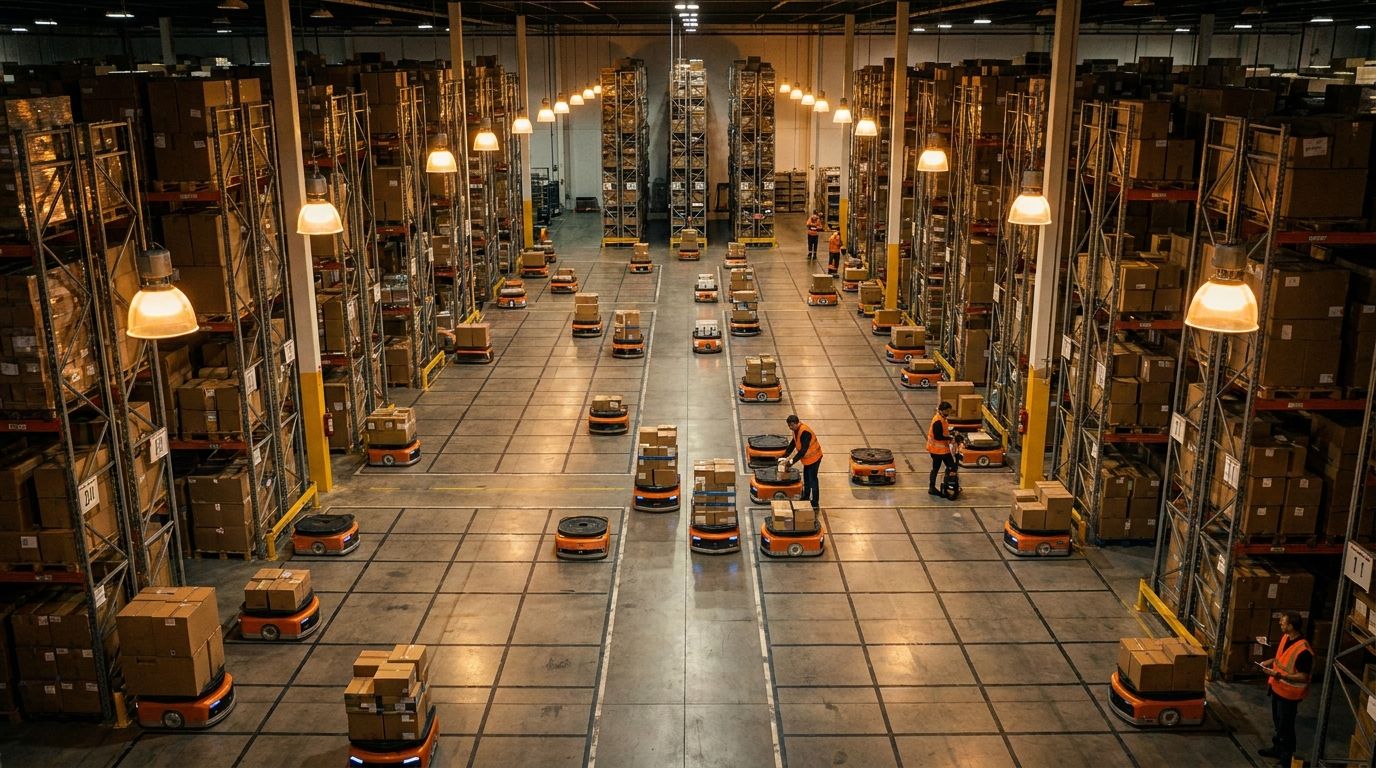
In 2016, Amazon acquired Kiva Systems (later renamed Amazon Robotics) for $775 million — at the time, one of the largest acquisitions in warehouse robotics history. The bet was that autonomous mobile robots could radically accelerate pick-and-pack operations by bringing inventory to workers rather than sending workers to inventory. A decade later, that bet has paid off to a degree that transformed the industry, and the technology has spread far beyond Amazon's own walls.
The global AMR market in 2026 is valued at approximately $8.5 billion and growing at 25% annually, according to estimates from MHI (Material Handling Industry) and Interact Analysis. More than 4 million units are deployed in warehouses, fulfillment centers, manufacturing facilities, and retail back rooms worldwide. The question for operations teams is no longer "should we deploy AMRs?" but "which system, how many, and how do we integrate them?"
What AMRs actually do (and how they differ from older systems)
An autonomous mobile robot navigates a facility without fixed infrastructure — no magnetic tape on the floor, no QR code grids like Amazon's original Kiva system required. Modern AMRs use a combination of LiDAR, cameras, ultrasonic sensors, and SLAM (Simultaneous Localisation and Mapping) algorithms to build and maintain a real-time map of their environment, detect obstacles, and navigate around people and other robots without a centralised traffic controller managing every movement.
This is the key distinction from the older generation of automated guided vehicles (AGVs), which required fixed infrastructure and could only follow predetermined paths. AMRs are reprogrammable: change the warehouse layout, update the map, redeploy. They can operate alongside humans without extensive physical separation (cages, safety barriers), which is critical for facilities that mix automated and manual operations.
The primary use cases in 2026 are:
Goods-to-person picking: Robots navigate to a storage location, retrieve a shelf or tote of inventory, and bring it to a stationary human picker. Workers stay at an ergonomic picking station while robots handle all the walking — reducing the average picker's daily step count from 15–20km to under 5km and increasing picks per hour by 2–3× in controlled deployments.
Autonomous cart transport: Robots move carts of picked items between zones (packing, shipping, returns processing) autonomously, eliminating the manual cart-pushing that is one of the most labour-intensive tasks in a standard facility.
Inventory scanning and cycle counting: Sensor-equipped AMRs autonomously navigate the warehouse outside working hours to scan barcodes and RFID tags, building a real-time inventory picture without requiring manual count cycles.
The major players in 2026
The market has consolidated somewhat from the fragmented landscape of 2019–2021, but remains competitive. The major deployments are from:
Amazon Robotics remains the largest single deployer globally, with over 750,000 robots across its own fulfillment network. They sell limited capacity to third parties and have been increasingly integrating the Robin and Sparrow robotic arms alongside mobile bases for fully autonomous pick-and-pack cycles.
6 River Systems (owned by Shopify) and Locus Robotics are the two largest third-party AMR vendors for mid-size fulfillment operators. Locus's collaborative robots (Locusbot) are deployed in over 200 customer sites; 6RS's Chuck platform has strong adoption among 3PL (third-party logistics) operators.
Geek+ (Chinese company, global operations) and HAI Robotics dominate high-density vertical storage AMR deployments — a variant that uses tall shelving with AMRs that can reach multiple levels, increasing storage density per square metre by 3–4× compared to conventional racking.
OTTO Motors (Clearpath subsidiary, now part of Rockwell Automation) leads in manufacturing and heavy industrial AMR deployments where the robots move WIP (work in progress) between production cells rather than handling consumer goods.
The ROI reality
Vendors typically quote AMR ROI timelines of 2–3 years. Real-world deployments from operations teams at mid-size retailers and 3PLs that have gone public with their numbers suggest 3–5 years is more representative for first deployments, with subsequent expansions showing faster payback as the organisational learning curve (software integration, workflow redesign, maintenance procedures) has already been climbed.
The ROI calculation is also sensitive to labour market conditions. In markets with high warehouse labour costs and low unemployment (Northern Europe, Japan, coastal US), the case is substantially stronger than in markets with lower labour costs and flexible workforces. The inflection point where AMRs become clearly cost-effective — accounting for hardware, software licensing, maintenance, and deployment costs — differs by geography and by the specific tasks being automated.
Key ROI drivers that vendors often underemphasise in their pitches: software integration costs (connecting the robot management system to the WMS, OMS, and ERP is a real engineering project, not a weekend configuration task); facility modification costs (charging infrastructure, minor layout changes); and the ongoing cost of the vendor's software subscription, which is typically 15–20% of hardware cost annually.
The workforce question
The empirical data on AMR deployment and employment is more nuanced than either "robots are taking all the jobs" or "robots just help workers." The most honest summary from published case studies: AMRs typically reduce headcount requirements for picking operations at a given throughput level, but operators most commonly deploy them to handle throughput growth without proportional headcount growth rather than to immediately reduce existing staff. The short-term effect is often redeployment to different roles (packing, QA, exception handling) rather than immediate layoffs — but the long-term trajectory, as throughput continues to grow with static or declining headcount, is reduced employment density relative to unautomated operations.
The jobs that persist alongside heavy AMR deployment tend to be higher in the task hierarchy: robot maintenance and fleet management, exception handling for items the system can't process, and operations oversight. Whether this represents a net positive for the workforce depends substantially on whether retraining pathways to these roles are made available to the workers displaced from lower-skill picking tasks — which varies considerably between operators.
Where the technology goes next
The near-term development focus in the industry is on closing the last gaps in full automation. Robotic arms that can reliably pick arbitrary items from mixed bins — the "random pick" problem, notoriously difficult for manipulation systems — have improved dramatically with AI vision systems trained on millions of product images. Amazon's Sparrow and the Covariant-based systems deployed by major 3PLs have demonstrated reliable random pick rates above 95% across tens of thousands of SKUs, approaching the reliability threshold for full unattended operation on standard e-commerce assortments.
The convergence of capable mobile bases with reliable manipulation arms — so that a single robot can both navigate and pick, rather than requiring separate transport and picking robots — is the medium-term goal of several major vendors. Systems that reach this point will meaningfully change the economics of fully automated fulfillment for mid-size operators who can't justify the infrastructure cost of goods-to-person systems at current scale.