Bidirectional EV charging is moving from demo to infrastructure — and it could change how homes manage power
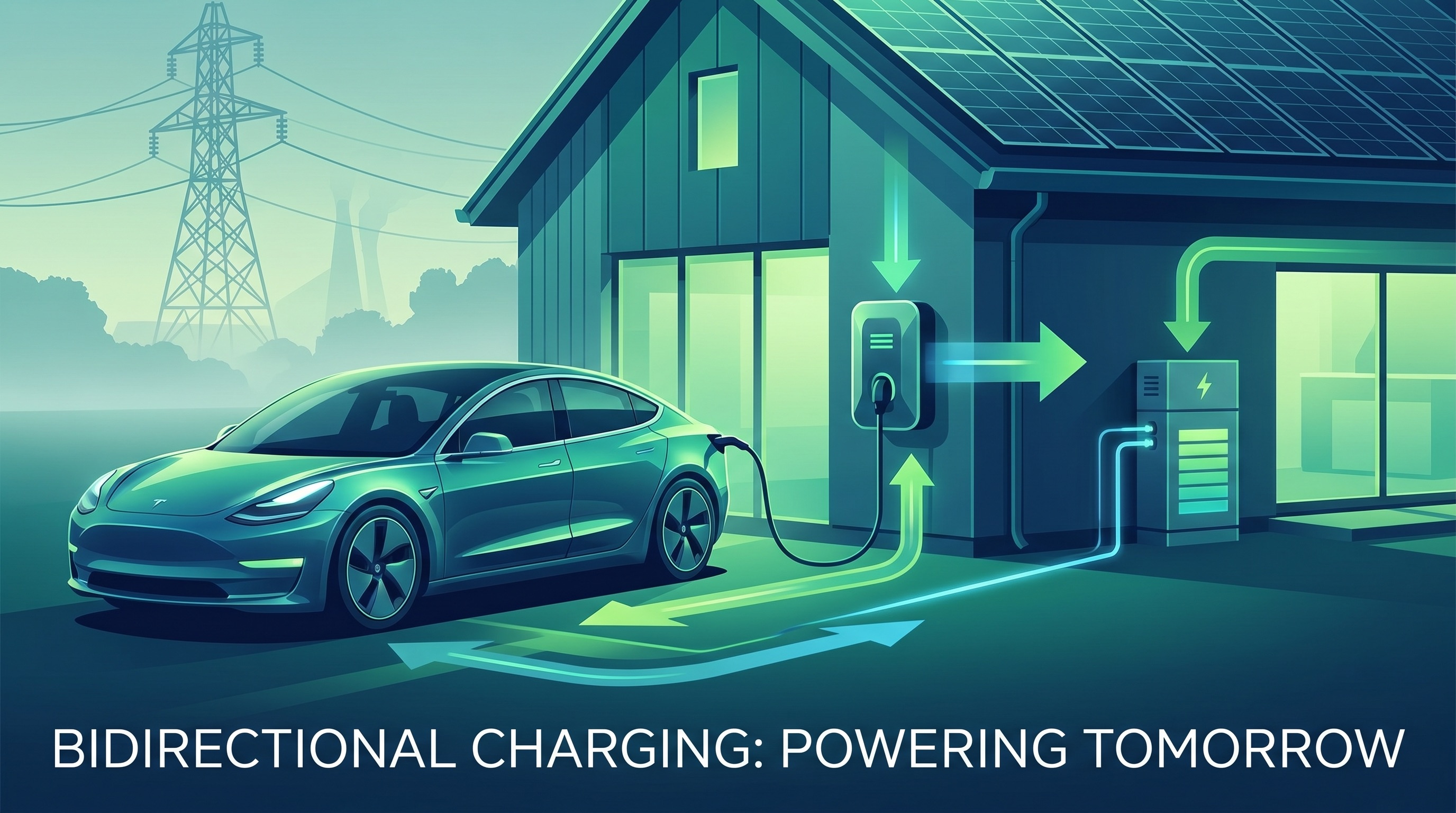
The concept has been discussed for over a decade: electric vehicles spend most of their lives parked and plugged in, carrying battery packs that dwarf home energy storage systems in capacity. If those batteries could export power back to the home or grid, millions of EVs would represent a massive distributed energy resource — smoothing peak demand, providing emergency backup, and reducing household electricity costs. Vehicle-to-grid (V2G) and vehicle-to-home (V2H) technology makes this possible. The obstacles have always been alignment: hardware, communication standards, utility programs, and regulatory frameworks were never quite synchronized.
In 2026, that alignment is substantially further along. California has authorized V2G grid exports under its Rule 21 interconnection framework. Ford's F-150 Lightning includes bidirectional charging as standard equipment. Japanese automakers have offered V2X capability for years. Volkswagen's ID.7 and Hyundai's IONIQ 5 support bidirectional charging in European markets. Several US utilities are running pilots that pay EV owners for grid services. The technology is not yet mainstream, but it is no longer experimental.
What Bidirectional Charging Actually Requires
Standard Level 2 EV charging converts AC grid power to DC for the battery. Bidirectional charging requires the reverse: converting DC from the battery back to AC for home circuits or grid export. This requires an inverter in the charging equipment, a communication protocol between the charger and vehicle, and — for grid export — certification from the local utility.
Two main configurations exist. Vehicle-to-home (V2H) routes battery power through the home's electrical panel to power appliances, without exporting to the utility grid. This requires a bidirectional charger and compatible vehicle but no utility approval in most jurisdictions. Vehicle-to-grid (V2G) exports power through the utility meter back onto the distribution grid, requiring utility approval and a separate metering arrangement.
The communication standard matters. DC Fast Charging with CCS using ISO 15118 supports bidirectional power negotiation — the basis for most V2G pilots in the US and Europe. CHAdeMO, the Japanese DC standard, has supported bidirectional communication since version 1.0 and underpins the most established V2G deployments globally. The fragmentation between CCS and CHAdeMO has been a genuine obstacle: Japanese vehicles are predominantly CHAdeMO while North American and European V2G programs are predominantly CCS-based.
The F-150 Lightning as Proof of Concept
Ford's F-150 Lightning is the highest-profile V2H example in the US market. The truck's Intelligent Backup Power feature, combined with Ford's Home Integration System (a bidirectional charger made with Sunrun), exports up to 9.6 kW continuously. During a grid outage, the truck detects the outage and switches over automatically. With the 131 kWh extended-range battery pack and average US household consumption of roughly 30 kWh per day, a fully charged F-150 Lightning can run an average home for four days or longer.
This is V2H rather than full V2G — the Lightning powers the home but does not export to the utility grid in most US markets. Ford has run V2G pilots with Pacific Gas & Electric, but grid export certification and utility tariff structures have not been standardized enough for mass deployment. The importance of the F-150 example is that it demonstrated demand: home backup capability was cited by buyers as a primary purchase motivation, not a secondary feature.
The Economics: When V2G Actually Pays
The economic case for V2G depends almost entirely on the utility program structure. Pacific Gas & Electric's EV GridSaver program pays $1.00–$1.50 per kWh exported during grid stress events. At 20 stress events per year averaging 3 hours each with 10 kW export capacity, an enrolled vehicle owner could earn roughly $200–$450 annually. The more compelling economic case is backup power value: replacing a dedicated home battery system that costs $12,000–$18,000 installed with a capability built into a vehicle the owner already purchased for transportation.
Texas's ERCOT grid — which experienced catastrophic failures in February 2021 — has become a focus for V2G pilot programs. If 10% of Texas's EVs participated in V2G with average 30 kWh usable capacity, that represents roughly 1.5 GWh of dispatchable storage — comparable to several large grid-scale battery installations.
The Battery Degradation Question
The most common concern about V2G is battery degradation from additional cycling. Research from the University of Michigan and Argonne National Laboratory found that optimized V2G operation — avoiding deep discharge, operating within a 20–80% state-of-charge window, limiting high-power export events — causes less incremental degradation than random DC fast charging. The operative word is "optimized": aggressive V2G dispatch without SoC constraints would accelerate degradation significantly. Automakers are managing this through software-enforced operating windows. LFP (lithium iron phosphate) batteries, used in many Volkswagen and BYD vehicles, are meaningfully more cycle-tolerant than NMC chemistry used in most premium EVs.
The Standards Gap Slowing Deployment
The main blocker for widespread V2G adoption is not vehicle hardware — it is fragmented charging standards and the slow pace of utility certification. In the US, utilities must individually certify V2G systems. There is no federal standard. Each utility certification takes 12–24 months and costs tens of thousands of dollars per system configuration. The US Department of Energy has stated a goal of standardizing V2G communication protocols — specifically getting ISO 15118-20 adopted as a required standard in federal EV programs. Whether DOE follows through in the 2026–2027 budget cycle is the key policy watchpoint.
The faster path to widespread adoption may be through V2H rather than V2G — home backup does not require utility certification in most jurisdictions, and the consumer value proposition is simpler. Once V2H hardware is widespread and standardized, the incremental step to V2G export becomes smaller. Bidirectional charging was a demo feature two years ago. It is becoming standard equipment on new vehicles and the foundation of emerging utility programs. The mainstream moment is probably three to five years away, but the direction is no longer in doubt.