Why Insuring an EV Costs 20–30% More Than an Equivalent Petrol Car — and What's Being Done About It
The total cost of EV ownership pitch typically leads with running costs: electricity is cheaper than petrol, maintenance is simpler without oil changes or complex transmissions, and government incentives in many markets reduce the purchase price gap. What the pitch often glosses over is insurance, where EVs consistently cost more — typically 20 to 30% more in the UK and US, with some models and markets showing gaps of 40% or higher.
For a driver paying £1,200 per year to insure an equivalent petrol car, that premium gap adds £240 to £360 annually — a meaningful offset against fuel savings, especially for lower-mileage drivers. Understanding why the gap exists, and whether it is permanent or transitional, requires looking at the claims data insurers are actually processing.
Repair costs: the core problem
The single largest driver of EV insurance premiums is repair cost per claim. Data from Mitchell International (one of the largest automotive claims processing platforms) consistently shows average EV repair costs running 25 to 30% higher than comparable ICE vehicles after collision, with some EV segments — particularly premium models like the Tesla Model S and Rivian R1T — showing repair cost differentials of 40% or more.
The reasons are specific:
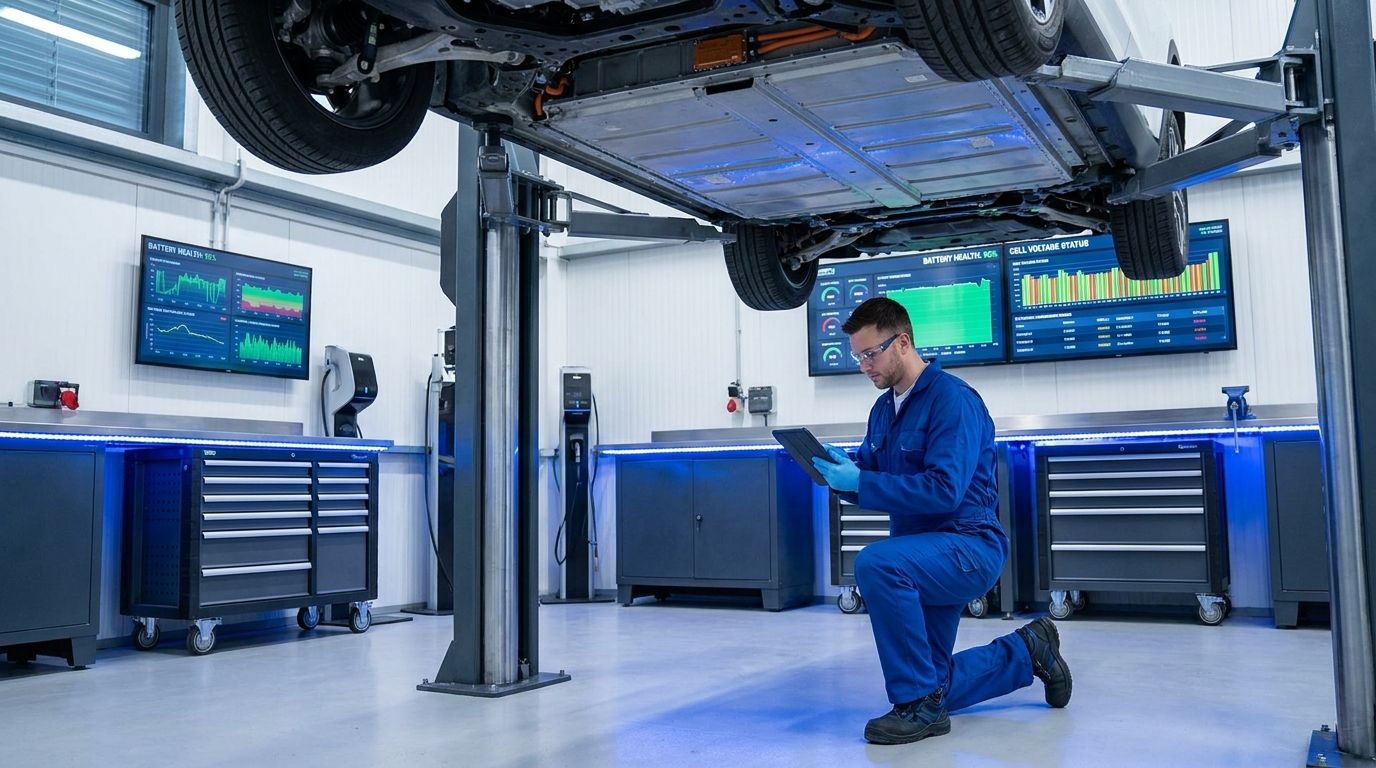
Battery pack proximity to impact zones. The structural design of most EVs places the battery pack along the floor between the axles. In a frontal or side collision, even moderate-speed impacts can require battery pack inspection, partial replacement, or full replacement. A battery pack that cannot be certified as undamaged after an impact may need to be replaced as a unit — at a cost of $10,000 to $25,000 depending on the vehicle — even when the visible collision damage would otherwise be a routine repair.
High-voltage systems require specialised technicians. Any repair touching the high-voltage system requires certified EV technicians, which are fewer in number and whose time costs more. The number of mechanics qualified to work on EV high-voltage systems has increased substantially since 2022, but in many markets supply has not yet caught up with demand, creating delays and cost premiums.
Proprietary parts and restricted repair ecosystems. Tesla has historically restricted access to its parts and repair documentation to its own service centres and approved repairers. This effectively creates a captive repair network with less price competition. The situation has improved after right-to-repair legislation in several US states and EU regulatory pressure, but remains more restricted than ICE vehicle repair ecosystems.
Integrated body structures. Vehicles built on purpose-designed EV platforms — Tesla's unibody designs, the Volkswagen MEB platform, Hyundai's E-GMP — use large structural castings and adhesive bonding techniques that reduce repairability of individual components. A minor rear-end impact that would involve replacing a boot lid and bumper cover on a conventional car may require section replacement or complete structural assessment on an EV platform.
Total loss rates
Closely related to repair costs is total loss rate: the proportion of insured vehicles written off after a claim rather than repaired. EVs are written off at higher rates than comparable ICE vehicles, primarily because battery pack uncertainty after an impact can cause estimated repair costs to exceed the vehicle's insured value even when the vehicle appears structurally intact.
A 2025 report from the Highway Loss Data Institute (HLDI) found that EV collision claims resulted in total losses at a rate approximately 50% higher than ICE vehicles of similar value. For lower-value used EVs — where a 5-year-old 60 kWh battery pack may have uncertain residual capacity — this rate is even higher, as the cost of battery inspection and potential replacement approaches or exceeds the vehicle's market value.
This dynamic creates a problematic feedback loop for the used EV market: higher total loss rates mean higher premiums; higher premiums increase the total cost of ownership for used EV buyers; reduced demand suppresses used EV residuals; lower residuals mean more vehicles are written off at lower damage thresholds; and so on.
What's being done
Several developments are beginning to address the structural cost drivers:
Battery inspection technology. Companies including Charged Analytics, Spiers New Technologies, and EV/Auto Analytics have developed non-destructive battery assessment tools that can evaluate pack health after an impact without full disassembly, reducing the uncertainty that drives conservative write-off decisions. Several major insurers now include battery health reports from these services in their claims assessment processes.
Battery repair and reconditioning. Rather than replacing an entire pack when individual cells or modules are damaged, battery reconditioning specialists can replace damaged sections of modular packs. This is currently most viable for the Tesla Model 3/Y platform (where pack architecture is well-documented) and is expanding to other models as technical documentation improves.
Tesla Insurance and OEM insurance products. Tesla's vertically integrated insurance product, available in 12 US states, uses real-time telematics data to price insurance and has direct access to repair costs within Tesla's own service network. This eliminates the information asymmetry that inflates independent insurer premiums. Several other OEMs — Ford, Hyundai, GM — have launched or are launching similar products.
Right-to-repair progress. The EU's upcoming Right to Repair Directive, fully effective from 2027, will require EV manufacturers to provide repair documentation and make spare parts available to independent repairers. US state-level right-to-repair laws are advancing in California, Colorado, and New York. These changes will increase repair market competition and reduce parts premiums over time.
The trajectory
The consensus view among actuaries and claims professionals is that the EV insurance premium gap will narrow but not disappear within the next five years. The structural factors — battery cost, high-voltage specialisation, and platform repairability — will improve as the industry matures, technician supply expands, and right-to-repair legislation takes effect. But EVs will likely continue to carry a modest insurance premium over comparable ICE vehicles for as long as battery packs represent a significant fraction of vehicle value and total replacement remains the conservative default in ambiguous impact scenarios.
For current EV buyers, the practical implication is straightforward: get multiple insurance quotes before purchase, compare against the specific model (Tesla Model 3 premiums differ substantially from Volkswagen ID.4 premiums), and factor the premium gap into total cost of ownership calculations rather than relying on generic EV cost comparisons.