MCP ist zum Standard fuer die Integration von KI-Tools geworden: Was es ist und warum es sich so schnell verbreitet hat
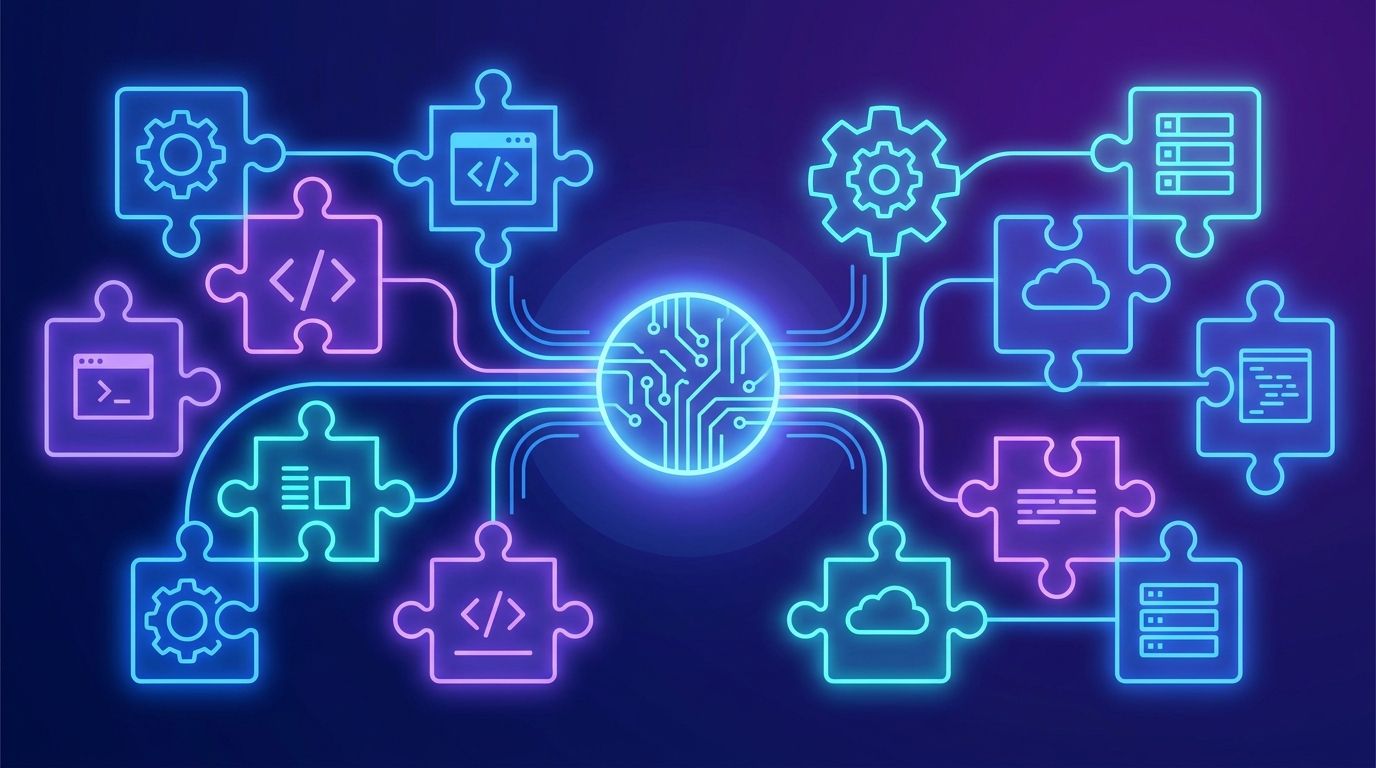
In November 2024, Anthropic released a specification called the Model Context Protocol. The announcement did not generate much noise outside of developer circles. Eighteen months later, MCP has 97 million monthly SDK downloads, 17,000 active public servers, and support from OpenAI, Google, Microsoft, GitHub, and AWS. Anthropic donated the protocol to the Linux Foundation in December 2025, forming the Agentic AI Foundation with OpenAI and Block as co-founders. MCP is now the closest thing the AI tooling ecosystem has to a universal standard, and understanding it has become a baseline skill for developers building anything with AI.
What MCP Actually Is
MCP is a protocol that standardizes how AI models connect to external data sources and tools. Before MCP, each AI application built its own bespoke integration layer: custom code to connect the model to a database, a calendar, a code repository, a web search API, or any other external system. Every integration was one-off, fragile, and non-transferable. If you built a Claude integration to read your company's documentation, it would not work with GPT-4o without being rewritten.
MCP solves this by defining a standard interface -- a common language that any AI model can use to communicate with any MCP server, and that any MCP server can use to expose its capabilities to any AI model. An MCP server is essentially a wrapper around a data source or tool that speaks this standard language. Build one MCP server for your documentation system, and it works with Claude, GPT-4o, Gemini, and any other MCP-compatible model without modification.
The architecture has three components. An MCP host is the application running the AI model -- Cursor, Claude Desktop, VS Code with Copilot, or a custom application. An MCP client is built into the host and handles communication with servers. An MCP server exposes resources (readable data), tools (callable functions), and prompts (reusable interaction templates) to the client. The protocol runs over stdio for local connections and HTTP with server-sent events for remote servers.
Why Adoption Happened So Fast
The 97 million monthly downloads figure is not just impressive -- it is structurally surprising. Protocol adoption in software typically takes years, requires a dominant platform to force adoption, and faces years of competing alternatives. MCP achieved critical mass in about 13 months. Several factors explain this.
The timing was right. The AI tooling ecosystem was growing rapidly and developers were experiencing the integration problem firsthand -- building the same kind of glue code repeatedly for every new model and every new data source. MCP arrived when the pain was acute enough that a clean solution was immediately credible.
The design was pragmatic. MCP did not try to solve every possible AI integration problem. It defined a narrow, clear interface for the most common patterns -- reading data, calling tools, reusing prompts -- and left everything else out. A protocol that does less reliably beats one that tries to do everything.
The governance move was decisive. Donating MCP to the Linux Foundation under the Agentic AI Foundation structure removed the barrier that would have stalled enterprise adoption: vendor lock-in concern. When OpenAI, Google, Microsoft, GitHub, Cloudflare, and Bloomberg joined as supporting members of a foundation rather than as licensees of an Anthropic-controlled protocol, the standard became genuinely neutral. Enterprise architects who would have waited to see whether a competitor protocol emerged made the decision to adopt instead.
The Production Reality in 2026
41% of software organizations are already running MCP servers in limited or broad production environments, according to a 2026 survey. The most common use cases are connecting AI tools to documentation and knowledge bases, API integrations, and developer tooling like Git repositories. The shift from local to remote servers is accelerating -- approximately 80% of the most frequently searched MCP servers offer remote deployment, which is more maintainable at scale than local stdio connections.
FastMCP (42% adoption) and Anthropic's own SDK (38%) dominate the server-building toolchain. Zuplo is used by 21% for MCP server management and security. The practical gap between "I want to expose my data to AI tools" and "I have a working MCP server" has narrowed considerably with these frameworks -- a developer familiar with building a REST API can build a working MCP server in a few hours.
The Known Problems
The most discussed critique of MCP in 2026 is token bloat. When an MCP server returns context to a model -- a documentation excerpt, a database schema, a list of available tools -- that context consumes tokens in the model's context window. For simple integrations with small data sources, this is fine. For complex integrations that pull in large amounts of context, the overhead can significantly increase inference costs and, in edge cases, crowd out the actual conversation content in the model's context window.
The proposed solutions involve layering: using a lightweight retrieval step to identify the most relevant context before sending it to the model, rather than dumping everything the MCP server has available. This is an architectural pattern rather than a protocol change, and it requires developers to think carefully about what their MCP servers expose and when. The teams handling this well are treating MCP servers like APIs rather than data dumps -- returning only what the current query requires, not everything that might conceivably be relevant.
Where It Goes Next
The protocol roadmap for 2026 and beyond focuses on stateless streamable HTTP (reducing the overhead of maintaining persistent connections at scale), stronger authentication models for remote server access (addressing the enterprise security concern that remote MCP servers introduce), and better tooling for governance and auditing -- tracking which tools a model called, what data it accessed, and what decisions those calls influenced. As AI agents become more autonomous, the audit trail for their external tool use becomes a compliance requirement rather than a nice-to-have. MCP's architecture is well-positioned to provide that trail if the governance tooling matures appropriately.