Orbital debris is becoming a mission-critical problem — and the race to clean up low Earth orbit has started
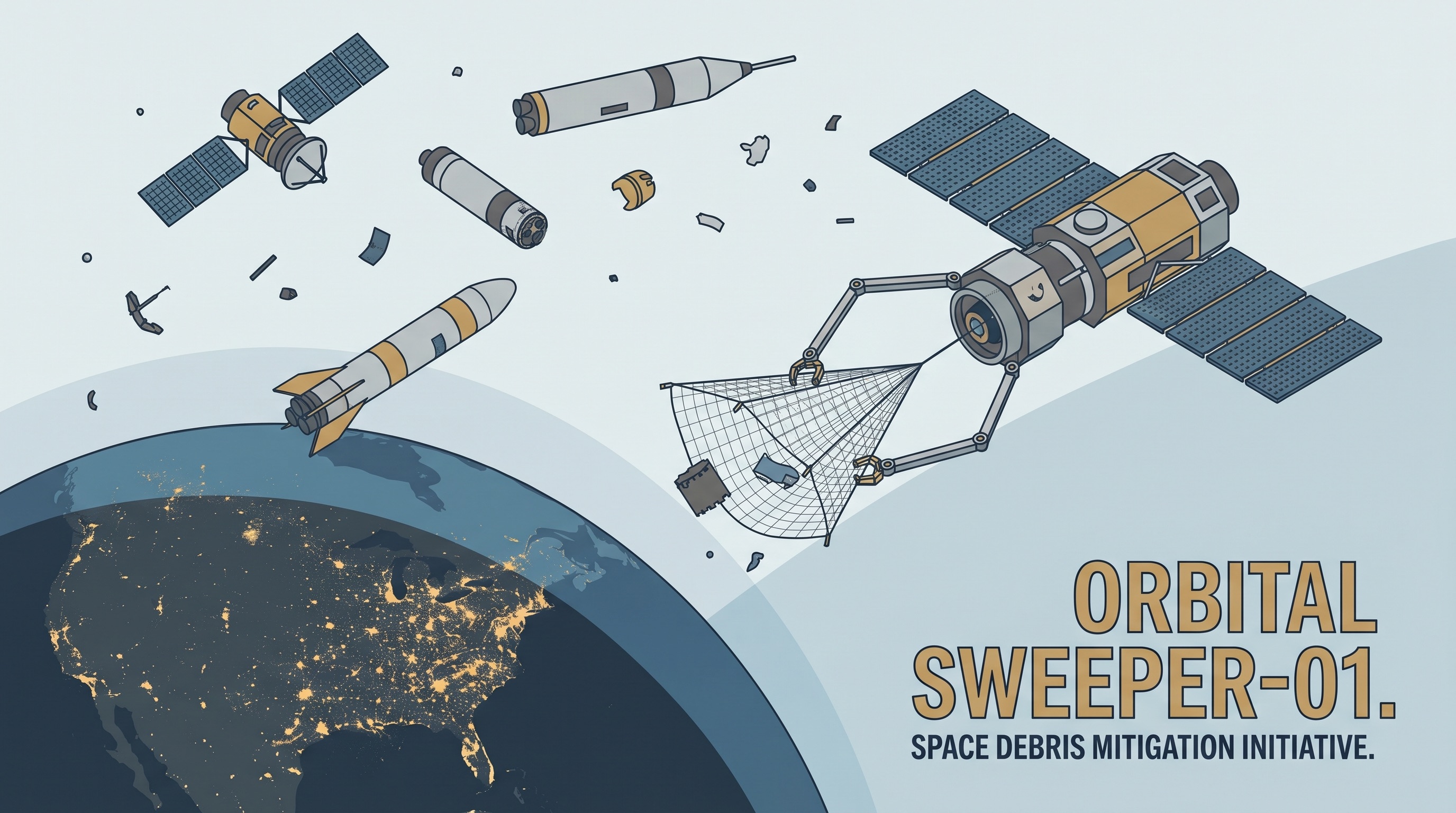
In April 2021, a defunct Soviet satellite came within 55 meters of colliding with a Chinese rocket body in low Earth orbit. Neither was operational. Neither was maneuverable. They missed by a margin that, in orbital terms, was nearly nothing. If they had collided, the resulting debris cloud would have seeded thousands of new fragments — each capable of triggering further collisions in a cascade that the space industry calls Kessler Syndrome.
That near-miss was not unusual. The European Space Agency performs hundreds of collision avoidance maneuvers every year for its operational satellites. The International Space Station has had to maneuver more than 30 times in its history to avoid debris. As the orbital population grows — driven by the mass deployment of commercial constellations — the problem is moving from theoretical to operational at an accelerating pace.
What's actually up there
The US Space Surveillance Network currently tracks approximately 27,000 objects larger than 10 centimeters in orbit. Beyond that threshold, radar sensitivity falls off sharply. Estimates for objects between 1 and 10 centimeters — large enough to destroy a spacecraft on impact but too small to track reliably — run to roughly 500,000. Objects smaller than 1 centimeter number in the hundreds of millions.
The distribution matters. Low Earth orbit, below approximately 2,000 kilometers altitude, contains the majority of operational satellites and the densest concentration of debris. It's where SpaceX's Starlink operates, where Planet's imaging constellation runs, where the ISS flies. It's also where debris persists longest before atmospheric drag pulls it down — at 400 km altitude, objects deorbit naturally within a few years; at 800 km, the timescale extends to decades; above 1,000 km, fragments can remain for centuries.
The Kessler cascade risk
Kessler Syndrome — named for NASA scientist Donald Kessler who described the risk in 1978 — describes a self-reinforcing debris cascade. A collision creates new debris; new debris increases collision probability; more collisions create more debris. The cascade doesn't require any new launches to sustain itself once started; it's driven by the existing population. Some orbital altitudes may already have enough debris that the cascade is, on a long timescale, inevitable without active remediation.
The most dangerous current objects are "zombie satellites" and spent rocket upper stages from the pre-mitigation era — large objects with no propulsion, in orbits that will persist for decades, slowly accumulating collision risk. NASA has identified about 50 objects in particularly hazardous orbits whose removal would have disproportionate impact on overall collision probability.
Who is working on cleanup
Active debris removal — actually going up and retrieving or deorbiting existing objects — is technically and commercially challenging. The targets don't cooperate: they're tumbling, often with no docking interface, and they may be structurally fragile. The economics are unclear: who pays for cleaning up debris created by parties who may no longer exist?
Several companies and space agencies are nonetheless developing removal capabilities. Astroscale, a Japanese-British company, has been the most active. Its ELSA-d mission demonstrated magnetic docking technology with a cooperative target in 2021-2022. Its ADRAS-J mission, launched in 2024 under a JAXA contract, performed rendezvous and proximity operations with an actual defunct Japanese rocket stage — the first commercial mission to inspect non-cooperative debris up close. A follow-on mission to actually deorbit the rocket stage is planned.
ClearSpace, a Swiss startup, has a contract with ESA to remove VESPA, a piece of Vega rocket hardware left in orbit in 2013. The mission, planned for 2026, will use robotic arms to grab the target and deorbit both spacecraft together. If successful, it will be the first-ever active debris removal of a large object.
On the government side, JAXA's Commercial Removal of Debris Demonstration (CRD2) program is developing the procurement model for regular commercial cleanup services. DARPA and the US Space Force are funding research into debris inspection and servicing technologies. The EU Space Programme is developing a Space Traffic Management framework that would include debris removal requirements.
Prevention: the bigger lever
While active removal gets more attention, prevention — keeping new debris from being created — is the bigger near-term lever. The international standard for LEO objects is a 25-year deorbit rule (revised to 5 years in updated guidelines), but compliance is uneven and enforcement is essentially nonexistent.
SpaceX has adopted aggressive deorbit practices for Starlink, targeting deorbit within 5 years of end-of-life and using propulsion to lower orbits quickly when satellites fail. The company argues that its low-altitude constellation (around 550 km) will naturally deorbit within 5 years even for non-maneuverable failures. Critics note that the sheer number of Starlink satellites — targeting tens of thousands — means even a small failure rate could produce significant debris.
OneWeb, Amazon's Project Kuiper, and other constellation operators face similar scrutiny. Regulators including the FCC have begun imposing stricter deorbit requirements as a condition of spectrum licenses, with the FCC's 5-year deorbit rule for new constellations entering force in 2023.
The economics of orbital sustainability
The fundamental challenge is that orbital debris is a classic tragedy of the commons. Each operator benefits from access to orbit; the costs of their debris are borne collectively by all current and future operators. Without a pricing mechanism that internalizes debris creation costs, operators have no financial incentive to go beyond minimum compliance.
Proposals to address this include orbital use fees (paying a per-satellite-year fee that reflects collision risk contribution), debris insurance requirements, and mandatory removal bonds. None have been implemented at scale, and the international coordination required to implement them effectively is substantial.
What's changed recently is that the operators most exposed to the debris problem — large constellation operators who would be most affected by a Kessler event in their operational altitude band — are beginning to treat orbital sustainability as a business-critical issue rather than a regulatory compliance exercise. That shift in incentive structure may ultimately do more to address the problem than any regulatory framework.