Agricultural Robots Are Delivering Real ROI in Three Specific Applications — and Struggling Everywhere Else
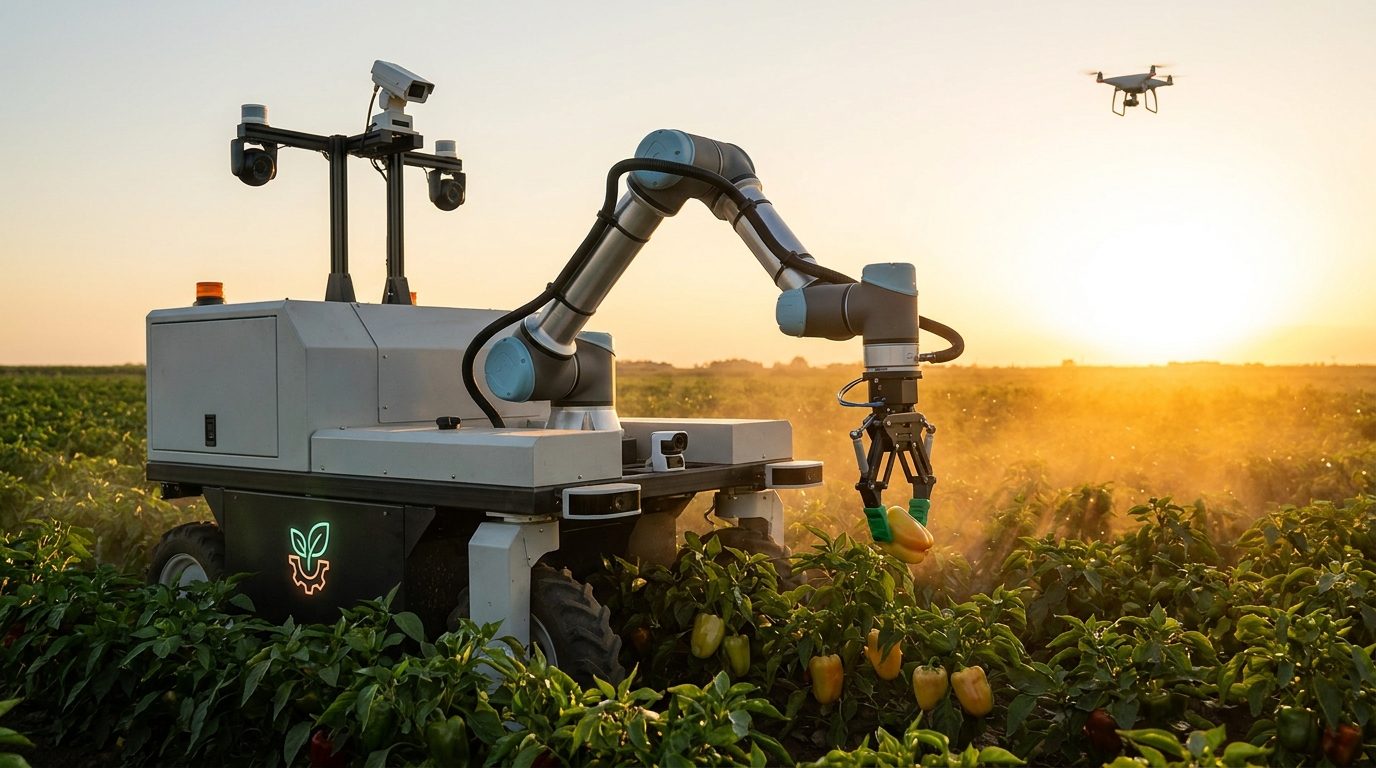
Agricultural robotics has attracted substantial investment and significant hype for the better part of a decade, with the standard pitch involving autonomous machines reducing labor costs, increasing yields, and applying pesticides and fertilizers with precision. The reality in 2026 is considerably more nuanced: a small number of specific applications have proven genuine ROI under real farm conditions, while a larger number of applications that worked in demonstrations have struggled to justify their cost at commercial scale. Understanding the difference matters for farmers evaluating purchasing decisions, investors sizing the market, and engineers choosing where to direct development effort.
The agricultural robotics market reached approximately $11.4 billion in 2025 according to MarketsandMarkets, and is forecast to grow to $20.3 billion by 2030. But these aggregate figures mask a significant distribution problem: the majority of deployed agricultural robots are concentrated in controlled environment agriculture (greenhouses and vertical farms), fresh produce harvesting in high-value crops, and precision spraying. The vast majority of global farmland — row crops like corn, wheat, soy, and rice — remains largely untouched by robotics, for reasons that are structural rather than technical.
What Is Actually Working
Strawberry, tomato, and soft fruit harvesting have seen the most commercially validated deployments. Tortuga AgTech's strawberry harvesting robot operates across farms in California and Spain, picking at a documented rate of approximately 8 strawberries per minute per arm — commercially slow compared to an experienced human picker but economically viable when accounting for the 30-40% labor shortage that California strawberry farms face during peak harvest windows. Harvest CROO Robotics reported in late 2024 that its commercial fleet had harvested over 7 million pounds of strawberries across Florida operations, with per-tray economics approximately at parity with human labor when factoring in availability, not just hourly cost.
Autonomous field scouting is another category with demonstrable ROI. Carbon Robotics' LaserWeeder and the competing systems from Farming Revolution (FarmDroid) and Naïo Technologies use computer vision to identify weeds with 95%+ accuracy and eliminate them either mechanically or via targeted laser — removing the need for blanket herbicide application. For organic farms where herbicide use is prohibited, the economics are particularly strong: FarmDroid FD20 units deployed in Danish sugar beet fields in 2024 showed herbicide cost elimination of $180-220 per hectare compared to conventional mechanical weeding, with the robot paying back its purchase price within 3-4 growing seasons under conservative assumptions.
Precision spraying drones have achieved commercial scale in Asia faster than in Western markets due to regulatory differences and geography. DJI's Agras series drones are now used across an estimated 20 million hectares of farmland in China according to DJI's 2024 annual report, and are credited with 30% reduction in pesticide use through variable-rate application triggered by multispectral imaging. In Western markets, regulatory approval for drone spraying has been slower (the FAA's Part 137 certification process remains burdensome), but commercial deployments are accelerating in specialty crops in California and the Southeast.
What Is Not Working at Scale
The much-discussed autonomous tractors for row crop operations — typified by CNH Industrial's partnership with Raven Industries (acquired 2021) and John Deere's ExactDrive and TractorPilot systems — represent a more complicated picture. John Deere's fully autonomous tractor, demonstrated in 2022, operates commercially on a limited set of flat, open-field operations: corn planting and tillage in the US Corn Belt under controlled conditions. Adoption has been slower than analysts projected in 2022, for a specific reason: the capital cost of the autonomous upgrade kit ($50,000-$80,000 per tractor as a retrofit) does not generate positive ROI on typical US corn and soy farms given current commodity prices, labor availability in those regions, and the operational limitations that require human supervision for headland turns and edge cases.
Robotic milking systems — the highest-penetration robotics category in agriculture by unit count — demonstrate a related lesson about where robotics value actually lands. Lely and DeLaval have collectively installed over 40,000 robotic milking units globally. These machines generate clear ROI in labor-scarce markets (Scandinavia, Netherlands, parts of Canada) where skilled dairy labor is genuinely difficult to source. In labor-abundant regions, the ROI is negative at current equipment prices. The robot does not inherently beat a human at milking; it beats the market rate for dairy workers in specific geographies.
The Real Constraint: Field Variability and Edge Cases
The deeper challenge for agricultural robotics is not the core task — most picking, spraying, or planting operations are technically solvable with current robotics and vision systems. The challenge is field variability and the long tail of edge cases that agricultural environments generate. A strawberry robot that works at 95% picking accuracy leaves 5% of fruit on the plant, which is commercially unacceptable in most markets. A weeding robot that cannot distinguish between a weed and a crop seedling in unusual lighting conditions, or that gets stuck in wet clay soil, creates operational failures that require human intervention — eliminating the labor savings that justified the purchase.
The companies making the most progress on this problem are those that have reframed the challenge from "full autonomy" to "supervised autonomy with meaningful data collection." Plenty Unlimited's vertical farm operations use robots that flag exceptions for human review rather than attempting full autonomous resolution. Monarch Tractor's autonomous tractor collects GPS-tagged data on soil conditions, yield variations, and equipment performance on every pass — building farm-specific models that improve autonomous operation over time. The robotics-as-data-collection platform is becoming as important as robotics-as-labor-replacement in evaluating which systems create lasting value.
Labor Economics and the 2026 Reality
The 2024-2026 period has seen agricultural labor conditions diverge significantly across geographies, which is directly affecting robotics adoption rates. In California, H-2A guest worker visa caps and California's AB 1066 minimum wage expansion to agricultural workers (pushing farm worker minimum wage to $20/hour in 2024) have dramatically improved the economics of automation. Growers who were marginal buyers at $15/hour labor have become active buyers at $20/hour. In contrast, parts of Mexico, Central America, and Asia where labor costs remain under $10/day, agricultural robotics economics remain challenged for most applications except the highest-value crops.
Actionable Takeaways
- For farmers: Evaluate agricultural robotics against your specific labor cost, labor availability, and crop value — not industry average figures. Systems that generate clear ROI in California or Scandinavia may not in regions with abundant seasonal labor. The strongest early candidates are precision spraying (if drone-approved in your region), cover crop seeding automation, and scouting drones for field monitoring.
- For investors: The agricultural robotics companies with defensible moats are those accumulating farm-specific operational data at scale, not those with the most impressive single-robot demonstration. Monarch Tractor, Granular (now part of Corteva), and similar companies building agronomic intelligence layers on top of hardware have asymmetric data advantages that are not easily replicated.
- For engineers and product teams: The edge case problem is the field. The teams solving 95% → 99% reliability on soft fruit picking are working on computer vision models trained on multi-season, multi-geography datasets — not faster actuators. The limiting factor today is data, not actuator speed or compute power.
- For policymakers: The regulatory environment for drone spraying in the EU and US is the single largest non-technical constraint on agricultural robotics adoption in those markets. Streamlined Part 137 equivalents and EU Commission drone regulation updates specifically addressing agricultural use cases would unlock an estimated $2.4 billion in deployable capital currently waiting on regulatory clarity (AUVSI, 2025).