Agricultural Robots Are Quietly Transforming Farming — Starting With the Jobs Nobody Wants
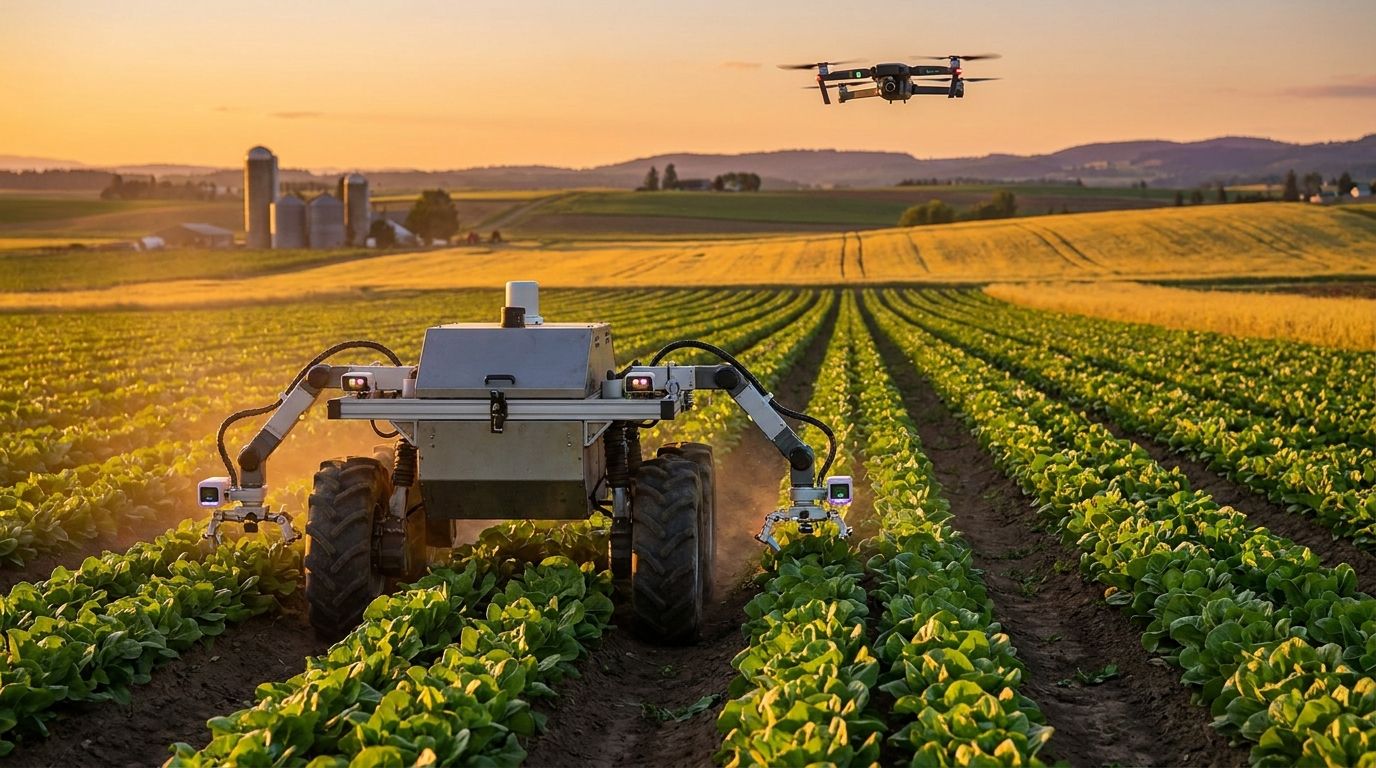
Agriculture is the largest industry by employment in human history and one of the last sectors to be substantially automated. The reasons are not a mystery: farming involves unstructured outdoor environments, enormous biological variability, weather dependency, and the need to make subtle judgments about plant health that have historically required human perception. Factory robots work in controlled environments with predictable objects at fixed positions. A strawberry field is none of those things.
And yet the conditions driving agricultural automation have finally reached a point where the technology is viable. Labor shortages in agricultural regions across North America, Europe, and Japan have become structural rather than cyclical — the supply of workers willing to do seasonal harvest work has been shrinking for years, and immigration policy changes have made the existing supply less reliable. Input costs — pesticides, herbicides, fertilizer — have risen sharply. The climate is becoming less predictable, compressing the windows in which field operations need to happen. The economic pressure to automate has never been higher, and the technology is, for the first time, genuinely ready to respond.
Where Robots Are Already Working
The first wave of agricultural robots targets the operations that are most labor-intensive, most uniform, and most economically damaging when delayed. Weeding is the clearest example. Manual weeding is extremely labor-intensive, herbicide-based weeding has growing regulatory and resistance problems, and the timing matters — weeds not removed early compete for resources at the most critical growth stages.
Carbon Robotics' LaserWeeder uses a combination of machine vision and high-power lasers to identify and kill weeds at the base of the plant stem, at a rate that covers a hectare in roughly an hour. It runs autonomously between crop rows, requires no herbicide, and eliminates the labor cost of manual weeding crews. The company's machines were operating on more than 800 farms in the US and Canada by 2025, primarily in vegetable crops where herbicide use is restricted and manual weeding costs are highest.
FarmWise's Vulcan robot uses mechanical precision cultivation — small rotating blades that disturb the soil around weeds without damaging crops — and operates autonomously on lettuces, broccoli, and other row crops. The machine processes up to 34 acres per day and has accumulated millions of hours of field operation in California's Salinas Valley.
Spraying is a second high-value target. Conventional large-format sprayers apply pesticide or herbicide uniformly across entire fields — wasteful and environmentally problematic. Precision sprayers, using machine vision to identify plant health and weed presence at the individual plant level, can reduce chemical input by 70–90% while improving application accuracy. John Deere's See & Spray technology, integrated into its large sprayers, is the mainstream commercial version; smaller autonomous precision sprayers from Monarch Tractor and others serve smaller operations.
Harvesting: The Hard Problem
Harvesting is the most labor-intensive and most technically challenging agricultural operation to automate. It requires identifying ripe produce (which varies in color, size, and orientation), applying exactly the right force to detach it without damage, and doing this at commercial speeds in an unstructured environment. The dexterity and speed of experienced human pickers has been the benchmark that machines have consistently failed to meet at comparable cost.
Progress is finally happening in specific crops. Abundant Robotics (acquired by AGCO in 2021) developed a vacuum-based apple harvesting system that picks at commercial speeds. Tortuga AgTech and other strawberry robot developers have demonstrated machines that can identify and harvest ripe strawberries — a particularly complex problem because berries hide under leaves and vary significantly in orientation. Current strawberry robots operate at roughly 30–50% of human picker speed, making them economically viable when labor costs are high enough and labor availability is low enough.
Asparagus is a case study in how labor constraints force automation: asparagus must be cut by hand at exactly the right moment as it emerges from the ground, it emerges at unpredictable positions and intervals, and the window for cutting is small. Several European and Japanese robotics companies have developed asparagus harvesting robots specifically because asparagus-growing regions were facing genuine harvest failures from labor shortages. Economic necessity drove investment in a problem that had been considered unsolvable.
Autonomous Tractors and Field Operations
At a larger scale, autonomous tractor technology is now commercially available. John Deere's 8R series tractor with Autonomous capability was announced in 2022 and began commercial deployment in 2023. The system uses six pairs of stereo cameras providing 360-degree field vision, GPS, and machine learning to navigate fields autonomously, executing preprogrammed operations like tillage, planting, and fertilizer application without a driver in the cab.
The operator monitors and manages the tractor remotely via a smartphone app — they can supervise multiple machines simultaneously, approve path plans, and intervene when the system encounters unexpected obstacles. The economics are compelling for large row-crop operations: a single operator can oversee several tractors running overnight operations, effectively multiplying the productive capacity of each hired worker.
CNH Industrial (Case IH and New Holland parent) and AGCO have their own autonomous field operation programs. The technology is most mature for large-scale row-crop agriculture in flat terrain — the conditions where GPS accuracy is high and obstacle variability is manageable. It's less ready for irregular fields, mixed crops, and the steeper terrain common in European and Asian farming contexts.
The Data Layer
The most underappreciated aspect of agricultural robotics is the data generated by field operations. Every robot operating in a field is collecting detailed imagery and sensor data about crop health, soil conditions, weed pressure, and yield variability at resolutions that were previously achievable only through manual scouting. This data, accumulated over multiple seasons, is becoming a competitive asset for the companies that collect it.
John Deere's Operations Center platform aggregates field data across its customer base to improve the machine learning models that power its autonomous systems. Climate Corporation (now part of Bayer) has built yield prediction models from years of field data across millions of acres. The robot companies are, in parallel to their hardware businesses, building agricultural data assets that will power the next generation of precision farming decisions.
The long arc of agricultural automation is from mechanization (replacing animal power with engines) to automation (replacing human labor with robots) to intelligence (replacing human judgment with data-driven decisions). The first transition took 50 years. The second has taken 30 years to reach commercial viability in specific applications, and is now accelerating. The third is beginning now, enabled by the data infrastructure the robots themselves are building. The farm of 2040 will be managed primarily by machines — not because technology forced the change, but because the economics of an aging workforce and volatile climate left no other viable path.