AI coding tools are splitting into two markets — and Cursor just proved the enterprise tier is where the money is
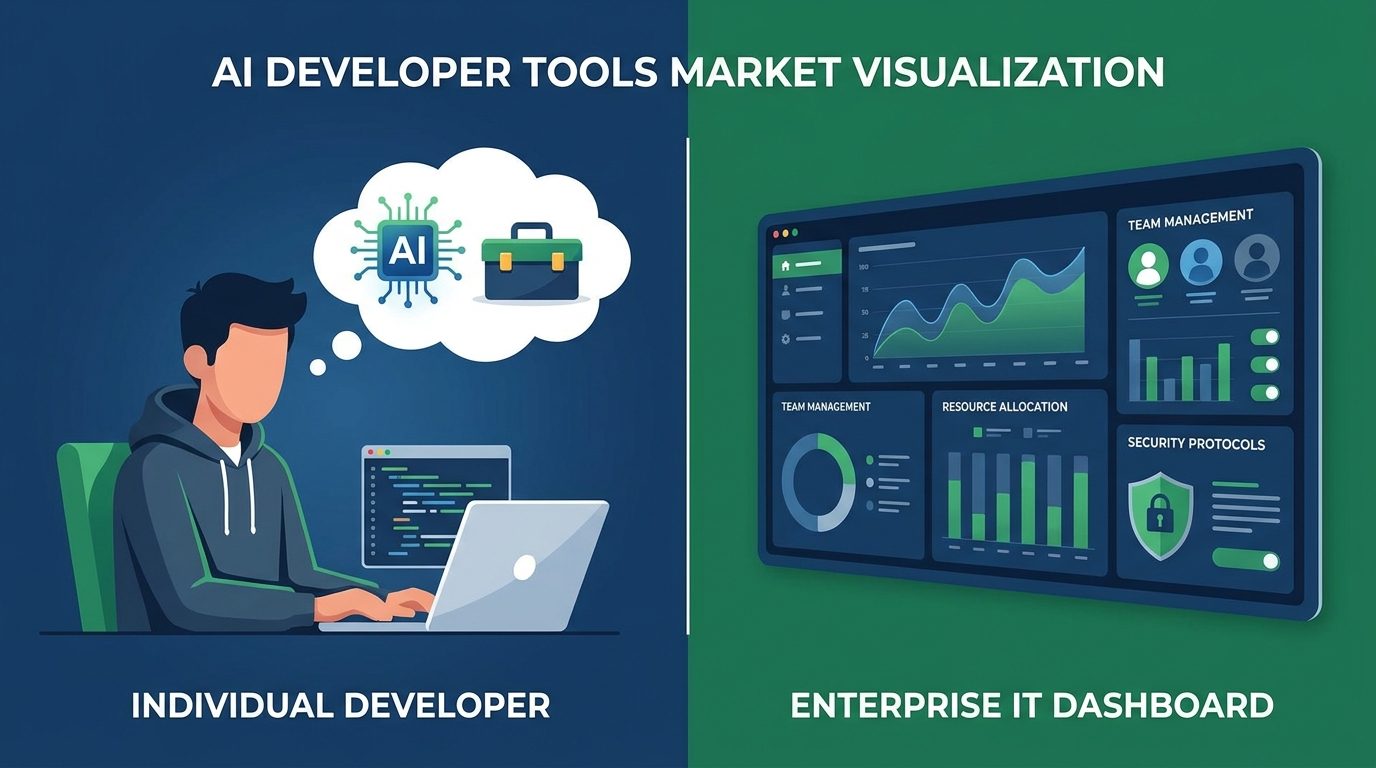
Two years ago, the pitch for AI coding tools was simple: autocomplete, but smarter. Today, that pitch has bifurcated into two entirely different product categories with different buyers, different budgets, and different success metrics. The split is not theoretical — it is showing up in ARR trajectories, funding rounds, and now in product roadmaps.
The Individual Tier: Raw Capability Wins
For indie developers, freelancers, and small engineering teams, the competition among AI coding tools is fought on a single axis: how good is the AI? Cursor, Windsurf, Continue, and Codeium have spent the past 18 months in an arms race over context window utilization, multi-file reasoning, and agent-mode reliability. Price is nearly irrelevant at $20–$40 per seat per month. What matters is whether the tool ships working code faster than the competitor.
Cursor crossed $200M ARR in early 2026, a run-rate that would have seemed implausible for a two-year-old company without a single Fortune 500 contract. Its growth was driven almost entirely by individual developers and small teams adopting the product on personal credit cards — the classic bottom-up SaaS motion. Windsurf (formerly Codeium) followed a similar trajectory, leaning into its multi-IDE support and model-agnostic positioning to capture developers who refused to live inside VS Code full-time.
In this tier, the product decision framework is simple: open a free trial, spend two days building something, and decide whether the tool earns its subscription. No legal review. No security questionnaire. No procurement committee.
The Enterprise Tier: Governance Is the Product
Enterprise procurement operates in a completely different reality. When a 2,000-engineer organization wants to standardize on an AI coding platform, the conversation rarely starts with "how good is the autocomplete?" It starts with: which LLM providers does this send our code to? Can we restrict that to approved models only? How do we manage budgets across 40 engineering teams? What happens if a contractor account gets compromised — do we have audit logs? Does this integrate with our existing SSO and SAML identity provider?
These are not unreasonable questions. Enterprise security teams have watched too many SaaS tools leak proprietary code through training pipelines. Legal teams have flagged IP ownership concerns around AI-generated code. CFOs want line-item visibility into per-team AI spend before it lands as a surprise six-figure invoice.
The result is that "AI coding tool" has become a genuinely different product in the enterprise context. Raw model quality is table stakes. The actual product is the governance layer sitting on top of it.
Cursor's Enterprise Move: Organizations
In June 2026, Cursor launched Organizations for Cursor Enterprise — a significant expansion of its enterprise offering that goes well beyond slapping SSO onto the consumer product. The Organizations feature set includes an admin dashboard for centralized account management, per-team budget controls that let IT allocate AI spend by department or project, granular model access controls (so a team working on a sensitive codebase can be restricted to on-premise or specific approved models), and full audit logging for compliance and security review.
This is not a minor feature drop. It reflects a deliberate strategic bet: the $20-per-month individual developer market is valuable, but the $50–$100 per seat enterprise contract — multiplied across thousands of seats with annual commitments — is where the real ARR density lives. A single enterprise deal can be worth more than a thousand individual subscriptions, with dramatically lower churn.
Cursor's timing is notable. The company had previously been criticized by enterprise buyers for lacking the administrative controls that make centralized procurement possible. The Organizations launch addresses that gap directly and signals that Cursor is no longer content to win on product quality alone — it wants the procurement win too.
Competitive Dynamics: Microsoft's Distribution Moat vs. Cursor's Iteration Speed
GitHub Copilot Enterprise remains the default choice for organizations already deep in the Microsoft ecosystem. The distribution advantage is formidable: Copilot ships as part of GitHub Enterprise agreements that many large organizations already have in place. The IT security team knows Microsoft. The legal team has reviewed Microsoft's data processing terms. The path of least resistance for a cautious enterprise buyer is often to expand an existing vendor relationship rather than introduce a new one.
GitHub Copilot Enterprise added policy controls, audit logs, and organization-level management features throughout 2025, largely in response to pressure from enterprise customers who needed them for compliance. The product has matured significantly from its initial public release, though it continues to trail on raw model capability benchmarks compared to Cursor's latest releases.
JetBrains AI occupies a narrower but defensible position: developers who live in IntelliJ, PyCharm, or Rider often strongly prefer IDE-native AI that does not require switching contexts or running a separate application. JetBrains has the existing enterprise sales motion and customer relationships to push AI capabilities into large Java and Kotlin shops, particularly in financial services and enterprise software.
The competitive dynamic, then, is: Microsoft wins on distribution and trust inertia; JetBrains wins on IDE-native depth for its installed base; Cursor wins on product iteration speed and raw capability. For enterprise buyers evaluating in 2026, the question is which axis matters most to their engineering organization.
Business Metrics: ARR, Funding, and the Numbers That Matter
Cursor's $200M ARR figure comes with an important asterisk: the vast majority was built on individual and small-team subscriptions. The enterprise Organizations launch is an attempt to expand average contract value and shift the mix. Anysphere (Cursor's parent) raised at a valuation exceeding $9B in its most recent round, giving it the runway to build out an enterprise sales motion without sacrificing the product-led growth engine that got it here.
Windsurf, backed by investors including General Catalyst, has raised over $150M and competes aggressively on the individual tier while building out enterprise features. Codeium's rebranding to Windsurf was itself a signal: the company wanted a more consumer-friendly identity as it pursued the bottom-up motion, even as it maintains a separate enterprise product line.
Continue, the open-source AI coding assistant, occupies a different market position entirely — preferred by developers at organizations where data sensitivity makes cloud-based tools non-starters. Its enterprise play is around on-premise deployment and integration with self-hosted LLMs, a niche that may become more valuable as data residency regulations tighten globally.
M&A Implications: Which Tools Get Acquired?
The enterprise tier's emergence as the high-value segment changes the M&A calculus for this space considerably. An acquirer paying $5B+ for an AI coding tool is not buying the consumer subscriber base — it is buying the enterprise ARR, the governance infrastructure, and the sales relationships with large engineering organizations.
The most likely acquirers are the players who need AI coding capability but lack the product: Atlassian (which owns the developer workflow through Jira and Confluence but has no coding AI), ServiceNow (which has been aggressive about AI platform acquisitions), and cloud providers who want to close the gap with Microsoft's GitHub Copilot distribution advantage.
For IDEs, the longer-term question is whether AI coding becomes so integral that the AI tool is the IDE — the scenario where Cursor's or Windsurf's interface displaces VS Code as the primary development environment, rather than existing as a plugin on top of it. Cursor has been quietly building toward this for two years. The Organizations launch suggests it now has the enterprise credibility to make that case to CIOs, not just individual engineers.
The market split is real, the enterprise money is confirmed, and the governance layer is no longer optional. The next 18 months will determine which players have built both sides of the equation well enough to survive the inevitable consolidation.