Why AI Is Forcing Data Centers to Rethink Cooling from the Ground Up
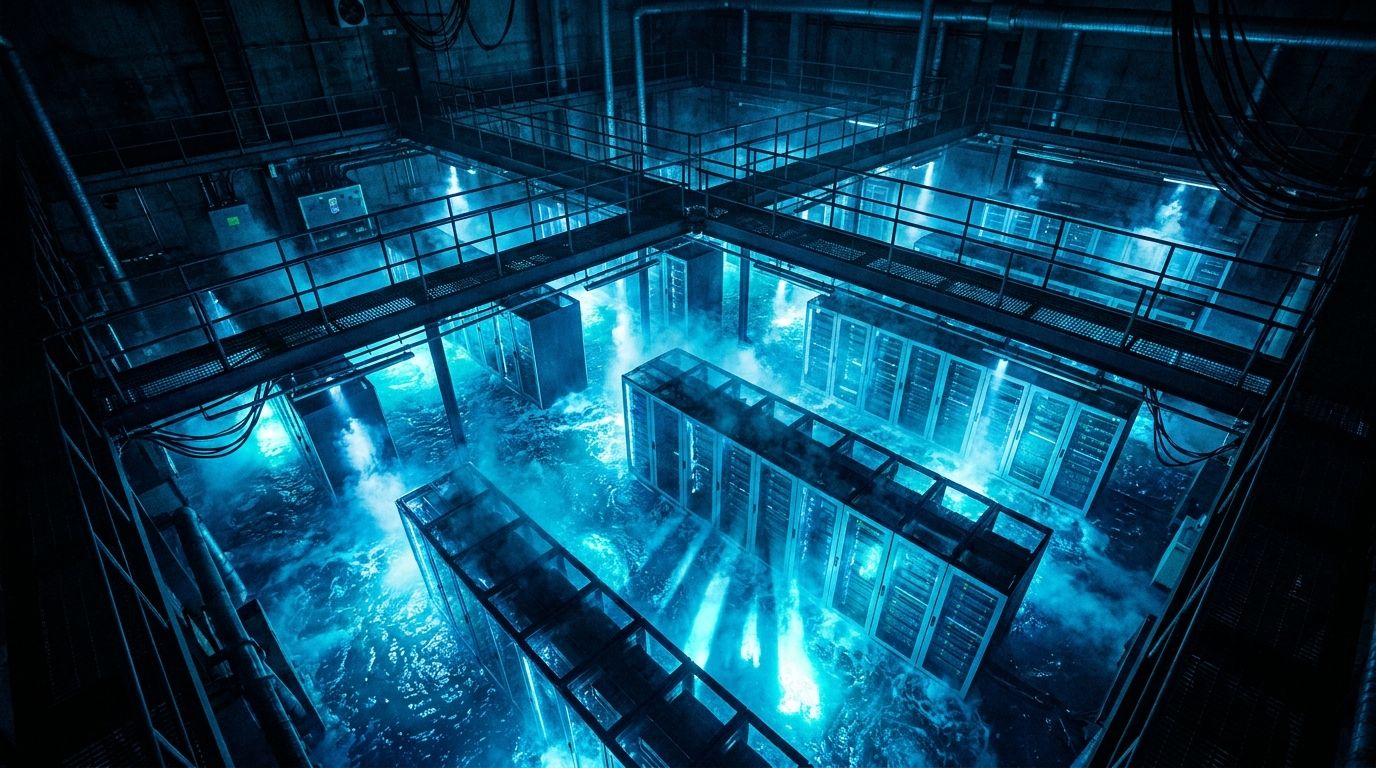
For most of computing history, keeping servers cold meant moving air. Fans, raised floors, hot aisles and cold aisles, precision air conditioning -- air cooling was the universal answer because it was simple, well-understood, and adequate for traditional server thermal loads. AI has ended that era. The GPU clusters that run large language models and power inference at scale produce heat densities that air simply cannot remove quickly enough. Liquid cooling has moved from a niche technique used in supercomputers to a standard requirement for any serious AI infrastructure deployment.
The Numbers That Forced the Change
A standard server rack in a traditional data center draws around 5 to 10 kilowatts. A dense AI training cluster can reach 100 kilowatts per rack. Some configurations being deployed in 2026 are targeting 300 kilowatts per rack, with roadmaps extending toward 2 megawatts within five years. An NVIDIA H100 GPU draws around 700 watts under load -- a rack of eight H100s already hits 5.6 kilowatts before accounting for the host system, networking, and storage.
At these densities, air cooling is not an option. Liquid can transfer heat up to 3,500 times more effectively than air. The physics is simply not close.
Direct-to-Chip vs Immersion
Two liquid cooling approaches have emerged as dominant in AI infrastructure. Direct-to-chip cooling circulates coolant through a cold plate mounted directly on the processor die. The servers look largely conventional from the outside; the cooling infrastructure change is internal. Direct-to-chip is the most widely deployed approach for AI GPU clusters today because it can be retrofitted into existing data center buildings not designed for full liquid immersion.
Immersion cooling submerges entire server boards in a non-conductive dielectric fluid. Immersion enables even higher heat removal capacity, supports near-silent operation, and can dramatically reduce physical footprint. The tradeoffs are cost, operational complexity, and the fact that servicing hardware requires pulling it out of the fluid -- a messier proposition than swapping a hot-plug drive in a conventional rack.
What This Does to Data Center Design
The shift to liquid cooling is reshaping how data centers are designed and built. Buildings optimized for air cooling rely on raised floors, perforated tiles, and ceiling-level return air paths. A liquid-cooled facility optimized for AI workloads needs piped coolant distribution to every rack, heat exchangers, pumping infrastructure, and connections to the building's chilled water plant. This is a significant capital investment that existing facilities cannot easily retrofit at scale.
The result is a bifurcation: hyperscalers and AI-first operators are building new liquid-ready facilities from the ground up, while co-location providers are carving out liquid-cooled zones within existing buildings to serve AI tenants without overhauling their entire infrastructure.
Heat Recovery: Turning a Problem into a Resource
A compelling consequence of liquid cooling is the quality of waste heat it produces. Air-cooled data centers exhaust heat at temperatures too low to be useful for anything beyond warming a large building. Liquid cooling systems can operate at supply temperatures of 40 to 60 degrees Celsius, producing return fluid hot enough for district heating, greenhouse agriculture, aquaculture, or industrial processes.
Several European data centers are already selling waste heat to municipal heating networks, turning a pure cost center into a revenue stream. As carbon pricing increases and regulators scrutinize AI infrastructure energy consumption more closely, the economics of heat recovery are shifting from interesting to compelling.
The AI-Managed Cooling System
There is a certain recursiveness to the most recent development in data center cooling: AI models are increasingly being used to manage the cooling systems that keep AI models running. Thermal management platforms using machine learning to predict hotspots, dynamically adjust cooling distribution, and anticipate maintenance needs before failures occur are now available from most major DCIM vendors. The practical effect is that cooling a modern AI data center has become a continuous optimization problem, not a static engineering decision made at build time. The infrastructure that keeps machine learning running is itself running machine learning.