AI data centers are rewriting how US electricity infrastructure gets built
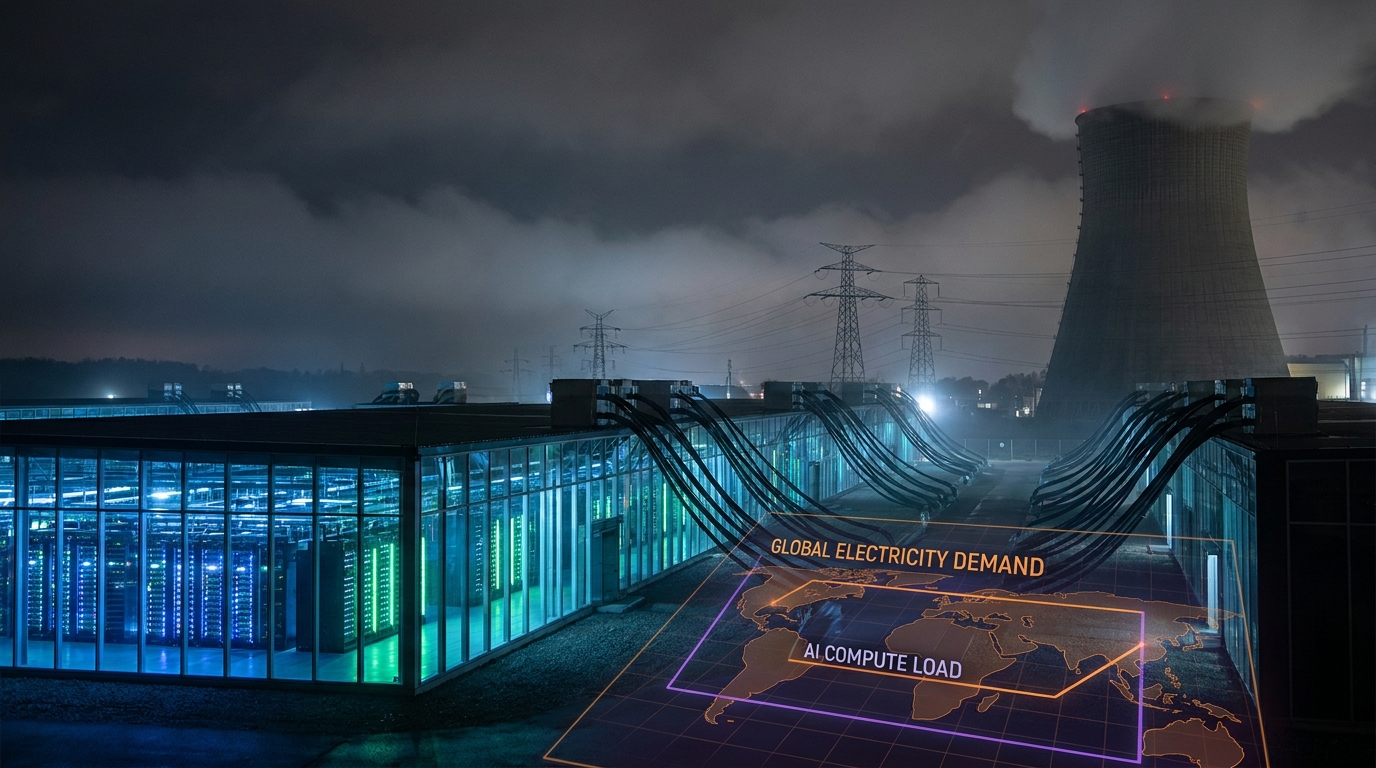
US data center power demand is projected to reach 41 gigawatts in 2026, up from 31 GW in 2025 — a 32% increase in a single year. By 2027, Goldman Sachs Research projects that number to climb to 66 GW. To put that in context: 41 GW is roughly the combined generating capacity of France's entire nuclear fleet. The US grid is being asked to absorb that much new load in the time it takes to plan and permit a single large power plant.
This is not a future problem. It is the current operating condition of energy infrastructure in regions with high data center concentrations, and it's reshaping decisions about where AI compute gets built, what energy sources fund it, and who pays the cost of grid expansion.
The numbers behind the demand surge
Global data center electricity consumption is expected to exceed 1,000 terawatt-hours in 2026, roughly double 2023 levels. AI-optimized servers — the GPU and custom accelerator racks running training and inference workloads — are the primary driver. They're projected to constitute 21% of total data center power consumption in 2025, rising to 44% by 2030. A hyperscale AI data center built today can demand between 100 MW and 750 MW per site. New facilities planned for the late 2020s are being designed at 20 times the power density of the hyperscale facilities built five years ago.
In Northern Virginia — the largest data center market in the world — facilities already consume over a quarter of the region's electricity. In July 2024, a voltage fluctuation caused 60 data centers to simultaneously disconnect from the grid, creating a 1,500 MW power surplus that required emergency adjustments to prevent widespread outages. That incident documented in concrete terms what grid planners had been modeling in spreadsheets: AI-scale loads are creating stability risks that didn't exist at prior data center densities.
Why tech companies went to nuclear
The rush toward nuclear power purchase agreements is a direct response to a specific constraint: renewable energy (solar, wind) is intermittent, and data centers need constant power. A large language model training run or inference cluster cannot tolerate the variability that grid operators smooth out across a diverse load portfolio. A data center at 100 MW of constant load needs 100 MW of constant generation capacity, not an averaged equivalent.
Nuclear power generates constantly, at high capacity factors, with a carbon footprint comparable to wind and solar over a full lifecycle. The deals signed in the past 18 months reflect this logic:
- Microsoft signed a 20-year, 835 MW purchase agreement to restart Three Mile Island Unit 1 in Pennsylvania. The plant began supplying power in late 2024.
- Google ordered up to 500 MW of small modular reactors from Kairos Power, with initial delivery targeted for the early 2030s.
- Amazon invested over $20 billion to transform the Susquehanna nuclear site in Pennsylvania into an AI data center campus powered by the adjacent plant.
- Meta signed agreements with TerraPower, Oklo, and Vistra securing up to 6.6 GW of clean energy capacity by 2035. The TerraPower Natrium deal includes 690 MW of initial capacity with options for 2.1 GW more.
Combined, the major tech companies have contracted for more than 10 GW of potential new nuclear capacity in the US within roughly a year. That number doesn't include the existing nuclear capacity being locked into long-term purchase agreements — just the new-build commitments.
The grid isn't keeping up
PJM Interconnection — the grid operator serving approximately 65 million people across 13 states and DC — forecasts a 6 GW reliability shortfall by 2027. Utilities are experiencing a 50–150% increase in interconnection requests, and the permitting and construction pipeline for new transmission capacity operates on 5–10 year timescales that are incompatible with the speed at which data center capacity is being committed.
Goldman Sachs estimates data centers' share of peak US summer electricity demand will grow from 4.1% in 2025 to 8.5% in 2027. That sounds manageable until you consider that historically, annual grid load growth was below 1%. Some grid operators saw 4% load growth last year. Infrastructure designed for 0.8% annual growth cannot absorb 4% without significant investment and planning horizon mismatches.
The cost is not abstract. Residential electricity prices are projected to increase 5% in 2026. One analysis estimates that unchecked data center load growth could add $163 billion to regional power bills through 2033, increasing the average family's monthly electricity bill by approximately $70 by 2028. These costs fall disproportionately on residential and small commercial customers who have less ability to negotiate rates or shift load.
Where new data center construction is heading
The grid constraint is already redirecting where hyperscale data center investment goes. Locations with available power are commanding a premium: sites near existing or planned nuclear plants, near large hydroelectric resources, or in regions with underdeveloped grid capacity relative to generation are attracting data center announcements that would have gone to established markets a few years ago.
Wyoming, Idaho, and the Pacific Northwest are seeing new interest for different reasons — existing hydro and wind capacity in the Northwest, proximity to developing nuclear projects in Idaho and Wyoming. Texas has been attractive for power availability and regulatory environment but has grid stability concerns that some operators factor into resiliency planning.
The colocation model — where a data center company leases capacity in a third-party facility — is under pressure. Colocation providers are competing for the same scarce power interconnections that hyperscale operators are pursuing directly. The companies with the capital to sign decade-long power purchase agreements and build directly on power-abundant sites have a structural advantage over the colocation model in a supply-constrained environment.
The sustainability accounting problem
Google attributed a 48% increase in its greenhouse gas emissions over five years to AI infrastructure. Microsoft has reported similar challenges meeting its 2030 sustainability commitments because AI compute growth outpaced the clean energy procurement that was designed to offset it. The nuclear deals are the structural response — contracting clean baseload capacity that grows with data center demand rather than trying to offset dirty grid power with renewable energy credits.
The fundamental tension is that the energy transition and the AI build-out are both happening simultaneously and are pulling on the same grid infrastructure, the same equipment supply chains (transformers, switchgear, high-voltage cable), and the same permitting processes. Neither is slowing down. The bottleneck is the grid's ability to evolve fast enough to serve both.