The NPCs That Remember You: How AI Is Rewriting What Game Characters Can Do
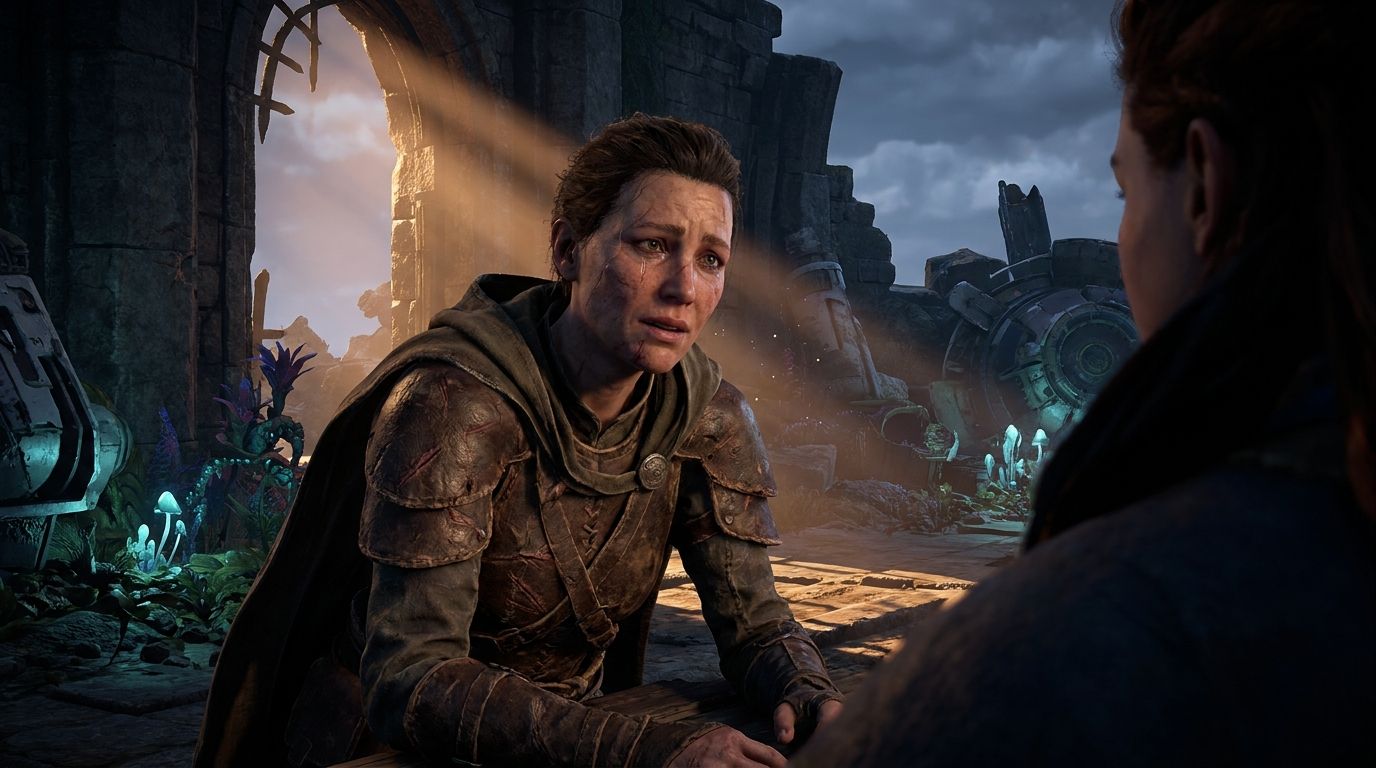
The NPC has always been a compromise. Game writers spend months crafting characters with histories, motivations, and emotional depth — and then players discover every conversation is a tree of pre-authored choices that exhausts itself in three visits. The character who seemed complex on first meeting becomes mechanical on the fourth, cycling through the same responses with no awareness that time has passed or that the player has done anything in the world since they last spoke.
Large language models change the underlying constraint. A scripted NPC has a finite number of possible responses, authored by a writer, triggered by flags. An LLM-powered NPC generates responses from a bounded character definition, drawing on context — world state, relationship history, conversation content — to produce dialogue that has not been written before. The writer defines the character; the model does the talking.
What shipped games are actually doing
The clearest commercial evidence for AI NPCs working at scale is a social simulation game called Status, developed by Wishroll. Launched in public beta in February 2025, Status lets players have generative conversations with AI characters representing celebrities, fictional personas, and various social archetypes. The game reached one million registered users in its first two weeks and sustained 500,000 daily active users, with average daily playtime of one hour and 36 minutes — longer than the typical TikTok session. Players are not browsing a feed; they are having sustained, ongoing conversations with AI characters who remember previous exchanges.
The economic challenge almost killed the product. Running frontier language models at scale costs money at a per-interaction level that is straightforward to underestimate. Wishroll's initial AI infrastructure cost $12 to $15 per daily active user per day at top-tier quality — a number that makes a free-to-play game's unit economics immediately untenable. Inworld AI, the NPC platform underlying the product, rebuilt the inference pipeline and reduced that cost by approximately 95% without perceptible quality degradation. The commercial model now works. But the engineering required to make it work is not trivial.
In action-game territory, KRAFTON launched inZOI in March 2025 — a life simulation game in the style of The Sims, where every character has a "Smart Zoi" system giving them what the developers describe as a considerate personality that adjusts based on daily experiences. The same month, KRAFTON deployed PUBG Ally in PUBG: Battlegrounds — an AI co-player powered by NVIDIA's ACE platform running a Mistral-Nemo-Minitron 8-billion parameter model on the player's own GPU. The Ally communicates strategy, distributes loot, operates vehicles, and engages enemies. A parallel launch in NARAKA: BLADEPOINT by NetEase introduced an AI teammate that locates items, exchanges gear, and makes tactical decisions entirely on the local device, with no cloud inference latency.
Memory is the feature that changes everything
What separates a genuinely novel NPC experience from a more responsive chatbot is persistent memory. The technically straightforward part of an AI NPC is generating contextually appropriate dialogue in a single session. The part that creates genuine player investment is when the character remembers — accurately and naturally — what happened weeks ago.
Inworld AI's architecture stores every player-NPC interaction in a vector database, embedding each exchange in a format that makes it retrievable by semantic similarity rather than exact match. When a player returns after a month away, the NPC can surface relevant memories — the promise made, the betrayal witnessed, the favour owed — woven into naturally generated dialogue rather than presented as a recap. The character does not say "last time you came here, you helped me with X." The character reacts to the player with the accumulated emotional weight of X, expressed through improvised words.
Players report this creates something qualitatively different. Reddit threads from games with AI NPCs consistently describe moments where a character's recall of a past interaction produced what players describe as an involuntary emotional response — "I got chills when she brought up what happened in the cave three sessions ago." The engagement mechanisms that make human social relationships compelling — continuity, recognition, memory — are now replicable in a game character at reasonable engineering cost.
How development workflows are changing
The impact of generative AI on game development is not limited to runtime NPCs. A Google Cloud survey of game developers published in August 2025 found AI already integrated into most major studios, with 47% using AI for playtesting and balance testing, 45% for localisation, and 44% for code generation and scripting support. Autonomous AI agents that explore open worlds, interact with NPCs, engage in combat, and navigate terrain are running QA cycles that previously required armies of human testers.
Asset generation has compressed timelines dramatically. Concept art that previously required two weeks now takes two days with AI assistance. Environment population — filling a game world with varied foliage, rubble, furniture, and props — has been partially automated in a way that reduces the time required by 60 to 80%. The downstream effect is visible in indie development: small teams are producing production values that previously required studios an order of magnitude larger.
Studio attitudes toward AI have hardened on the labour side. GDC's 2026 State of the Game Industry report found 52% of game industry professionals now view generative AI negatively, up from 30% the previous year. The concerns are about data ownership, job displacement, and uncertainty around authorship of AI-generated content — legitimate questions the industry has not resolved. The technology adoption and the cultural resistance are advancing simultaneously.
The major studios are watching, slowly moving
Ubisoft has been the most publicly active AAA studio in this space. Its NEO NPC prototype, shown in 2024, demonstrated real-time NPC reasoning in Ubisoft's own game engines. The successor project, Teammates, features an AI companion named Jaspar in a first-person shooter setting — providing player recognition, threat identification, and mission guidance in real time. No launch date has been announced, but the studio has disclosed an active partnership with Inworld AI and described internal QA bot deployments using autonomous AI agents to test its open worlds.
CD Projekt Red confirmed in its 2025 Management Board Report that a dedicated AI research team is testing tools for The Witcher 4 and the Cyberpunk sequel, with goals including "realistic crowds of non-player characters." EA has over 100 active AI projects across its studios, has named Mass Effect as a future application for custom AI NPC dialogue, and launched Project Air — a mobile experience where users create and interact with AI characters. Rockstar has said nothing officially, though GTA 6's NPC behaviour improvements are widely discussed as sophisticated behavioural AI rather than generative dialogue.
What remains genuinely unsolved
Inference latency is the most technically visible limitation. Cloud-based LLM generation takes between 0.8 and 2.5 seconds for a coherent response — long enough to feel like a pause rather than a conversation. NVIDIA's ACE approach, running inference locally on RTX 40 and 50 series GPUs, solves this but limits the feature to high-end hardware. Inworld has demonstrated 200-millisecond responses in optimised deployments, but at engineering cost that not every team can replicate.
Coherence over long sessions degrades without careful architecture. LLMs can contradict world lore, break character, or generate responses inconsistent with what the character established earlier. Every serious NPC deployment addresses this through extensive character grounding prompts, output filtering, and hybrid scripted-generative architectures that constrain the model within defined narrative rails.
The deepest unsolved problem has a name at Ubisoft: "the soul problem." Procedurally generated dialogue can be contextually correct, emotionally appropriate, and linguistically fluent — and still feel hollow. The character responds accurately to what the player said but does not feel like it actually means anything. Giving AI characters the quality that makes human characters worth caring about is not an engineering problem. It is an authorship problem, and no platform has solved it yet.