AI's Energy Problem Is Turning Data Center Operators Into Nuclear Power Customers
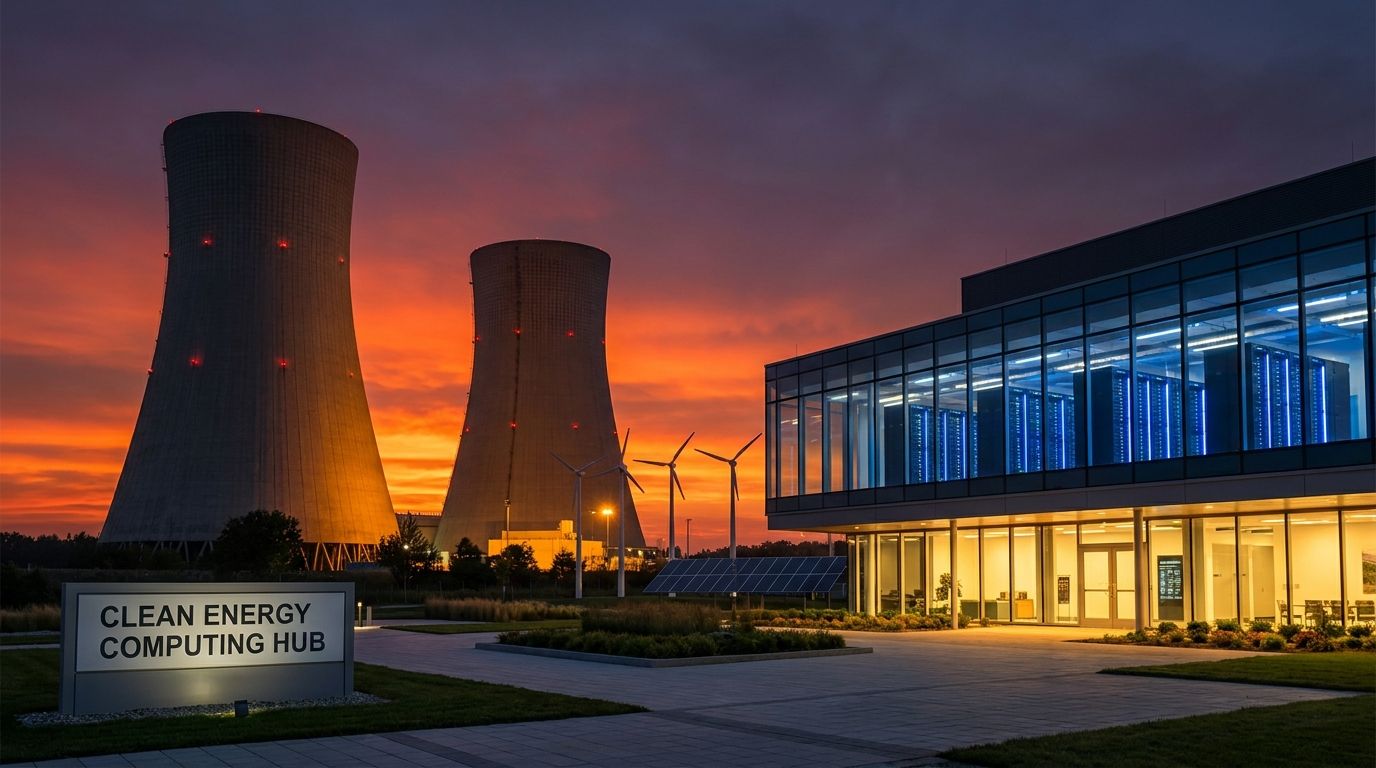
Nuclear power fell out of fashion in the tech industry the same way it fell out of fashion everywhere else: slowly after Three Mile Island in 1979, then sharply after Chernobyl in 1986, and almost completely after Fukushima in 2011. Data centers, like most large electricity consumers, built their sustainability strategies around wind and solar power purchase agreements (PPAs), procured clean energy certificates, and pushed suppliers for renewable sourcing commitments.
That strategy is running into a wall. AI model training and inference requires vast amounts of compute, which requires vast amounts of electricity, and the electricity must be available 24 hours a day, 7 days a week, at consistent voltage and frequency. Wind and solar produce power intermittently. Batteries can buffer short-term gaps but are nowhere near the capacity needed to back up gigawatt-scale data centers through multi-day calm or overcast periods. The industry's clean energy accounting was already being stretched thin; the AI buildout has snapped it entirely.
Nuclear power has one property that wind, solar, and batteries don't: it produces consistent, high-density, carbon-free electricity around the clock regardless of weather. And it's coming back.
The Deals That Signal the Shift
Microsoft made the most visible move in September 2023, when it signed a 20-year power purchase agreement with Constellation Energy to restart Unit 1 of the Three Mile Island nuclear plant in Pennsylvania — the unit that was undamaged in the 1979 accident and had operated successfully until its 2019 shutdown due to economics. The restarted plant, renamed Crane Clean Energy Center, came back online in September 2024 and now delivers approximately 835 megawatts to the grid, with Microsoft contracted to take all of it. The project required $1.6 billion in capital investment and demonstrated that restarting a mothballed US nuclear plant is technically and economically viable.
Google signed a deal with Kairos Power in October 2023 to purchase electricity from a fleet of small modular reactors (SMRs), with the first unit planned to come online by 2030. Amazon Web Services has invested in X-energy's SMR program and purchased a data center site adjacent to a nuclear facility in Pennsylvania to enable direct power connection. All three major hyperscalers have now committed real capital to nuclear power specifically for data center electricity supply.
Oracle announced in September 2024 that it is designing a data center campus powered by three small modular reactors. Constellation Energy is in discussions with multiple technology companies about additional restarts of plants that were shut down due to economics rather than safety concerns.
What Small Modular Reactors Are
A conventional nuclear plant produces 1,000 megawatts or more from a single reactor. Building one takes 10-20 years and costs $10-30 billion, with significant cost overrun history. SMRs are typically defined as reactors with output under 300 megawatts, designed to be factory-manufactured in modules and assembled on-site. The manufacturing-in-a-factory model promises lower costs, shorter construction timelines, and better quality control than traditional on-site construction.
The most advanced US SMR company is NuScale Power, which received the first-ever NRC design certification for a SMR in 2023 — the VOYGR-6, a 462 megawatt plant using six 77 MW modules. NuScale's lead project, the Carbon Free Power Project in Idaho, was cancelled in 2023 when projected costs rose to $9.3 billion for 462 MW, making it uncompetitive with other power sources for its original utility customers. This was a setback for the SMR industry's near-term economics argument.
Kairos Power's reactor, which uses molten fluoride salt as coolant and TRISO fuel particles, operates at atmospheric pressure — removing the high-pressure steam hazards of conventional light-water reactors. Kairos completed the first-ever non-water-cooled nuclear reactor construction in the US in 2023, a test reactor in Hermes, Tennessee. Its partnership with Google represents the first significant commercial power purchase agreement for an SMR from a tech company.
X-energy's Xe-100 is a pebble bed reactor that also uses TRISO fuel in graphite pebbles, designed to be inherently walk-away safe — the reactor physics prevent a runaway reaction without any active safety intervention. These passive safety designs are central to the argument that SMRs can be built near load centers like data center campuses, rather than in remote locations.
The Grid Math
Goldman Sachs estimated in 2024 that data center electricity demand would grow by roughly 160% between 2023 and 2030, reaching approximately 8% of US electricity consumption. AI accelerators at full utilization consume substantially more power than general-purpose servers. An Nvidia H100 at 700 watts, in a cluster of 10,000 GPUs, requires 7 megawatts — before accounting for cooling, which typically adds another 30-50% overhead. The largest training clusters being built in 2025-2026 are measured in hundreds of megawatts of continuous power draw.
Renewable energy PPAs can match this capacity on paper — a long-term solar agreement for 500 MW looks fine on a carbon accounting spreadsheet. In practice, that solar installation produces power for 5-7 hours a day in good conditions and nothing at night. Without load-following backup generation (typically natural gas), the data center cannot run solely on solar. Nuclear produces full capacity 24/7, with capacity factors above 90%, making it a much better match for the continuous power demand profile of AI compute.
The Timeline Problem
Nuclear's main disadvantage is time. The Three Mile Island restart took roughly 2 years from announcement to operation — unusually fast because the infrastructure already existed. Kairos Power's SMRs are not expected to come online until 2030 at the earliest. NuScale's setback in 2023 showed that SMR economics at scale are not yet proven. The hyperscalers need power now, not in 2030.
In the near term, this creates continued dependence on natural gas as a bridge fuel. Ironically, several data centers that proclaim sustainability commitments are effectively backed by gas generation when renewable supply falls short — a reality that utility-scale accounting rarely makes visible.
The longer-term trajectory is more interesting. If SMRs can be deployed at cost and within reasonable timelines — both still uncertain — the ability to site a 300 MW nuclear plant adjacent to a data center campus, rather than connecting to a transmission grid stressed by competing demand, changes the economics of large-scale AI compute fundamentally. The tech industry's renewed interest in nuclear isn't nostalgia. It's arithmetic.