AlphaFold 3 Opened to Researchers — Here's What a Year of Access Has Actually Produced
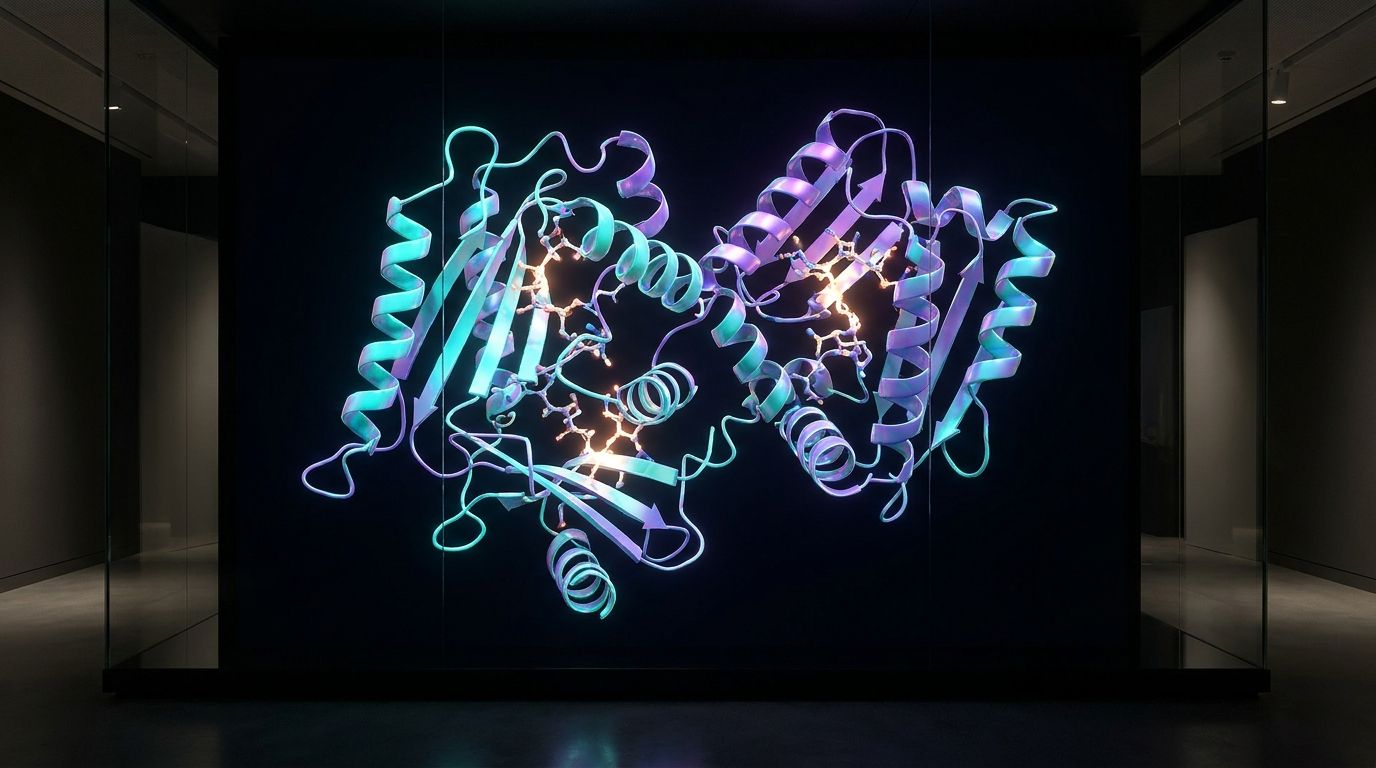
When DeepMind released AlphaFold 2 in 2020, it solved a 50-year-old grand challenge in biology: predicting how a protein folds from its amino acid sequence into a three-dimensional structure. Within two years, AlphaFold had predicted the structures of over 200 million proteins — essentially the entire known protein universe — and made them freely available through the European Bioinformatics Institute's database.
AlphaFold 3, released in 2024, went further. It can predict not just protein structures but the structures of protein complexes — proteins interacting with DNA, RNA, ligands, and small drug molecules simultaneously. That's the capability drug discovery has been waiting for: predicting not just what a protein looks like, but how it interacts with potential therapeutics at atomic resolution.
What AlphaFold 3 Actually Predicts
AlphaFold 3 uses a diffusion-based architecture (similar to the models behind image generation) rather than the transformer-based approach of AlphaFold 2, which allows it to handle heterogeneous molecular inputs — mixing proteins, nucleic acids, and small molecules in a single prediction. Benchmarks published at launch showed it outperforming specialized docking tools on protein-ligand prediction tasks, which was the result that got drug discovery teams' attention.
What Researchers Have Done With It
The most immediate application has been virtual screening: using AlphaFold 3 to predict how thousands or millions of candidate drug molecules bind to a target protein, then filtering to the most promising before running physical experiments. This compresses what was once a multi-year hit-identification process into weeks. Several academic labs have published preprints describing novel binding candidates for previously "undruggable" proteins identified entirely through AlphaFold 3-guided computational screening.
Antibody design has been another high-value application. Isomorphic Labs, DeepMind's drug discovery spinout, has disclosed that multiple programs in its pipeline were designed with AlphaFold 3 assistance. Enzyme engineering has produced the most rapid concrete results — researchers have designed novel enzyme variants that break down specific plastic polymers, synthesize complex natural products, and catalyze reactions with improved selectivity.
What It Still Can't Do
AlphaFold 3's predictions are static. It predicts the lowest-energy structure of a complex, not the dynamics of how molecules move and flex over time. Protein motion — the conformational changes governing how drugs enter binding pockets and how enzymes open and close — requires molecular dynamics simulation. Many drug failures happen because a compound binds to the predicted static structure but behaves differently in the dynamic physiological context.
Accuracy is also not uniform. G-protein coupled receptors (GPCRs) — the most common class of drug targets — remain challenging because their conformational flexibility isn't fully captured. Intrinsically disordered proteins, which lack stable structures under physiological conditions, are by definition resistant to structure prediction.
The Access Question
AlphaFold 3's rollout has been complicated by access policy. The AlphaFold Server is free for non-commercial academic research, but model weights were initially withheld by DeepMind. Following significant scientific community pushback, DeepMind released weights under a license permitting non-commercial research use and local deployment. The practical impact on drug discovery timelines is real — not in the "cure cancer tomorrow" framing of early coverage, but in genuine compression of the hit identification and lead optimization phases that historically account for years of preclinical work.