Anthropic's Model Context Protocol Has Won: How MCP Became the Universal Standard for AI Tool Integration
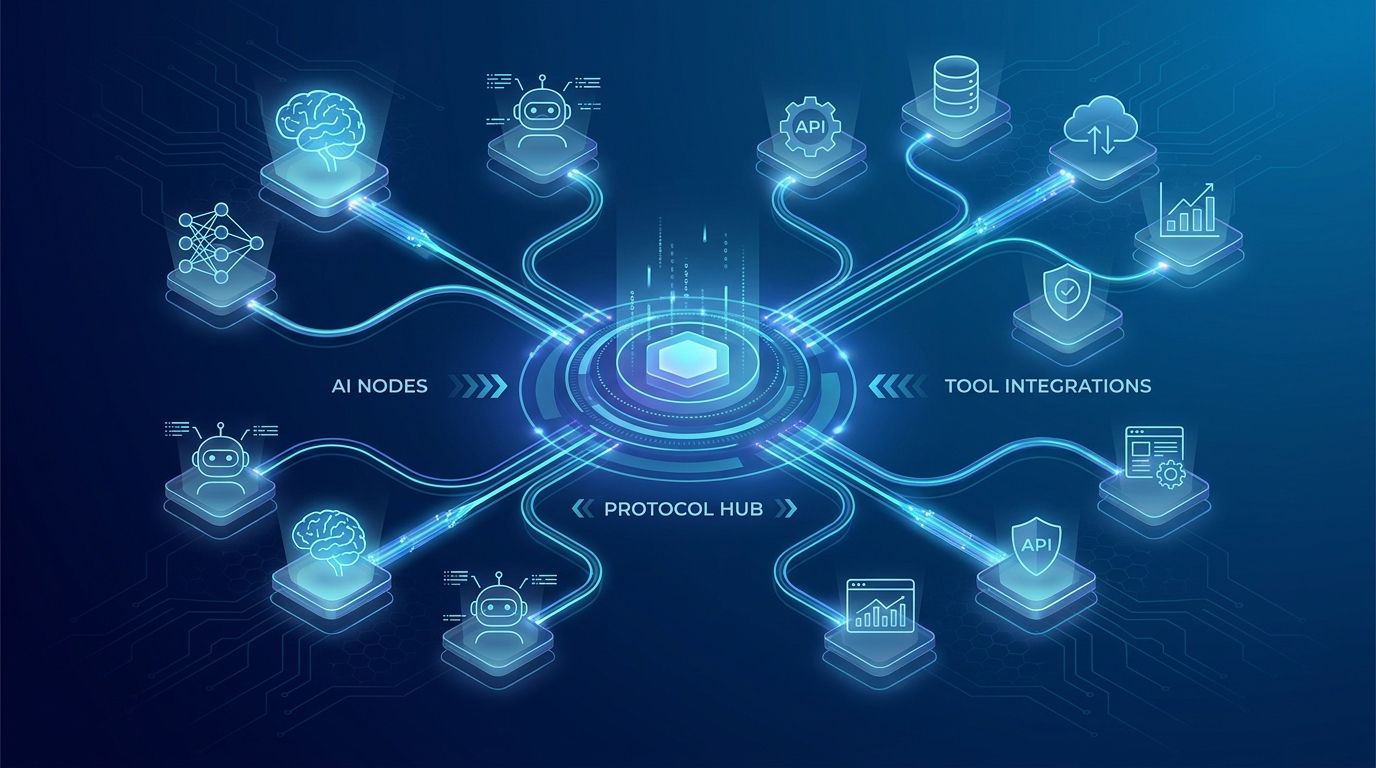
In November 2024, Anthropic published a specification called the Model Context Protocol — an open standard for connecting AI models to external tools, data sources, and services. At the time, it looked like yet another vendor-specific integration format. By mid-2026, every major AI platform had adopted it. MCP solved the fragmentation problem that had been quietly holding AI agents back: the inability to share tool integrations across models and runtimes.
What MCP Actually Is
MCP is a client/server protocol built on JSON-RPC 2.0. An MCP server exposes capabilities — tools, resources, and prompts — over a transport layer (stdio for local processes, HTTP/SSE for networked services). An MCP client, embedded in an AI host like Claude, Copilot, or Cursor, discovers and calls those capabilities at runtime.
The protocol defines three primitive types:
- Tools — callable functions the model can invoke, with typed JSON Schema input/output definitions. Think:
github.create_pull_request,postgres.run_query,slack.send_message. - Resources — structured data the model can read, identified by URI. A file, a database row, a calendar event.
- Prompts — reusable, parameterized prompt templates the server exposes for common tasks.
The transport-agnostic design is intentional. An MCP server running locally communicates over stdin/stdout. The same server deployed as a microservice switches to HTTP with Server-Sent Events for streaming. The client does not care which transport is in use.
The Adoption Timeline That Changed Everything
Anthropic open-sourced MCP and released SDKs in Python and TypeScript alongside the spec. Early adoption came from developer tooling: Cursor, Zed, and Continue integrated MCP within weeks, giving their users access to a growing catalog of servers for GitHub, file systems, databases, and web search.
The inflection point came in early 2025 when OpenAI announced native MCP support in the Responses API and its agent framework. That decision signaled that MCP was not a Claude-specific feature — it was infrastructure. Google followed with Gemini's MCP integration in Google AI Studio and Vertex AI, enabling Gemini agents to consume the same server catalog that Claude users had been building. Microsoft Copilot Studio added MCP connector support, letting enterprise teams expose internal APIs as MCP servers without writing custom plugin code.
By mid-2026, the MCP server registry had grown to over 2,000 community and vendor-maintained servers. AWS, Azure, and GCP each published first-party MCP servers for their core services. Stripe, Linear, Notion, and Atlassian shipped official integrations. The ecosystem that had taken years to build around REST APIs was rebuilding itself around MCP in months.
Why MCP Won Over Alternatives
Before MCP, every AI platform had its own tool-calling format. OpenAI had function calling with its own JSON schema dialect. LangChain had Tools with Python class definitions. Semantic Kernel had plugins with OpenAPI descriptors. Each ecosystem required rewriting integrations from scratch when switching models or runtimes.
MCP won for three reasons:
- It is genuinely open. The spec is MIT-licensed and governed independently. No vendor controls the roadmap unilaterally. That made adoption politically safe for OpenAI and Google, who would not have shipped a protocol that locked users into Anthropic's ecosystem.
- It is simpler than the alternatives. An MCP server is a process that speaks JSON-RPC. You do not need a framework, a plugin manifest, or an OpenAPI spec. A working server in Python is roughly 30 lines of code using the official SDK.
- Transport agnosticism removes deployment friction. The same server binary works in a local developer environment and in a Kubernetes cluster. That predictability matters for enterprise teams with strict network and security requirements.
What It Looks Like in Practice
A developer building a customer support agent today does not write custom tool-calling glue code for each model they want to support. Instead, they run an MCP server that exposes their CRM, their ticketing system, and their knowledge base as tools and resources. Any MCP-compatible AI host — Claude, GPT-4o, Gemini — can then use those tools without modification.
Consider a concrete stack. A team deploys:
- An MCP server wrapping their PostgreSQL database, exposing
run_queryandlist_tablesas tools - An MCP server for their GitHub repository, exposing issue management and PR creation
- An MCP server for Slack, exposing channel messaging and thread reading
Their AI agent — running on whichever model performs best for their workload — discovers all three servers at startup via a configuration file and can call any tool in any server during a reasoning session. Switching from Claude to Gemini does not break a single integration. That is the practical value MCP delivers.
The Developer Experience Shift
The mental model has changed for developers building AI-powered products. Previously, integrations were model-specific: you built for OpenAI's function calling, or you built for Claude's tool use, and porting between them meant rewriting schemas and glue code. Now integrations are capability-specific: you build an MCP server once, and every compliant AI runtime can use it.
This shift has practical consequences for how teams structure their AI infrastructure. MCP servers are now a distinct layer in the stack — separate from the application, separately deployed, separately versioned. Teams are building internal MCP server catalogs the way they previously built internal API catalogs. The discipline of API design — clear contracts, versioning, documentation — is being applied to AI tool integrations for the first time.
Security and Authorization
MCP 1.1, released in Q1 2026, added an OAuth 2.1 authorization layer for HTTP-based servers. An MCP client can now negotiate scoped access tokens before calling tools on a remote server. This addressed the main enterprise objection to early MCP deployments: that any connected model could call any tool without granular access control. With OAuth 2.1 flows standardized in the spec, enterprise MCP deployments are now viable without custom security middleware.
Actionable Takeaways
If you are building AI-powered products in 2026, MCP is no longer optional infrastructure to evaluate — it is the default integration layer. Here is what to do:
- Audit your existing tool integrations. Any custom function-calling schema you maintain for a specific model is now technical debt. Migrating to an MCP server gives you portability across all compliant models.
- Check the registry before building. The MCP server catalog at
modelcontextprotocol.iolikely has a maintained server for the API you need. Stripe, GitHub, Postgres, Slack, and Google Drive all have first-party servers. - Build MCP servers as internal products. Treat your MCP server the same way you treat an internal API: version it, document it, and give it a clear ownership model. Teams that invest in a well-designed internal MCP catalog will compound that investment across every AI feature they ship.
- Use the OAuth 2.1 flow for anything production-facing. Local stdio servers are fine for development. Any MCP server exposed to a production AI agent should require authenticated, scoped access.
MCP did not win because Anthropic marketed it well. It won because the problem it solves — AI tool fragmentation — was real and expensive, and the solution was simple enough that competitors had no incentive to build something else. That combination rarely fails.