AMRs are reshaping logistics — here's what Kiva, MiR, and Locus Robotics are actually deploying
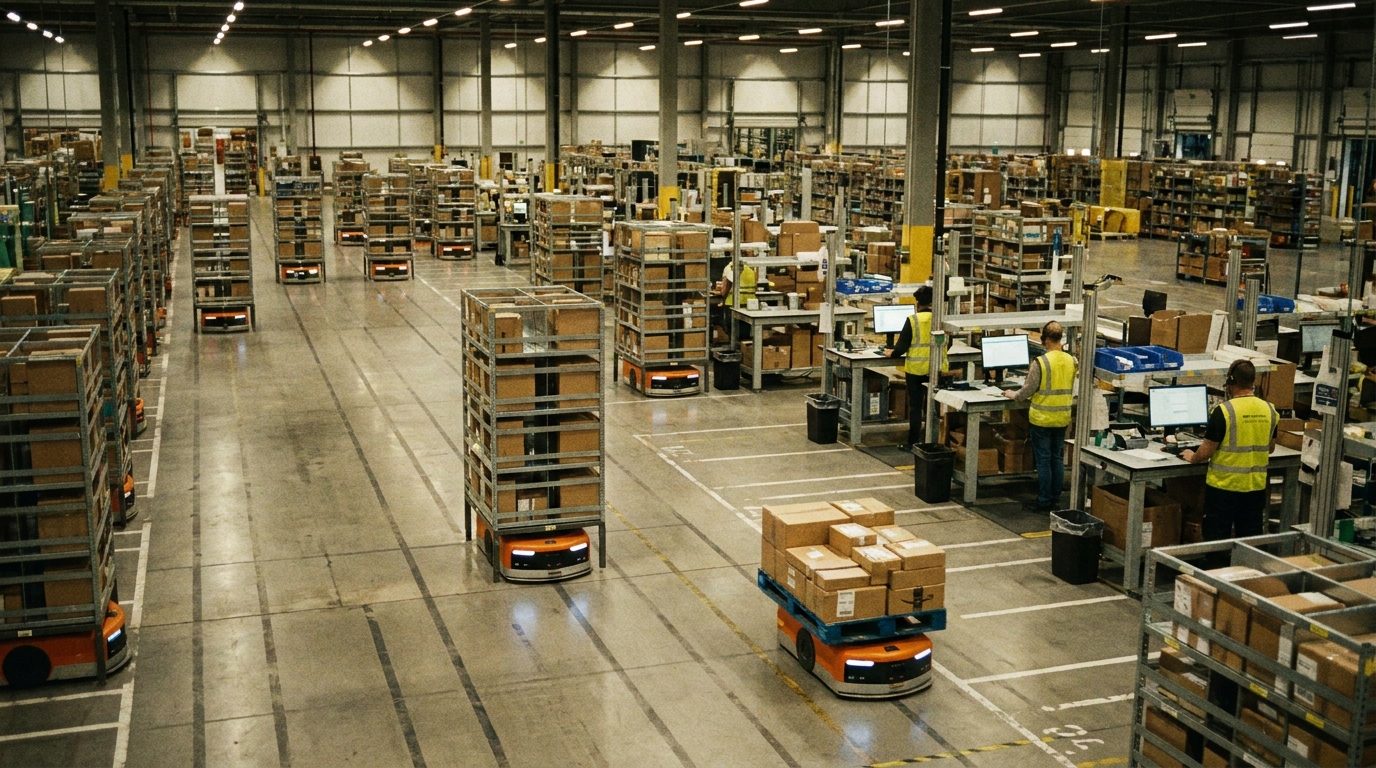
Walk into an Amazon fulfillment center today and the floor looks nothing like a warehouse from a decade ago. Orange Kiva robots — rebranded as Amazon Robotics drives after the $775 million acquisition in 2012 — move entire inventory pods to stationary human pickers, eliminating the miles of walking that defined the job. Amazon now runs more than 750,000 AMRs across its global network. That is not a pilot. That is infrastructure.
What counts as an AMR — and what doesn't
The term gets stretched. An AMR navigates autonomously using onboard sensors, maps its environment, and reroutes around obstacles in real time. That distinguishes it from an AGV (automated guided vehicle), which follows fixed magnetic tracks or reflector grids and stops dead when something blocks its path. The practical difference matters: AMRs can be deployed into an existing warehouse without tearing up the floor, which is why adoption accelerated so sharply after 2018.
The main categories in commercial deployment today are: goods-to-person pod movers (Amazon Robotics, Geek+, Quicktron), autonomous forklifts and pallet jacks (Seegrid, Vecna Robotics, Toyota's Autopilot line), case-picking and sortation robots (Locus Robotics, 6 River Systems), and outdoor/yard AMRs — still early but emerging in container ports.
The major platforms and where they're running
Amazon Robotics (Kiva-derived): The largest AMR fleet in the world. The Proteus and Hercules platforms handle pallet-level moves; the drive system handles pod transport. Tightly integrated with Amazon's warehouse management system and not commercially available — Amazon keeps this competitive advantage internal.
Locus Robotics: Deployed in hundreds of 3PL and retail fulfillment sites globally. The LocusBot works alongside human pickers — it navigates to a pick location, the human picks into the bot's tote, the bot routes to pack-out. DHL, Geodis, and Quiet Logistics (acquired by American Eagle Outfitters) have publicly disclosed multi-site deployments. Locus claims its system consistently delivers 2–3× the units-per-hour of manual picking.
6 River Systems (acquired by Shopify in 2019, then sold to Ocado in 2023): The "Chuck" collaborative robot takes a similar human-assist model. Shopify licensed the system for its own fulfillment network; the Ocado acquisition reflected strategic interest in automation-as-a-service for grocery fulfillment.
Mobile Industrial Robots (MiR, acquired by Teradyne): Focused on internal logistics — moving carts, racks, and heavy payloads between production lines and warehouses. Widely deployed in automotive and electronics manufacturing. BMW, B. Braun, and Flex have published case studies. MiR's MiR1350 handles up to 1,350 kg payloads, putting it squarely in heavy industrial use.
Geek+ and Quicktron: Dominant in Asia. Geek+ has deployed more than 50,000 robots globally, with particular density in Chinese e-commerce, apparel, and pharmaceutical fulfillment. Both companies have made inroads into European and North American 3PL markets.
How the navigation actually works
Modern AMRs rely on simultaneous localization and mapping (SLAM) — the robot builds a map of its environment while tracking its own position within that map, using a combination of LiDAR, depth cameras, and wheel odometry. The map is generated during an initial learning run, updated continuously as the environment changes, and shared across the fleet so all robots benefit from one robot's new observations.
Fleet management software runs above individual robot controllers and handles traffic: assigning tasks, routing robots to avoid collisions, managing charging cycles, and rebalancing workloads when demand spikes. The better platforms — Locus, 6 River, MiR Fleet — expose REST APIs and integrate directly with warehouse management systems (WMS) and order management systems (OMS), so task assignment is automated end-to-end.
Machine learning enters in two ways. Perception models handle obstacle classification (a person vs. a pallet vs. a stray box). Demand-prediction models, increasingly embedded in fleet management software, pre-position robots in zones likely to get busy before a wave hits, reducing the latency between order release and pick start.
What AMRs can reliably do today
- Goods-to-person transport: Move pods, shelves, or bins to a fixed pick station and return them to storage. This is solved at scale — the Kiva model has a decade of production proof.
- Collaborative picking assist: Navigate to pick locations ahead of or alongside a human worker, carry totes, and route completed work to pack-out. Reliable in structured, mapped environments with consistent lighting.
- Internal material transport: Move carts, racks, and pallet jacks between defined points in a factory or distribution center. MiR and Seegrid have this working in multi-shift automotive plants.
- Sortation: Some platforms handle final sort-to-carrier directly; others feed human or robotic sort arms. Throughput rates of 1,500–2,500 units per hour per station are commercially validated.
What they still can't do reliably
AMRs move things from A to B. They do not pick things up from shelves. The last inch — reaching into a bin, identifying a SKU among 50 similar items, grasping it without damaging it — remains the hard problem. Robotic piece-picking systems exist (Covariant, Mujin, RightHand Robotics) but they are separate systems and not yet integrated at the speed and accuracy that would let a warehouse eliminate human pickers altogether.
Unstructured or outdoor environments remain out of reach for most platforms. A warehouse has defined lanes, consistent lighting, and a known layout. A loading dock, a yard, or a retail store floor does not. Yard automation exists but is expensive and site-specific. Retail-floor replenishment by AMR is emerging (Simbe Robotics' Tally robot does shelf scanning, not stocking) but reliable autonomous restocking is not in general deployment.
Mixed-use environments with dense human traffic — the kind found in grocery stores or hospitals — are also harder than they look. Safety certification requirements, irregular human behavior, and narrow aisles all compound. The robots that work there tend to be smaller, slower, and more conservative in routing, which limits throughput.
The economics in 2026
A mid-range collaborative picking robot (Locus, 6 River Chuck) runs roughly $25,000–$40,000 per unit on a capital purchase, or $1,200–$1,800/month under robotics-as-a-service (RaaS) contracts. A heavy-payload AMR (MiR1350, Seegrid GT) is $60,000–$100,000 per unit. Those numbers have come down roughly 30–40% over the past five years as manufacturing volumes scaled.
The business case is built on labor hours displaced, not labor eliminated. A Locus deployment at a mid-size 3PL typically targets a 2–3× pick rate improvement per human worker, which means the same throughput with half to two-thirds the pickers — or substantially higher throughput with the same headcount. At a fully-loaded labor cost of $20–$25/hour including benefits and turnover (which in some high-churn warehouse markets reaches 100% annually), payback periods of 18–30 months are commonly cited.
The RaaS model, pioneered partly by Locus and broadly adopted across the sector, changes the financial profile: no large capex, performance-based pricing, and the vendor absorbs maintenance and software upgrade costs. For operators who can't justify a $2 million capital commitment, RaaS has been the unlock.
What this means for warehouse workers
The honest picture is more nuanced than either "robots are taking all the jobs" or "don't worry, new jobs will appear." The Bureau of Labor Statistics classifies more than 1.1 million people in the U.S. as order fillers, packers, and material movers — roles directly in the path of AMR deployment. Displacement is happening, but it is uneven, gradual, and concentrated in the highest-volume, most repetitive segments of the work.
What AMR deployment consistently does is bifurcate warehouse labor. Walking-and-picking roles shrink or are upskilled into robot supervision and exception handling. Maintenance, fleet management, and systems integration roles grow, but they require different skills and pay more. The workers who were doing the physical picking are not automatically the workers who will do the robot supervision — that transition requires training investment that most operators have been slow to provide.
Near-term pressure is concentrated in large-footprint e-commerce and 3PL fulfillment, where volume justifies the investment. Smaller operations, cold-chain facilities, and environments with high SKU variability have slower adoption curves. The jobs most protected in the near term are those requiring judgment in unstructured situations — the kind of flexibility that AMRs, as they exist today, genuinely do not have.