Boston Dynamics, Figure, and 1X Have All Deployed Humanoid Robots in Warehouses — the Results Are More Complicated Than the Press Releases Suggest
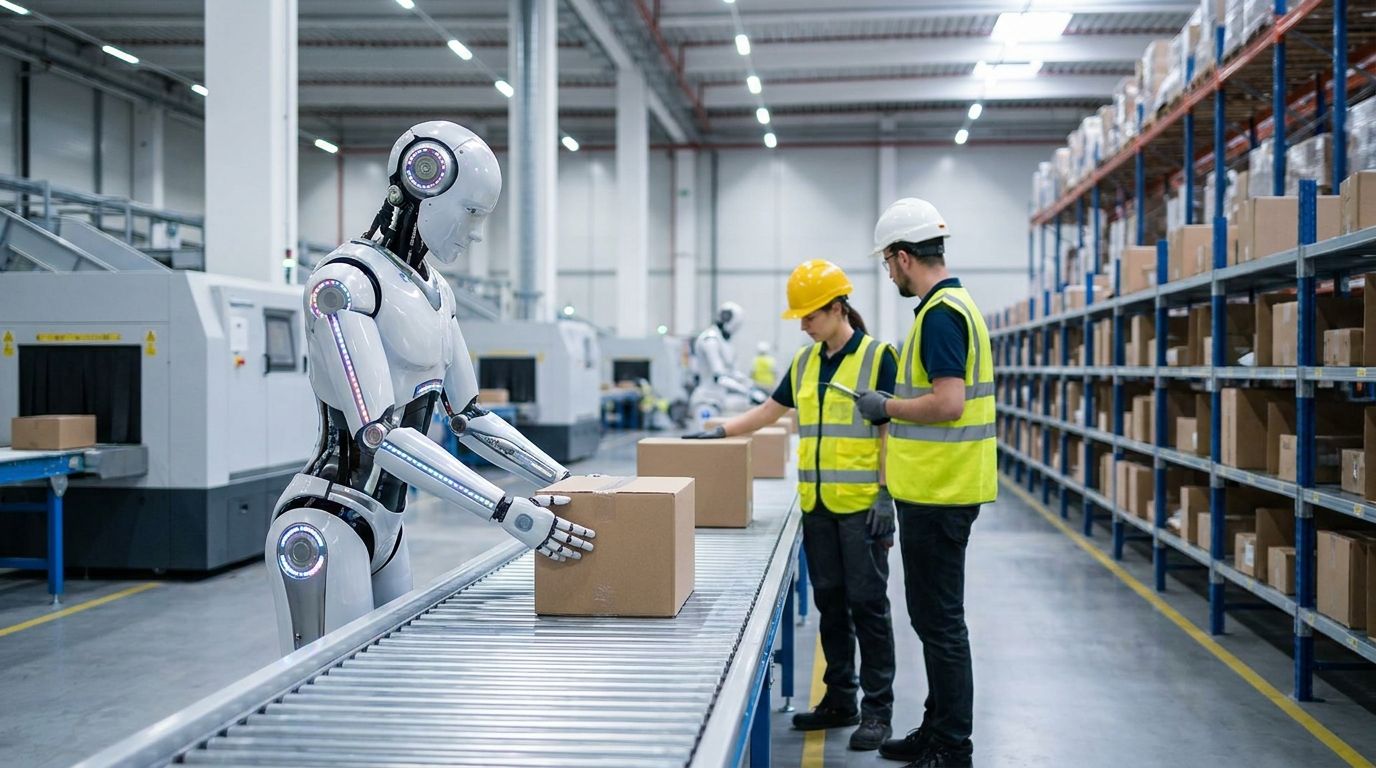
Six Months In: The Operational Reality
When Boston Dynamics deployed 50 Atlas units at a BMW manufacturing facility in Spartanburg, South Carolina in late 2025, the announcement made global headlines. Figure's deal with BMW came first, then Boston Dynamics, then 1X Technologies' deployment with a major 3PL fulfillment operator in Columbus, Ohio. By Q1 2026, all three deployments had generated enough operational data to evaluate seriously.
The headline from that data: humanoid robots are genuinely useful in specific, well-defined tasks within logistics environments. They are not general-purpose workers. The gap between what the demos show and what sustains in production is significant — but it's a solvable gap, not a fundamental one.
What the Data Shows by Deployment
Boston Dynamics Atlas at BMW Spartanburg
Atlas units in the BMW deployment handled part transfer tasks — moving components from storage racks to assembly line stations. After six months, Boston Dynamics reported an 87% task completion rate on targeted workflows, up from 71% at month two. Mean time between interventions (a key operational metric) reached 4.2 hours. That means a human operator needs to intervene roughly every four hours per robot — not autonomous, but manageable at scale.
The tasks Atlas couldn't handle reliably: anything involving flexible components (wiring harnesses, fabric-wrapped parts) and any task requiring more than 3 sequential grasp-and-place operations without a human checkpoint. The robot's dexterity with rigid parts is solid. Deformable objects remain a hard problem.
Figure 02 at BMW's Munich Logistics Center
Figure's deployment focused on container unloading — one of the most physically demanding and injury-prone tasks in warehouse operations. Figure 02 units achieved a throughput of 340 packages per hour in controlled conditions, roughly 85% of an average human worker's rate. In production, after accounting for error recovery and environmental variability, the sustained rate was 270 packages per hour — about 67% of human throughput.
The economics still work in Figure's favor at scale: a Figure 02 unit operates at a cost equivalent to roughly $17/hour when amortized over a 3-year deployment period (hardware cost + maintenance + software licensing). In markets where warehouse labor costs $22-28/hour including benefits, the unit economics are favorable. But the 33% productivity gap versus humans is real and needs to close for the business case to be compelling without labor cost subsidies.
1X Technologies NEO at Columbus Fulfillment
1X's NEO is designed differently — it prioritizes safe human coexistence over maximum task throughput. The Columbus deployment focused on pick-and-place tasks in a shared human-robot environment, operating at lower speeds with more conservative motion planning. Six-month results: 94% task accuracy on standard SKUs, with significant degradation on non-standard packaging (items without flat surfaces, irregularly shaped returns). Zero safety incidents involving human workers — a metric 1X has emphasized heavily in communications.
NEO's current limitation is speed. At 180 picks per hour maximum, it operates at roughly 45% of human throughput for comparable tasks. 1X's argument is that safe co-operation unlocks deployment contexts that fully autonomous high-speed robots can't access — environments where retrofitting physical segregation infrastructure is cost-prohibitive.
The Technical Problems That Remain Unsolved
Perception in Unstructured Environments
All three deployments showed performance degradation in environments with variable lighting, cluttered backgrounds, or non-standard item placement. The robots perform well when the environment is semi-structured and predictable. Real warehouses frequently deviate from those conditions — items are placed incorrectly, labels are damaged, lighting changes with shift rotations. This isn't a showstopper, but it means deployment ROI is highly sensitive to facility layout investment.
Long-Horizon Task Planning
None of the deployed systems can reliably execute tasks longer than 8-10 sequential steps without human intervention or a hard reset. This limits their applicability to complex assembly workflows, inventory auditing, or any task that requires contextual decision-making beyond "pick item A, place at location B." The LLM-based reasoning layers that several companies are grafting onto manipulation models help at the high level but don't yet bridge the gap to reliable execution at the manipulation layer.
Failure Mode Recovery
When a humanoid robot fails mid-task — drops an item, misidentifies an object, gets stuck in an edge-case configuration — recovery is slow and often requires human intervention. Average recovery time across the three deployments ranged from 8-23 minutes depending on failure type. Reducing that to under 2 minutes is critical for the technology to achieve the uptime levels ($90%+) that logistics operators require to build their staffing models around it.
The Supply Chain for Humanoid Robots Is Its Own Bottleneck
All three companies face the same constraint: actuator supply. The brushless motors and custom torque-dense actuators that humanoid robots require are in short supply globally, with most production capacity concentrated in Japan (Harmonic Drive Systems) and China. Boston Dynamics has disclosed that it can produce roughly 1,000 Atlas units per year at current manufacturing capacity. Figure has indicated a similar ceiling. At those production rates, scaling to meaningful warehouse deployments — a major 3PL might need 500-2,000 units per facility — takes years, not months.
Actionable Takeaways
- If you run logistics operations: The best near-term deployments are narrow-scope, well-structured tasks — not general labor replacement. Container unloading, specific part-transfer workflows, and isolated pick stations are appropriate first deployments. Budget for significant integration and facility preparation costs (typically 40-60% of robot hardware cost) when building ROI models.
- If you're evaluating vendors: Ask for mean time between interventions data and recovery time metrics, not just throughput numbers. Those figures tell you more about real operational viability than peak performance in controlled demos.
- If you invest in robotics: The actuator supply chain is the near-term constraint on scaling. Companies with proprietary actuator manufacturing or exclusive supplier relationships have a structural advantage that's underappreciated relative to software capabilities.
- Watch for Q3 2026: Both Figure and 1X have indicated next-generation hardware updates targeting improved dexterous manipulation. Whether those ships in 2026 or slips to 2027 will determine how quickly the productivity gap closes.