Cloud Gaming Still Hasn't Solved the Latency Problem — and That's Why It Hasn't Gone Mainstream
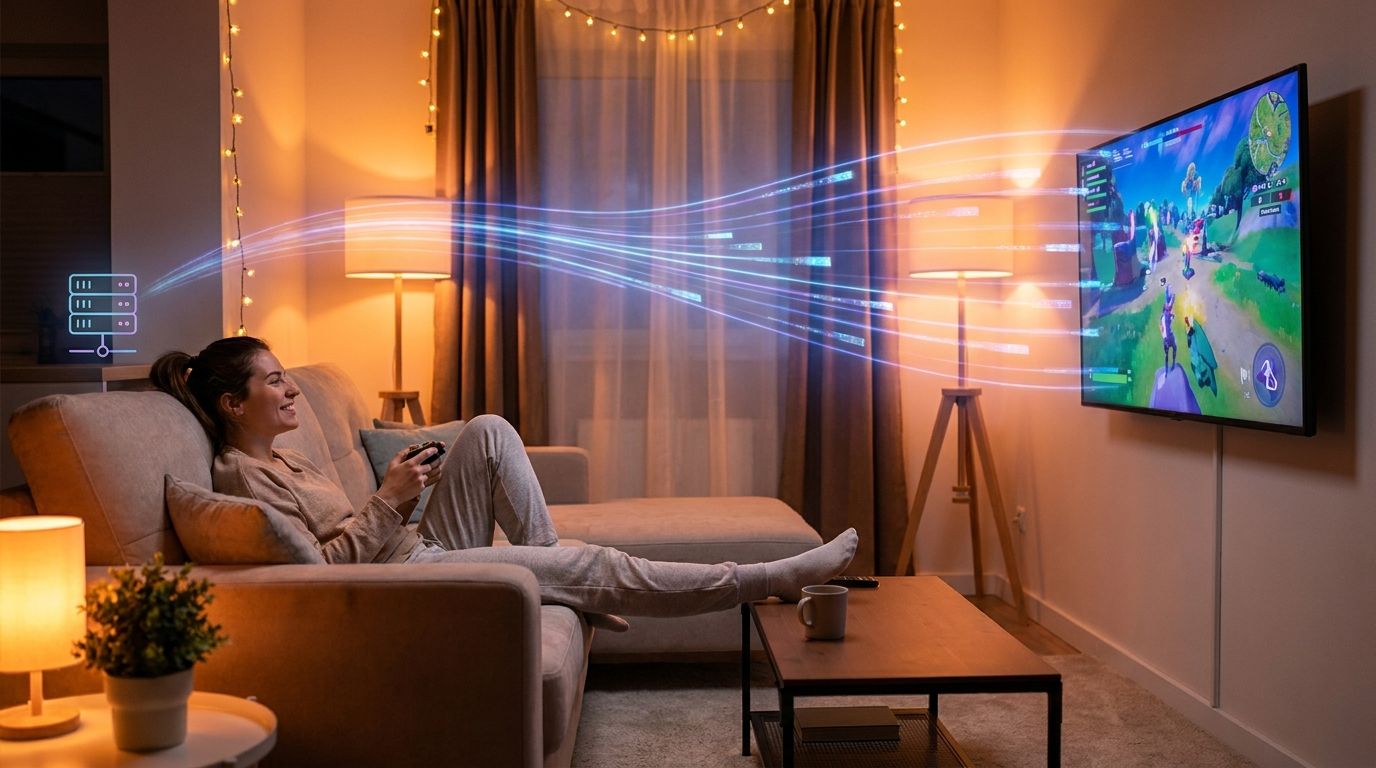
The promise of cloud gaming is simple and genuinely appealing: run games on powerful servers, stream the video to any device, eliminate the need for expensive local hardware. The pitch has been made since OnLive launched in 2010. In 2026, cloud gaming is a real product used by real people. Xbox Cloud Gaming has over 20 million users globally. GeForce Now has over 25 million registered users. The services work. And they remain a secondary gaming option for most players.
Understanding why requires engaging honestly with a physics problem that no amount of software optimization can fully eliminate.
The Latency Math
When you press a button in a locally-run game, the input travels to the CPU/GPU within a millisecond. The entire loop takes somewhere between 20ms and 70ms in a well-configured local gaming setup. Cloud gaming adds unavoidable steps: input leaves your device, crosses the internet to a data center, gets processed and encoded as a video frame, sent back, decoded, and displayed. Even with a server 30 miles away and a low-congestion fiber connection, the minimum realistic round-trip is 20-30ms for network transit alone. Add encoding and decoding: current video codecs add 30-80ms in practice. Total minimum latency for a well-optimized cloud setup is approximately 50-80ms versus 20-30ms locally.
In real-world conditions with Wi-Fi, higher server distances, and network congestion, 100-150ms is common. For casual players navigating menus, this is imperceptible. For competitive shooters or action games, the difference between 20ms and 100ms is the difference between a game that feels responsive and one that feels broken.
What Each Service Has Built
Microsoft has made the strongest strategic bet on cloud gaming. Xbox Game Pass Ultimate includes xCloud streaming, letting subscribers play any Game Pass title on phones, tablets, browsers, and Samsung TVs with no console required. The strategy is explicitly about reach rather than competing with local hardware performance.
NVIDIA's GeForce Now takes a different approach: it's a streaming PC in the cloud. Users connect their existing Steam, Epic, or Ubisoft Connect libraries, and NVIDIA runs the game on hardware scaling up to RTX 4080-class GPUs. The value proposition is paying $20/month for high-end GPU performance rather than buying a $1,200 graphics card.
PlayStation Plus Premium's streaming covers older PS3, PS4, and some PS5 titles, providing backward compatibility rather than positioning as the primary gaming delivery mechanism. Sony has been notably less aggressive about cloud gaming than Microsoft, keeping PS5 hardware sales as the core business.
Edge Computing and the 5G Promise
The theoretical solution to latency is edge computing: move servers closer to players via nodes in cell towers and neighborhood exchanges. This is genuinely happening at limited scale. Microsoft has deployed Xbox-compatible edge nodes with AT&T and Vodafone. In practice, coverage is thin. Building the density required to serve most gamers is extraordinarily capital-intensive and commercially uncertain.
5G's millimeter-wave variant offers low latency but is limited to dense urban areas and doesn't penetrate buildings. The 5G most users have adds 20-40ms for the air interface alone. It is not a solution to the cloud gaming latency problem.
The Genuine Success Story
Cloud gaming's real success is in expanding access, not replacing local hardware. A child can play a console-quality game on a tablet without buying a console. A traveler can continue a game on a hotel room TV. A player with an aging PC can access GPU-intensive titles at GeForce Now quality tier without hardware investment.
For casual players in these scenarios, the latency is acceptable and the value is clear. Newzoo estimated the cloud gaming market at $4.8 billion globally in 2025, growing toward $8 billion by 2028. That is real money and it is growing. But it is small relative to the total games market and largely additive rather than substitutive.
Better codecs will chip away at encoding latency. More edge nodes will reduce network latency in dense markets. But the latency floor set by physics means that for competitive gaming and demanding action titles, local hardware will remain the better option for the foreseeable future. The dream of replacing your console with a subscription has been deferred, not cancelled.