Commercial Moon Landers Are Finally Delivering — After a Rough Start
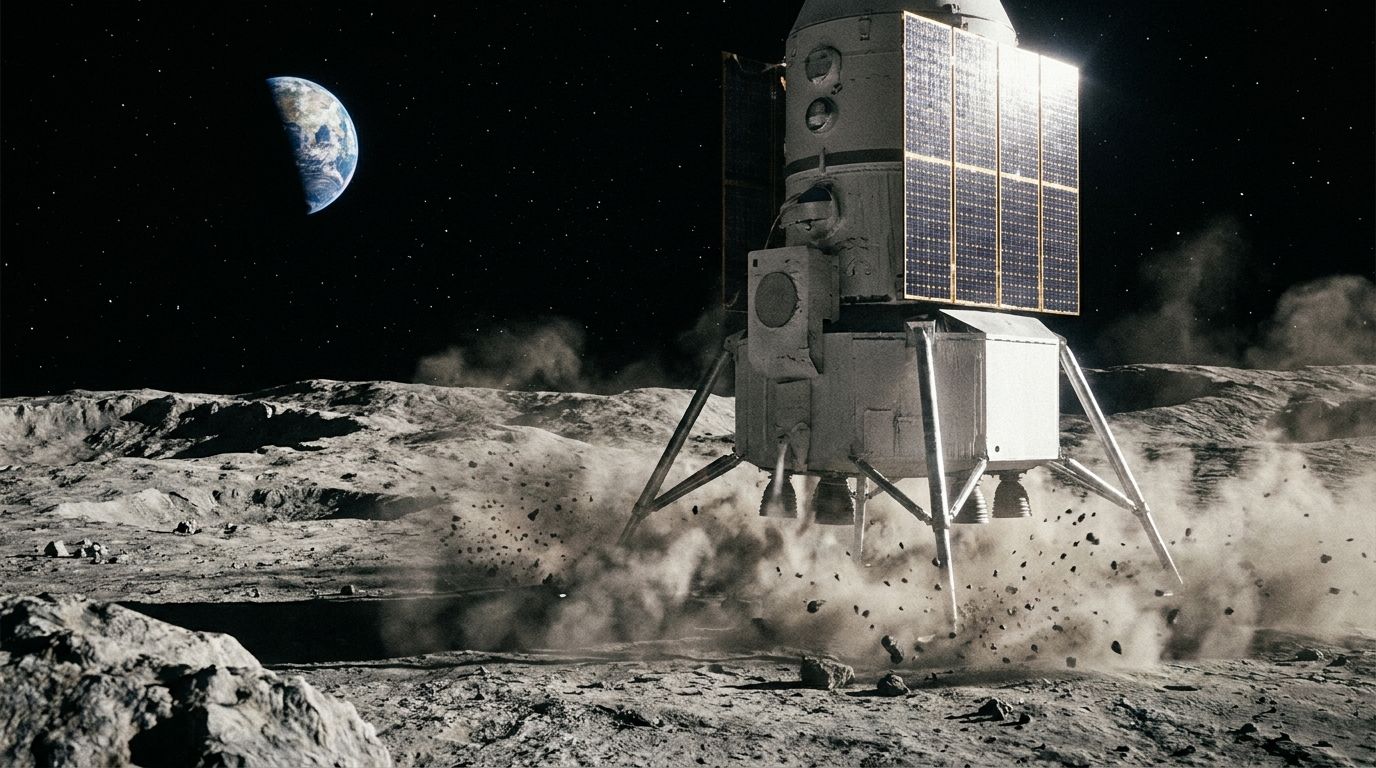
In February 2024, Intuitive Machines' Nova-C lander — IM-1, named Odysseus — touched down near the lunar south pole, becoming the first American spacecraft to soft-land on the Moon since Apollo 17 in 1972. It tipped over on landing, one foot catching in a crater rim, and lay on its side for the duration of its surface mission. It still transmitted data for six days. By the standards of commercial lunar landing, that was an unambiguous success.
One month earlier, Astrobotic's Peregrine Mission One had suffered a catastrophic propellant leak hours after launch. The spacecraft never reached the Moon, eventually burning up during a controlled reentry over the Pacific. The payload — 20 science instruments and 226 memorial capsules — went with it.
Both outcomes were funded through NASA's Commercial Lunar Payload Services (CLPS) program, a fixed-price commercial contract model that deliberately accepts higher mission risk in exchange for lower cost and faster development cycles. In that framing, IM-1's sideways landing was a success and Peregrine's propellant failure was a data point. In 2026, with several more missions flown and more in preparation, the program is producing a clearer picture of what commercial Moon access actually looks like.
What CLPS Is Trying to Do
CLPS is fundamentally a different procurement model than NASA's traditional cost-plus contracts. Instead of owning the spacecraft and paying contractors to build it, NASA buys rides: it contracts for delivery of scientific payloads to the lunar surface at a fixed price per mission, leaving spacecraft design, development, and operations entirely to the vendor. The program was authorized in 2018 and awarded task orders to nine companies initially, later expanding to fourteen.
The logic is that fixed-price contracts force cost discipline — vendors absorb cost overruns themselves rather than passing them to NASA. Multiple vendors in competition should drive down prices over time. And accepting a higher failure rate on individual missions, compared to NASA's traditional risk-averse flagship mission model, allows more missions to fly, generating more data and experience across the industry as a whole.
The risk tradeoff was always explicit. NASA Administrator Jim Bridenstine said at the program's launch that CLPS missions were expected to fail at a higher rate than NASA's own missions. The scientific payloads are real — Peregrine was carrying a NASA water ice detector and a neutron spectrometer — but each individual CLPS mission is sized to be a loss the program can absorb.
The Scorecard So Far
Peregrine Mission One (January 2024): propellant leak on orbit, mission loss. Complete failure by any conventional metric, though Astrobotic demonstrated launch, separation, and some early operations before the leak.
IM-1 / Odysseus (February 2024): soft landing achieved, vehicle tipped at touchdown, surface operations conducted for six days. Classified as a success by NASA and Intuitive Machines despite the orientation issue.
JAXA's SLIM (January 2024, not CLPS but relevant): Japan's Smart Lander for Investigating Moon achieved a 55-meter precision landing — far more accurate than any previous mission — but also tipped on landing, operating on solar power only when the Sun angle was favorable. SLIM validated precision landing technology while also demonstrating that lunar terrain makes final-meter accuracy genuinely hard.
IM-2 (2025): Intuitive Machines' second mission targeted the lunar south pole with a drill payload to search for water ice. The south pole is the most scientifically interesting and operationally difficult terrain on the Moon — permanently shadowed craters, extreme terrain, communications challenges. IM-2 achieved orbit but had difficulties with its landing sequence; surface operations were limited.
Firefly Aerospace's Blue Ghost (early 2026): delivered ten NASA payloads to Mare Crisium in the Moon's northern hemisphere. Blue Ghost achieved an upright landing and operated for approximately two weeks, completing all primary science objectives. The most operationally clean CLPS mission to date.
What the Commercial Lander Industry Has Learned
The pattern across CLPS missions reveals where commercial lunar landing is hard in ways that ground testing didn't predict. Propellant systems under the thermal cycling of deep space behave differently than they do on Earth. Landing legs interacting with loose regolith are difficult to simulate accurately; IM-1 and SLIM both tipped because the terrain was harder or more irregular than models predicted. Precision landing — getting within meters of a target — is achievable in mid-latitude plains but dramatically harder at the south pole where slopes and shadows complicate terrain navigation.
What the industry has also demonstrated is that the basic value proposition of CLPS works: Firefly's Blue Ghost mission cost significantly less than an equivalent NASA-developed lander would have, delivered multiple science instruments that returned data, and operated for two weeks. The payload-to-cost efficiency is improving as vendors build operational experience.
What's Coming
Intuitive Machines has IM-3 planned with a larger Nova-C variant targeting the lunar south pole. Astrobotic is developing the much larger Griffin lander, designed to deliver NASA's VIPER rover — a golf-cart-sized ice prospector — to Nobile Crater at the south pole. Griffin represents the program's most ambitious mission to date; VIPER weighs over 400 kilograms and requires precise landing on terrain that hasn't been directly imaged at high resolution.
Blue Origin entered the CLPS roster and has a Blue Moon lander in development that could carry significantly larger payloads. Draper Laboratory, Masten Space Systems, and several smaller vendors round out the roster, though not all are expected to fly missions in the near term.
The broader context is Artemis, NASA's program to return humans to the Moon. CLPS science missions are intended to characterize landing sites, test technologies, and establish operational experience before crewed missions. Whether the Artemis timeline — currently targeting a crewed lunar landing in 2026 or 2027 — holds is uncertain, but CLPS is producing the data Artemis needs regardless of when humans fly.
The commercial Moon lander industry is no longer theoretical. It's a working market with active vendors, delivered science, and accumulated operational knowledge. The early failures were expensive lessons, but the trajectory from Peregrine's propellant leak to Blue Ghost's clean two-week surface operation is a measurable arc of progress.