Cursor 0.50, Windsurf Wave 3, and Zed 0.160: Three AI Code Editors Tested on Real Production Work
Why This Comparison Matters Now
In early 2024, the conversation about AI code editors was mostly theoretical — impressive demos, limited practical use. By May 2026, a significant portion of professional software teams have integrated at least one AI editor into their daily workflow. The question has shifted from whether this is useful to which tool to standardize on, and for what kinds of work.
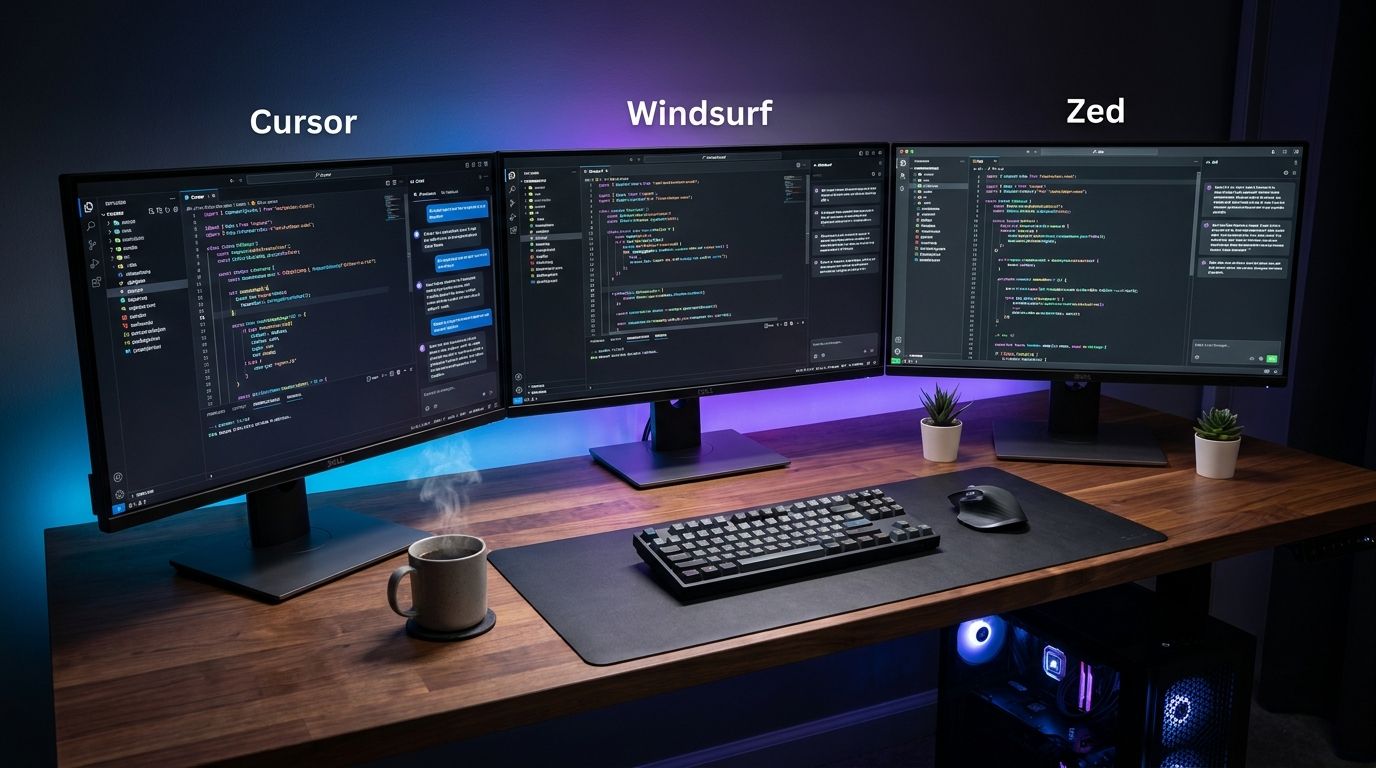
The three editors compared here — Cursor 0.50, Windsurf Wave 3, and Zed 0.160 — represent the current leading options outside of GitHub Copilot (which runs inside VS Code or JetBrains rather than being a standalone editor). Each has made substantial product changes in 2025-2026 that make earlier comparisons obsolete.
Test Setup and Methodology
Testing was conducted over six weeks across three different production codebases: a TypeScript/React frontend with a large legacy component tree (~180,000 lines), a Python FastAPI backend with complex async patterns and an existing test suite, and a Go microservice with tight latency requirements and extensive use of channels and goroutines. No synthetic benchmarks were used — only tasks that developers actually needed to complete.
Tasks included: refactoring a 2,000-line React component into smaller composable units, adding pagination to 14 existing API endpoints while maintaining backward compatibility, writing and debugging concurrent Go code, and diagnosing a subtle memory leak in a Python data pipeline.
Cursor 0.50: Still the Most Capable, With Trade-offs
Cursor's standout feature in version 0.50 is its upgraded codebase indexing — it now indexes up to 500,000 lines with context-aware chunking that understands import graphs rather than treating files as isolated documents. This showed up clearly in the React refactoring task: when asked to extract a custom hook from a 400-line component, Cursor correctly identified all three downstream consumers of that component and flagged the prop interface changes they would need, without being prompted.
The new Background Agent mode — where Cursor runs multi-step tasks asynchronously while you continue working — is genuinely useful for tasks like adding error handling to all API calls in a service across dozens of files. In testing it completed an 18-file sweep in about 4 minutes with 94% correct modifications and 3 cases where it added redundant error catching. That is not perfect, but it is good enough to use as a first pass.
Trade-offs: Cursor's pricing moved to $40/month for the Pro tier in March 2026, a $20 increase. The business tier at $60/month adds admin controls and audit logs. At those prices, the value proposition depends entirely on whether the productivity gains are real for your team's specific work. For complex TypeScript or Python codebases with lots of cross-file dependencies, the answer is probably yes. For simpler, more isolated codebases, the ROI is less clear.
The editor itself is still a VS Code fork and inherits all of VS Code's extension ecosystem — a significant practical advantage. If your team already uses a dozen VS Code extensions, switching to Cursor requires no workflow change.
Windsurf Wave 3: The Best Model Integration
Windsurf (built by Codeium) launched Wave 3 in February 2026 with a major change: it switched its default model from a proprietary Codeium model to a routing system that selects between Claude Sonnet 4.6, GPT-4.5, and their own Cascade model based on the type of task. This turns out to matter more than expected.
In the Go concurrent code tasks, Windsurf consistently routed to Claude for the channel-heavy goroutine code and produced output that was more idiomatically correct than either Cursor or Zed in the same tasks. The model routing correctly identified when to use Claude for Go concurrency patterns, and the results were noticeably better.
The Cascade feature — Windsurf's name for its agent that reads terminal output and iterates on code based on errors — worked well in the FastAPI test. After generating a pagination implementation that failed three tests, it read the pytest output, identified that it was treating page numbers as 1-indexed in one place and 0-indexed in another, and fixed all instances in one pass. That multi-step loop of generate, run, observe, and fix is what AI editors are supposed to do, and Windsurf does it more reliably than the competition in testing.
Pricing: $15/month for Pro (includes 500 Cascade credits), $35/month for Teams. Significantly cheaper than Cursor for comparable capability on many tasks.
Zed 0.160: Fast, Opinionated, and Not for Everyone
Zed is not a VS Code fork. It is a ground-up rewrite in Rust, and the performance difference is real — cold startup is under 200ms on M3 hardware, and large file operations are noticeably faster. For developers who spend time in very large files, Zed's editor feels faster in a way that Cursor and Windsurf do not.
Zed 0.160 added its Agentic mode in January 2026, which integrates Claude directly into the editor. The integration is clean and the context window management is intelligent — Zed truncates irrelevant context more aggressively than Cursor, which sometimes means less accurate suggestions on cross-file tasks but faster responses on single-file work.
The hard limitation: Zed's extension ecosystem is much smaller than VS Code's. As of May 2026, it has around 340 extensions versus VS Code's 57,000+. If you rely on specific language servers, linters, or team-specific tooling that only exists as a VS Code extension, Zed is not viable for you today. Zed is also macOS and Linux only — no Windows support is on the roadmap.
For individual developers on Mac who work primarily in one or two languages with good Zed support (Rust, TypeScript, Go, and Python all have strong LSP support), Zed at $10/month is a legitimate choice. For teams with mixed OS or complex tooling requirements, it is not the right pick in 2026.
The Honest Bottom Line
These are not interchangeable tools at different price points. They make different trade-offs:
- Cursor 0.50: Best for teams with complex, large cross-file TypeScript or Python codebases who are already in VS Code and want the smoothest upgrade path. The price increase is hard to justify unless the codebase complexity is real.
- Windsurf Wave 3: Best value for teams where multi-step agent behavior — run, observe, fix loops — matters more than raw suggestion quality. The model routing is a genuine differentiator. At $15/month it is the easiest recommendation.
- Zed 0.160: Best for individual developers on Mac who prioritize raw editor speed and work in well-supported languages. Not viable for Windows users or teams with complex tooling stacks.
None of them eliminate the need to actually understand the code they generate. That remains the most important skill. The AI editors that help the most are the ones used by developers who review, test, and understand the output — not those who treat acceptance of suggestions as the end of the workflow.