Digital Twins Are Leaving the Factory — Cities and Hospitals Are Building Their Own
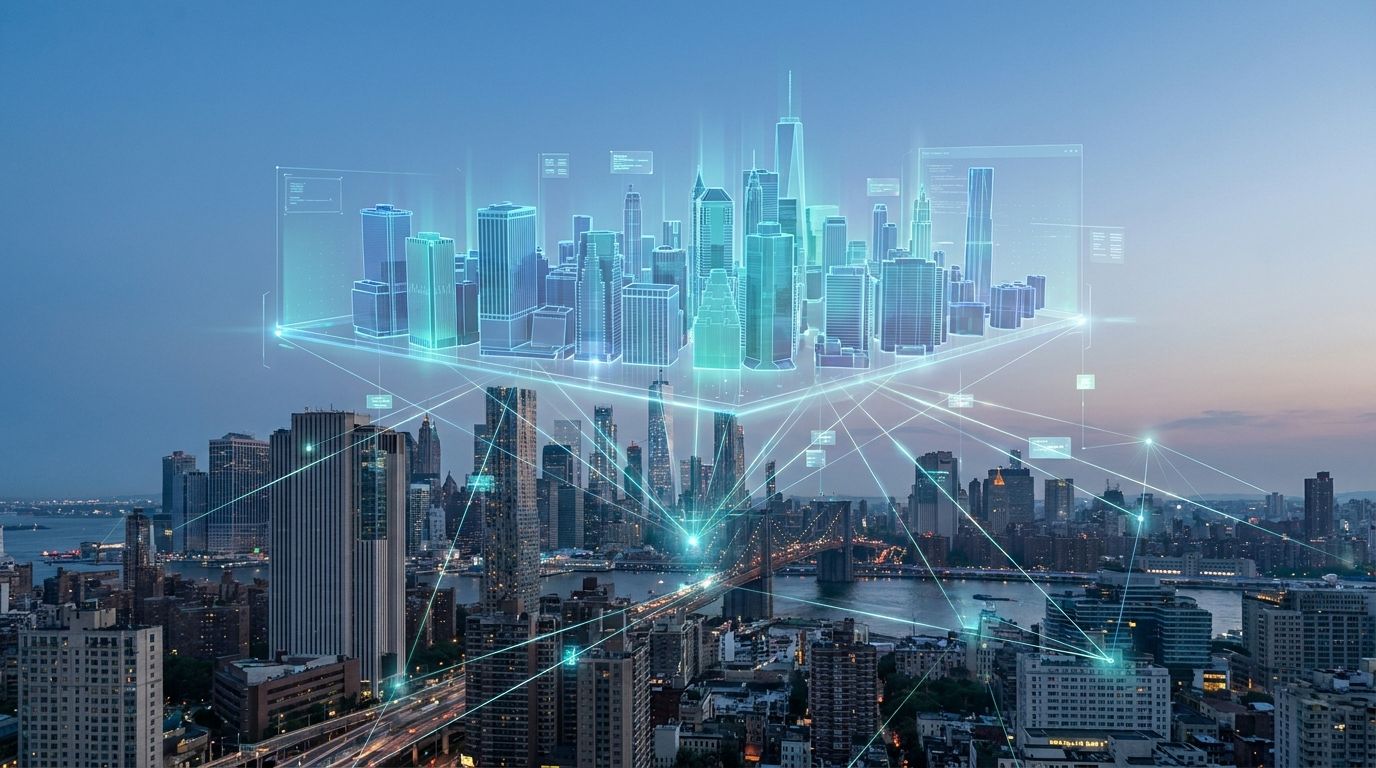
The concept of a digital twin started in aerospace: create a virtual replica of a physical object that updates in real time from sensor data, and use it to simulate stress, predict failures, and optimize performance before touching the real thing. For decades, digital twins were expensive, specialized, and confined to industrial contexts where the simulation ROI justified the engineering investment.
That constraint is dissolving. The combination of cheaper IoT sensors, cloud compute, real-time data pipelines, and increasingly capable simulation software has pushed digital twin technology into new domains: entire cities, hospital campuses, electrical grids, and logistics networks.
Singapore's City-Scale Experiment
The most ambitious public deployment is Singapore's Virtual Singapore platform — a 3D digital replica of the entire city-state, integrating building footprints, terrain, infrastructure data, weather, traffic, and sensor readings across its IoT network. Virtual Singapore is used for solar potential analysis, flood risk modeling, emergency response planning, and telecommunications network planning. The platform has inspired programs in Helsinki, Rotterdam, Boston, and Tokyo, and the European Commission's Destination Earth initiative is building a planetary-scale climate and disaster response twin.
Hospitals Are Building Operational Twins
Healthcare is an unexpected growth area, driven by the operational complexity of modern hospitals. Johns Hopkins Hospital's command center, operational since 2016, integrates real-time data from across the hospital to forecast bed demand, flag ED bottlenecks, and coordinate discharge planning 24-48 hours in advance. More recently, facility physical twins are emerging — 3D models of hospital buildings integrated with HVAC, sterilization equipment, and foot traffic sensors for renovation simulation and infection transmission modeling.
The Interoperability Problem
Digital twins face fragmentation: every platform vendor — Bentley's iTwin, Autodesk Tandem, Siemens' Xcelerator — has proprietary data models and APIs. The OGC and buildingSMART International are pushing CityGML and IFC formats as standards, and the Digital Twin Consortium is developing a reference architecture. But actual interoperability in production remains limited, which matters most for cross-boundary use cases like a hospital twin integrating with city emergency services infrastructure.
AI Changes the Economics
AI is automating substantial parts of the digital twin pipeline. Computer vision models extract 3D structure from camera footage and LiDAR scans with minimal manual intervention. LLMs trained on operational data can generate initial simulation rules from natural language descriptions of system behavior. The result: building a useful digital twin for a mid-sized campus — which would have required a six-figure custom engagement five years ago — can now be initiated with off-the-shelf platforms at a fraction of the cost.
The next frontier is bidirectional twins — systems where the digital model doesn't just observe the physical world but actively controls it. Autonomous building management, where the twin adjusts HVAC, lighting, and access control in real time based on predicted occupancy and energy prices, is already operating in leading-edge commercial buildings. The factory-floor origins of digital twins are becoming a distant starting point for a technology increasingly woven into the infrastructure of everything.