Drone Delivery Has Moved From Demo to Daily Operations. Here's Where It Actually Works.
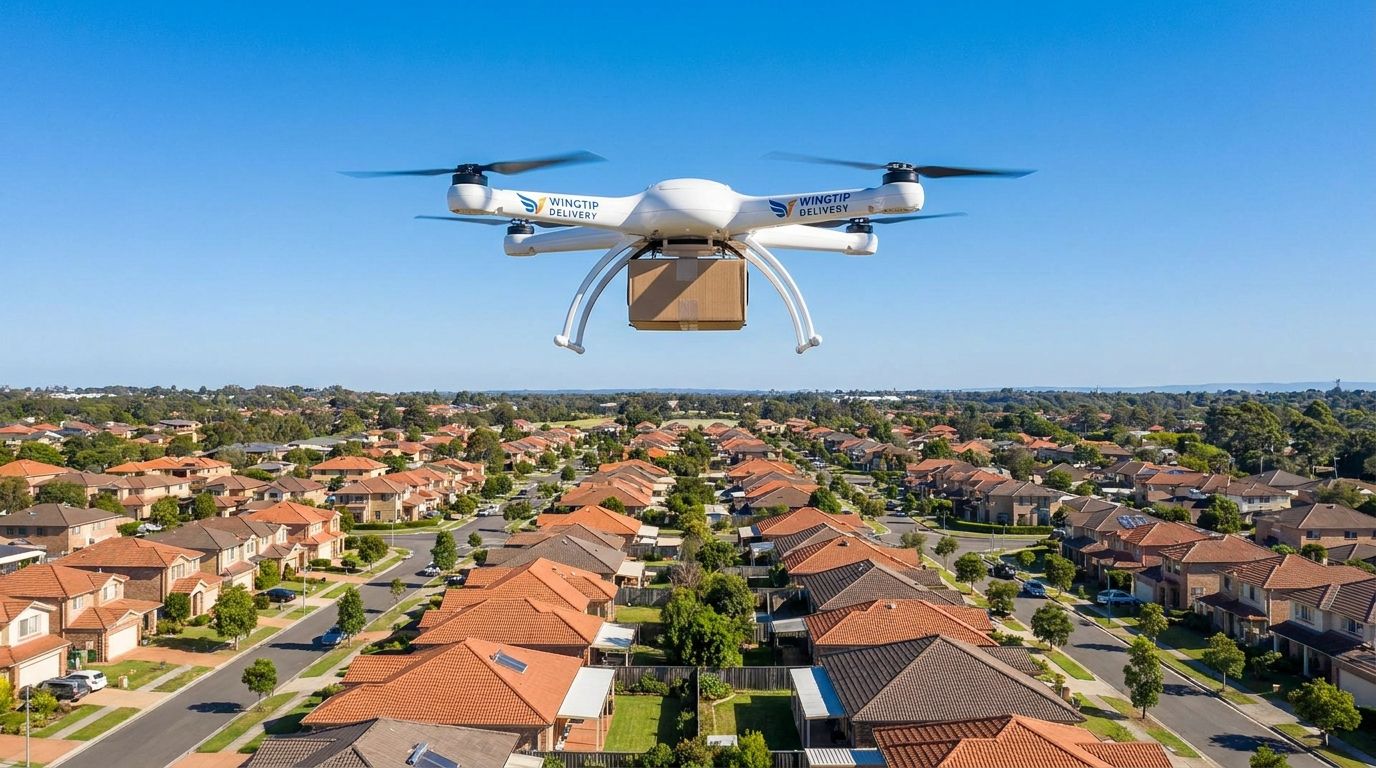
The first credible drone delivery demonstrations happened around 2013. Amazon revealed its Prime Air concept in December 2013. Google X's Project Wing flew its first test delivery in 2014. Twelve years later, drone delivery is routine commercial infrastructure in parts of Australia, the United States, Rwanda, and Ghana.
Wing, Alphabet's drone delivery company, has completed over 400,000 commercial deliveries globally. Its operations in Christiansburg, Virginia, and Frisco, Texas are fully commercial. Zipline, which started with blood and medical supply delivery to remote clinics in Rwanda in 2016, now operates in several countries and has expanded into on-demand consumer delivery in the United States. Amazon Prime Air has received FAA type certification and operates in College Station, Texas and Tolleson, Arizona. The demo phase of drone delivery is over.
The Companies and Their Approaches
Wing uses a fixed-wing aircraft with vertical takeoff and landing capability. Deliveries are made by hovering at altitude and lowering a package on a tether, avoiding the need to land. This is faster and mechanically simpler than landing, but requires the delivery area to be clear of overhead obstacles. Wing's footprint is built around suburban single-family neighborhoods that meet this criterion.
Zipline's Platform 2 drone uses a fixed-wing carrier that launches from a centralized dock, flies to the delivery location, and releases a smaller package delivery unit that descends on a rope. The same carrier drone makes multiple deliveries in sequence. Zipline claims 3-8 minute delivery times from nearby docks.
Amazon Prime Air uses a hexagonal aircraft with six rotors that can take off and land vertically. It carries packages up to 5 pounds and drops them in the customer's yard. The system is tightly integrated with Amazon's logistics: the drone dock co-locates with a delivery station stocked with fast-moving products.
Where It Works and Why
The geography of successful drone delivery reveals what conditions the technology requires: suburban single-family housing with open yards, flat terrain, moderate weather, and proximity within 10-15 kilometers to a fulfillment node. Dense urban areas remain impractical for most current drone delivery approaches. Rural areas are technically flyable but economically thin.
The use case that established commercial viability earliest was medical logistics. Zipline's Rwanda operations demonstrated that drones could perform life-critical missions reliably. The medical payload case tolerates higher per-delivery costs: a blood transfusion delivered in 30 minutes versus 3 hours has quantifiable value. Consumer retail delivery economics are harder. The cost per drone delivery is currently higher than van delivery for comparable distances.
The FAA Regulatory Picture
The FAA's Part 135 certification has been granted to Wing, Zipline, and Amazon Prime Air. The most important current constraint is BVLOS — Beyond Visual Line of Sight — operations, which require pilots to maintain visual contact with the aircraft. FAA has been granting BVLOS waivers selectively to operators with strong safety records. The FAA's Part 108 BVLOS rulemaking, expected to be finalized in 2025-2026, would establish a general framework rather than requiring individual waivers. When it clears, the ceiling on expansion lifts significantly.
What the Next Five Years Look Like
Operators with commercial approvals — Wing, Zipline, Amazon — will expand coverage methodically, adding zones that meet their operational requirements. Medical and pharmaceutical delivery will expand significantly. Consumer retail drone delivery will likely remain confined to suburban areas in a growing list of markets rather than achieving urban dominance in the next five years. The density economics require thousands of deliveries per flight hour to reach cost parity with ground vehicles.
The category is real, growing, and past the demo phase. It is not going to replace last-mile logistics in the next decade. For specific use cases — urgent medical supplies, fast-moving consumer goods in drone-friendly geographies, low-weight high-value items — it is already the best delivery option available. That is a narrower outcome than the promotional materials suggested in 2013, and a more durable one.