Fine-tuning vs. RAG: Which Approach Actually Works for Enterprise AI in 2026
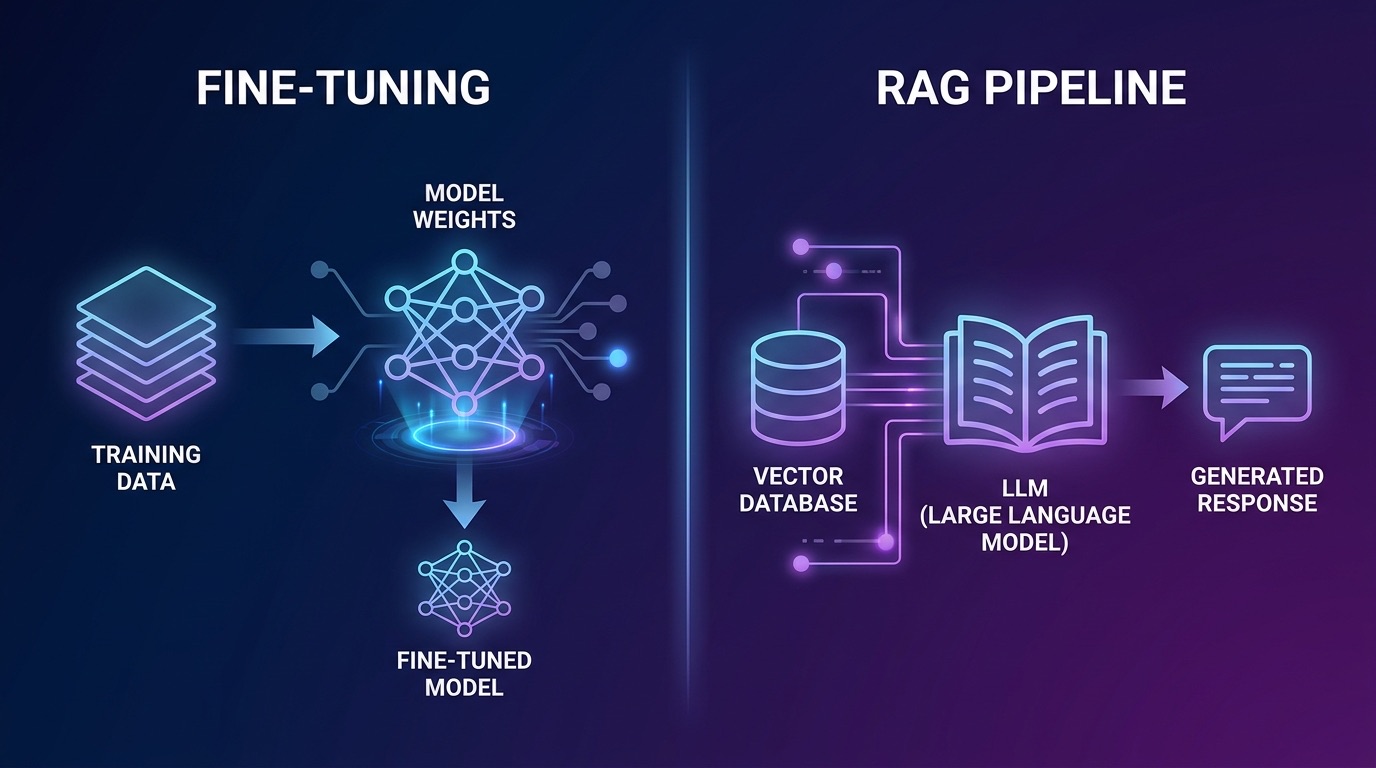
RAG Wins Most Enterprise Battles — But Fine-tuning Still Has a Role
For the vast majority of enterprise AI use cases in 2026, Retrieval-Augmented Generation (RAG) delivers better ROI than fine-tuning a base model. That's not a vendor pitch — it's the conclusion you reach when you look at total cost of ownership, update latency, and accuracy benchmarks across real deployments. Fine-tuning remains the right call in a narrow but important set of scenarios: highly specialized domain adaptation, latency-constrained edge inference, and style/format consistency tasks where no external retrieval is acceptable.
This post breaks down exactly why, with numbers. If you're an AI engineer deciding between the two approaches for an internal knowledge base, a customer-facing copilot, or a domain-specific classifier, here's the framework that will save you months of expensive iteration.
What Each Approach Actually Does (Beyond the Basics)
You know the textbook definitions. What matters in practice is understanding the failure modes of each.
Fine-tuning in Production
Fine-tuning adjusts model weights using a curated dataset of (prompt, completion) pairs. The result is a model that has absorbed patterns, terminology, and behavior from your training data into its parameters. The classic enterprise pitch: one fine-tuned model, no retrieval overhead, fast inference.
The hidden costs: A fine-tuning run on a 7B parameter model using QLoRA on a single A100 80GB takes 4–12 hours and costs roughly $40–$120 on cloud GPU pricing as of Q1 2026. For a 70B model, multiply by 8–10x. That's just the first run. Every time your knowledge base changes — a product update, a policy revision, a new regulation — you either retrain or accept stale model behavior. Most enterprise knowledge domains change weekly or daily.
Accuracy degradation is the other trap. A fine-tuned model can confidently hallucinate information from its training distribution that is now outdated. Morgan Stanley's internal analysis of their AI assistant pilot (disclosed in a 2025 earnings call) found that fine-tuned models on financial data required full retraining every 6–8 weeks to maintain acceptable accuracy on current market conditions, costing over $200K per quarter in GPU compute alone.
RAG in Production
A RAG pipeline retrieves relevant document chunks from a vector store at inference time and injects them into the model's context window. The model reasons over retrieved evidence rather than relying solely on trained weights.
The key advantages are freshness and auditability. When your knowledge base changes, you update the vector index — an operation that takes minutes for incremental updates and hours for full re-indexing. No model retraining required. You also get source attribution: every answer can cite the exact document chunk it was grounded in, which matters enormously for regulated industries.
The real failure modes: retrieval quality is the bottleneck. A naive cosine similarity search over embeddings retrieves approximately the right content but misses nuanced multi-hop reasoning chains. Production RAG systems at companies like Salesforce and ServiceNow have moved to hybrid retrieval (dense + sparse BM25) plus re-ranking with a cross-encoder, adding ~80–120ms of latency per query but improving answer accuracy by 15–25% on internal benchmarks.
Head-to-Head: Cost, Latency, Accuracy
Total Cost of Ownership (Annual, Mid-Scale Enterprise)
Assume 10 million queries/year, a 50,000-document knowledge base updated weekly, and a GPT-4o-class model.
- Fine-tuning approach: Initial fine-tune ($800–$2,000) + weekly retraining ($400–$1,200/week) + inference on fine-tuned model hosting ($3,000–$6,000/month) = $85,000–$140,000/year
- RAG approach: Vector database hosting (Pinecone, Weaviate, or pgvector on RDS) ($200–$800/month) + embedding generation for weekly updates ($50–$200/month) + base model inference ($4,000–$8,000/month) = $52,000–$108,000/year
RAG comes out 20–40% cheaper at this scale. The gap widens dramatically when knowledge update frequency increases.
Latency
- Fine-tuned model (no retrieval): 200–400ms p95 for a 500-token response on a dedicated GPU endpoint
- RAG pipeline (embedding + vector search + LLM): 400–900ms p95 depending on retrieval complexity and reranking
- Fine-tuned model + RAG (hybrid): 500–1,100ms p95
Fine-tuning wins on raw latency by 200–500ms. For most enterprise applications — internal copilots, documentation search, customer support — this difference is imperceptible to users. It matters for real-time applications like voice interfaces (where less than 500ms is a hard requirement) or trading systems where milliseconds have direct dollar value.
Accuracy on Knowledge-Intensive Tasks
On the FRAMES benchmark (a multi-document QA evaluation suite that became the de facto standard for RAG evaluation in 2025), a well-tuned RAG pipeline using GPT-4o achieved 72–78% accuracy on enterprise-style multi-hop questions. A fine-tuned GPT-4o on the same domain scored 61–67% — lower, because the fine-tuned model was answering from memorized patterns rather than retrieved evidence, and the test set included questions about information that changed after the training cutoff.
For classification and extraction tasks with fixed schemas, fine-tuning wins: a fine-tuned Llama 3.1 8B model for structured data extraction achieved 94% field-level accuracy versus 87% for a prompted GPT-4o with RAG context, at 1/8th the inference cost.
When Fine-tuning Is Actually the Right Call
There are four scenarios where fine-tuning outperforms RAG and the trade-offs are justified:
1. Specialized Domain Vocabulary and Reasoning
Medical imaging report generation, legal contract clause classification, chip design verification — domains where the terminology, reasoning patterns, and output formats are so specialized that a base model requires hundreds of tokens of in-context explanation on every query. Fine-tuning amortizes that context cost across all inferences. Hippocratic AI's clinical summarization model and Harvey AI's contract analysis system both rely on fine-tuning precisely because their domains require reasoning patterns that cannot be reliably elicited through prompting alone.
2. Strict Latency Requirements (under 300ms)
Voice interfaces, real-time coding assistants integrated into IDEs (like Cursor's autocomplete), and on-device edge AI where retrieval infrastructure is unavailable. A fine-tuned 3B–7B model running locally is the only viable architecture when you need sub-300ms response with no network round-trip.
3. Consistent Output Format and Style
If your application generates outputs in a highly specific format — structured JSON with a proprietary schema, a brand's exact writing style, a specific programming language idiom — fine-tuning locks in that format more reliably than prompt engineering. Copilot-style code completion tools from GitHub and JetBrains use fine-tuning for this reason.
4. Data Cannot Leave Your Environment
Some enterprises cannot send documents to an external vector DB or LLM API due to data sovereignty regulations (EU AI Act Article 28 data processing requirements, HIPAA, FedRAMP). A fully on-premise fine-tuned model with no retrieval dependency is architecturally simpler than an on-premise RAG stack, though the latter is increasingly viable with self-hosted Weaviate or Qdrant clusters.
When RAG Is the Right Call (Most of the Time)
RAG is the correct default for enterprise deployments when:
- Your knowledge base changes more frequently than quarterly
- You need source attribution for compliance or user trust
- Your query distribution is broad (questions span many topics, not a narrow domain)
- You are working with a knowledge base larger than 10,000 documents, where fine-tuning memorization becomes unreliable
- You want to A/B test model upgrades without retraining pipelines
Atlassian's Rovo AI assistant, Notion AI, and Intercom's Fin product all use RAG-first architectures. The common thread: their knowledge bases (Confluence pages, Notion documents, customer support tickets) change continuously, and freshness is non-negotiable.
The Hybrid Architecture: Where Production Is Heading
The most capable enterprise AI systems in 2026 use fine-tuning and RAG together, but in a specific way. The base LLM is fine-tuned on task format and reasoning style — not on factual knowledge. The factual knowledge lives entirely in the retrieval layer. This separation of concerns is sometimes called "format fine-tuning + knowledge RAG."
Cohere's enterprise Command R+ model is built on this principle: the model was instruction-tuned for RAG-specific reasoning (citation grounding, evidence synthesis, multi-hop chain-of-thought) rather than domain facts. Customers plug in their own knowledge bases. The result: better retrieval utilization than a generic base model, without the retraining burden of knowledge fine-tuning.
Decision Framework: A Practical Flowchart
Answer these questions in order:
- Does your knowledge base change more than once a quarter? Yes → RAG. No → continue.
- Do you need source attribution or audit trails? Yes → RAG. No → continue.
- Is p95 latency a hard requirement under 300ms? Yes → Fine-tuning. No → continue.
- Is your domain so specialized that a base model requires 500+ token system prompts to behave correctly? Yes → Fine-tuning (or hybrid). No → RAG.
- Do data sovereignty rules prevent external API calls? Yes → evaluate on-premise RAG vs. fine-tuned local model based on infra complexity. No → RAG.
Actionable Takeaways
- Start with RAG. The infrastructure investment is lower, iteration is faster, and you can always add fine-tuning later for specific components. The reverse — unwinding a fine-tuning investment — is expensive.
- If you do fine-tune, fine-tune for behavior, not facts. Train on reasoning patterns, output format, and task structure. Keep facts in the retrieval layer.
- Invest in retrieval quality before scaling. Hybrid BM25 + dense retrieval with a cross-encoder reranker is no longer optional for production; it's the baseline. Cheap cosine similarity RAG will underperform a well-prompted base model.
- Measure freshness separately from accuracy. A model can score well on a static benchmark while giving outdated answers in production. Build eval sets from documents added after your training cutoff.
- For edge/on-device: use quantized fine-tuned models (GGUF Q4_K_M on llama.cpp) — RAG is impractical without reliable network access.