Foldable Phones Have Grown Up. The Question Now Is Whether Enough Buyers Notice.
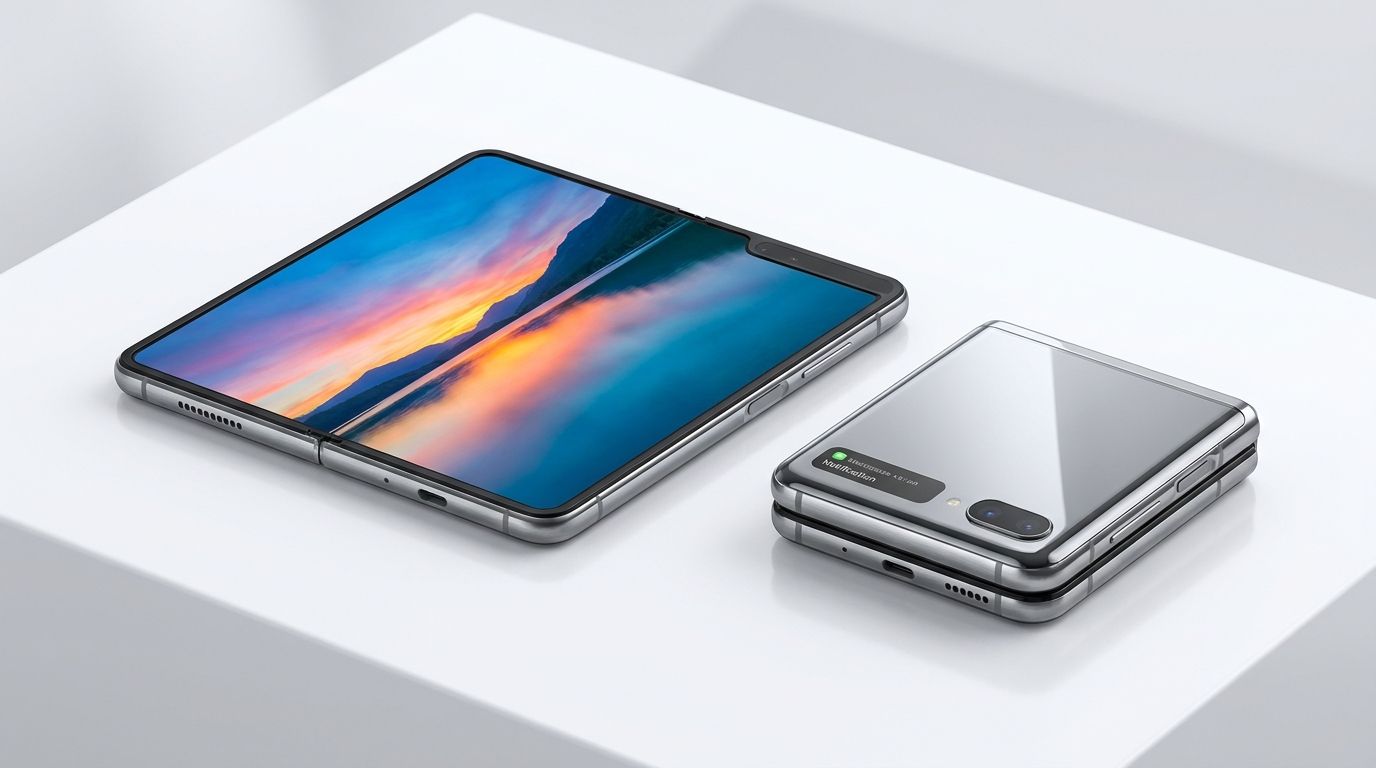
The first Samsung Galaxy Z Fold launched in 2019 with a crease you could feel, a hinge that failed in durability tests, and a $1,980 price tag. It was a proof of concept with a phone attached. By 2026, the category has matured into something genuinely useful — better hinges, near-invisible creases, water resistance, and prices that have fallen (somewhat). What has not followed is mass-market adoption.
Global foldable phone shipments reached approximately 25 million units in 2025, according to IDC estimates — up from 18 million in 2024. That sounds like growth, but it represents roughly 1.5-2% of total smartphone shipments. Foldables remain a premium niche, priced at $900-1,800 and competing primarily for the attention of enthusiasts and business users with specific use cases. Understanding why — after three generations of hardware improvement — requires looking at what actually changed and what has not.
What Three Generations Fixed
The original Galaxy Z Fold had a crease visible from across a room. The Z Fold 6 (2024) reduced the crease to something you would only notice in direct light at certain angles — perceptible but no longer a constant distraction. The primary mechanism was improving the hinge geometry, which allows the display to form a slight loop when folded rather than creasing sharply at a single point.
Durability was the early category's Achilles heel. Samsung now rates the Z Fold 6 hinge for 200,000 fold cycles — roughly 100 folds per day for five years. Water resistance reached IPX8 on the Z Fold 5, meaning submersion to 1.5 meters for 30 minutes. Gorilla Glass Victus 2 on the outer display and Samsung's proprietary Ultra Thin Glass (UTG) on the inner display reduced scratch susceptibility significantly.
The software ecosystem caught up too. Both Android and Samsung One UI now handle split-screen multitasking in ways that feel purposeful. Taskbar access, drag-and-drop between apps, and the ability to open three apps simultaneously make the larger interior screen functionally distinct from a standard phone display.
The Form Factor Split
The foldable market has settled into two clearly distinct form factors with different value propositions.
Book-style foldables — Galaxy Z Fold, Google Pixel Fold, OnePlus Open — fold outward to reveal a tablet-sized interior display, typically 7.2-7.9 inches. These are productivity devices: consuming long-form content, multitasking with multiple windows, video calls, and document review. They are thick and heavy compared to conventional phones — the Z Fold 6 is 239 grams and 12.1mm thick when folded, versus 174 grams and 7.7mm for the Galaxy S24 Ultra.
Flip-style foldables — Galaxy Z Flip, Motorola Razr — fold inward to create a compact device roughly half the size of a conventional phone. The value is pocketability, not productivity. The cover screen on the Motorola Razr+ 2024 grew to 3.6 inches and became genuinely useful for checking notifications and replying to messages without unfolding.
Samsung leads with roughly 60% market share, followed by Huawei (stronger in China), Motorola, and Google. Apple's absence remains conspicuous — the company has filed numerous foldable patents and is widely expected to enter the category in 2026-2027.
The Price Problem
The Galaxy Z Fold 6 launched at $1,899 in the US. The Google Pixel 9 Pro Fold at $1,799. The OnePlus Open at $1,699. Even the flip-style Z Flip 6 is $1,099 — $100 more than the Galaxy S24+, which has better cameras and longer software support. The premium for the foldable form factor is approximately $300-600 over a comparable conventional flagship.
This premium exists for legitimate reasons: foldable displays cost more to manufacture, the hinge mechanism adds components and assembly complexity, and UTG yields remain lower than conventional glass. But it also caps the addressable market. At $1,800, a foldable competes with gaming PCs, tablets, and high-end laptops for discretionary spending.
Chinese manufacturers have begun addressing this. Tecno's Phantom V Fold 2 launched under $900. Xiaomi's Mix Fold 4 is priced at roughly $1,100. These demonstrate that the hardware cost can come down significantly. If foldables follow the trajectory of premium phones generally, the $600-700 foldable might arrive by 2027-2028.
Apple and the Next Inflection Point
Every category Apple enters gets a distribution moment — a point where the general consumer becomes aware that this product category exists. The original iPhone did it for smartphones. AirPods did it for true wireless earbuds. Apple Watch validated smartwatches for skeptics of Samsung's approach.
Apple entering foldables would not validate the form factor technically — Samsung and Motorola have done that. But it would signal to millions of iPhone users who have never considered a foldable that this is a legitimate product choice rather than an enthusiast experiment. Analyst estimates from Ming-Chi Kuo suggest Apple is targeting a foldable iPhone launch in 2026, most likely a clamshell design first. Production constraints on the hinge mechanism and display have reportedly pushed back timelines multiple times.
In the meantime, the Galaxy Z Fold 6, Pixel 9 Pro Fold, and OnePlus Open are excellent products that a small fraction of the smartphone market will buy. The technology is ready. The question is whether the market is waiting for the right signal, or whether it has decided that a tablet experience in a phone form factor is not worth a $600 premium. Apple's move will answer that question more definitively than any benchmark or durability test.