GLP-1 Drugs Are Treating Heart Disease, Kidney Failure, and Liver Disease — Weight Loss Was Just the Beginning
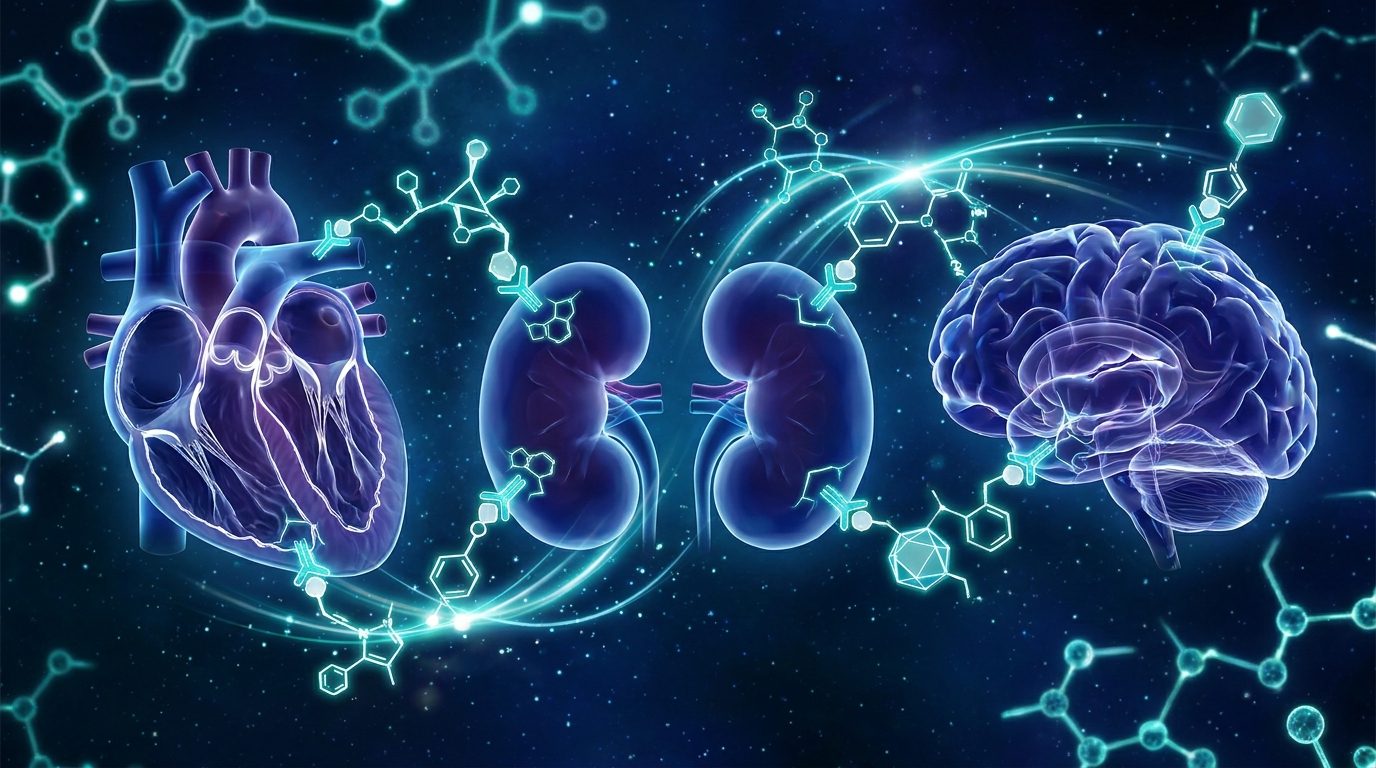
GLP-1 receptor agonists — the drug class that includes semaglutide (Ozempic, Wegovy) and tirzepatide (Mounjaro, Zepbound) — were approved for type 2 diabetes management in the early 2010s. Their obesity applications came later and generated enormous commercial attention. But the most consequential chapter of the GLP-1 story may have nothing to do with body weight at all. A mounting body of clinical evidence now shows these drugs are modifying disease outcomes across cardiovascular disease, chronic kidney disease, metabolic dysfunction-associated steatohepatitis (MASH), and potentially neurodegeneration — through mechanisms that researchers are still mapping.
The commercial narrative around GLP-1s has been dominated by weight loss, which is understandable given that Novo Nordisk's Wegovy generated approximately $6.7 billion in revenue in 2024 alone. But trial data published since 2023 strongly suggests that the weight-independent effects of these drugs may ultimately prove more clinically significant than the number on a scale — and are reshaping how cardiologists, nephrologists, and neurologists think about metabolic disease as a systemic condition.
Cardiovascular Disease: SELECT and Beyond
The SELECT trial, published in the New England Journal of Medicine in November 2023, enrolled 17,604 overweight or obese adults with established cardiovascular disease but without diabetes. Participants received weekly 2.4mg semaglutide injections or placebo. The primary endpoint — major adverse cardiovascular events (MACE: heart attack, stroke, or cardiovascular death) — fell by 20% in the semaglutide arm over a median follow-up of 33.3 months. Crucially, this benefit appeared regardless of baseline body weight and was observed even among patients who lost minimal weight during the trial.
This dissociation between weight loss and cardiovascular benefit has prompted serious mechanistic inquiry. Working hypotheses include direct anti-inflammatory effects via GLP-1 receptors expressed on macrophages and endothelial cells, reductions in visceral adipose tissue independent of subcutaneous fat loss, improved endothelial function through nitric oxide pathways, and reduced platelet aggregation. A 2024 paper in Nature Cardiovascular Research by Hess et al. demonstrated GLP-1 receptor activation directly reduces foam cell formation in atherosclerotic plaques in murine models — an effect not attributable to caloric restriction. None of these mechanisms is fully characterized yet, but the clinical signal is unambiguous.
Kidney Protection: The FLOW Trial
In March 2024, the FLOW trial — a dedicated kidney outcomes study enrolling 3,533 patients with type 2 diabetes and chronic kidney disease — was stopped early by its independent data monitoring committee because the benefit of semaglutide was so clear that continuing the placebo arm was considered unethical. Published results showed a 24% reduction in the composite kidney endpoint (sustained decline in kidney function, kidney failure, or kidney-related death) and a 29% reduction in kidney failure specifically.
The FLOW results are particularly striking because previous kidney-protective drugs — primarily SGLT2 inhibitors like empagliflozin — achieved roughly 30-40% risk reduction in similar patient populations. The emerging view from nephrologists is that the two drug classes may be complementary rather than competing, addressing different pathways in kidney disease progression. SGLT2 inhibitors primarily reduce intraglomerular pressure through hemodynamic effects; GLP-1 agonists appear to reduce inflammation and oxidative stress in tubular cells. A 2024 meta-analysis in JAMA Internal Medicine analyzing 13 trials found that GLP-1 agonists reduced albuminuria — an early marker of kidney damage — by approximately 17% on average.
Liver Disease: MASH Becomes Treatable
Metabolic dysfunction-associated steatohepatitis (MASH, formerly NASH) has historically been one of medicine's most frustrating therapeutic deserts — a disease affecting an estimated 38 million Americans with no approved treatment for most of the past decade. That changed in March 2024 when the FDA approved resmetirom (Rezdiffra), a thyroid hormone receptor agonist, as the first drug specifically for MASH with liver fibrosis. But GLP-1 agonists are following close behind with compelling data of their own.
The ESSENCE trial, presented at the European Association for the Study of the Liver (EASL) meeting in June 2024, evaluated semaglutide 2.4mg in patients with biopsy-confirmed MASH and liver fibrosis. At 72 weeks, 62.9% of patients in the semaglutide group achieved MASH resolution without worsening fibrosis, compared with 34.3% in the placebo group. Fibrosis improvement of at least one stage occurred in 36.8% versus 22.4%. These are clinically meaningful results that could prevent liver transplants for a substantial patient population.
Neurodegeneration: Early Signal, Large Implications
The most speculative — but potentially most significant — frontier for GLP-1 agonists is neurodegeneration. GLP-1 receptors are expressed in multiple brain regions including the hippocampus, substantia nigra, and cortex. Animal studies have consistently shown that GLP-1 receptor agonism reduces amyloid-beta aggregation, tau phosphorylation, and neuroinflammation in Alzheimer's models, and protects dopaminergic neurons in Parkinson's models.
Human evidence is beginning to emerge. A 2024 observational study published in JAMA Neurology analyzed medical records of 1.5 million patients and found that GLP-1 agonist users had a 40-70% lower incidence of Alzheimer's disease, Parkinson's disease, and other neurodegenerative conditions compared to matched controls on other diabetes medications — after adjusting for diabetes severity, BMI, and other confounders. The authors were careful to note that this is observational data subject to residual confounding, and randomized trials are needed. But the signal is strong enough that Novo Nordisk initiated the EVOKE trial (evaluating semaglutide in early Alzheimer's), and Eli Lilly has a parallel program with tirzepatide in the same indication.
The mechanism being studied most closely in neurodegenerative contexts is reduction of neuroinflammation via microglial modulation. GLP-1 receptors on microglia (the brain's resident immune cells) appear to downregulate inflammatory signaling cascades associated with neurodegenerative protein aggregation. Whether this translates to clinically meaningful disease modification in humans remains to be established.
What This Means for Prescribing, Access, and Drug Development
The multi-indication profile of GLP-1 agonists creates both opportunities and complications for the healthcare system. On the access side, payers who have been reluctant to cover GLP-1s for obesity — viewing weight loss as a lifestyle rather than medical benefit — may face different calculus when these drugs are positioned as cardiovascular, kidney, and liver protective agents. The SELECT trial data was influential in prompting CMS to expand Medicare coverage for semaglutide in patients with cardiovascular disease in late 2024.
For drug developers, the emerging mechanistic understanding is generating a new generation of targeted GLP-1 variants. Eli Lilly's retatrutide, a triple GIP/GLP-1/glucagon receptor agonist, showed 24.2% body weight reduction at 48 weeks in Phase 2 — exceeding current approved agents — and Phase 3 results are expected in 2025-2026. Structure Therapeutics and Jiangsu Hengrui are among the companies developing oral GLP-1 agonists with improved bioavailability profiles, addressing the major barrier of weekly injection requirements.
Actionable Takeaways
- For clinicians: The SELECT, FLOW, and ESSENCE trial results justify considering GLP-1 agonists in patients with cardiovascular disease, CKD, or MASH even without significant obesity — weight loss is no longer the primary rationale in these populations.
- For healthcare investors: The multi-indication thesis for GLP-1s extends the addressable market well beyond the estimated 650 million adults with obesity globally. Cardiometabolic, hepatic, and renal indications represent separate regulatory pathways and distinct payer relationships.
- For researchers: The mechanistic gap between clinical trial efficacy and understood biology remains large. The inflammatory, vascular, and neural effects of GLP-1 receptor agonism are active frontiers for basic science, with multiple unanswered questions about tissue-specific receptor expression and downstream signaling.
- For patients: If you are on a GLP-1 agonist for diabetes or weight management, the drug is likely doing more than you realize — but that does not mean non-approved indications are equivalent to approved ones. Discuss the full risk-benefit profile with your prescriber, including the gastrointestinal side effects that cause 10-15% of patients to discontinue.