The handheld gaming PC has matured — but crossing $1,000 changed the conversation
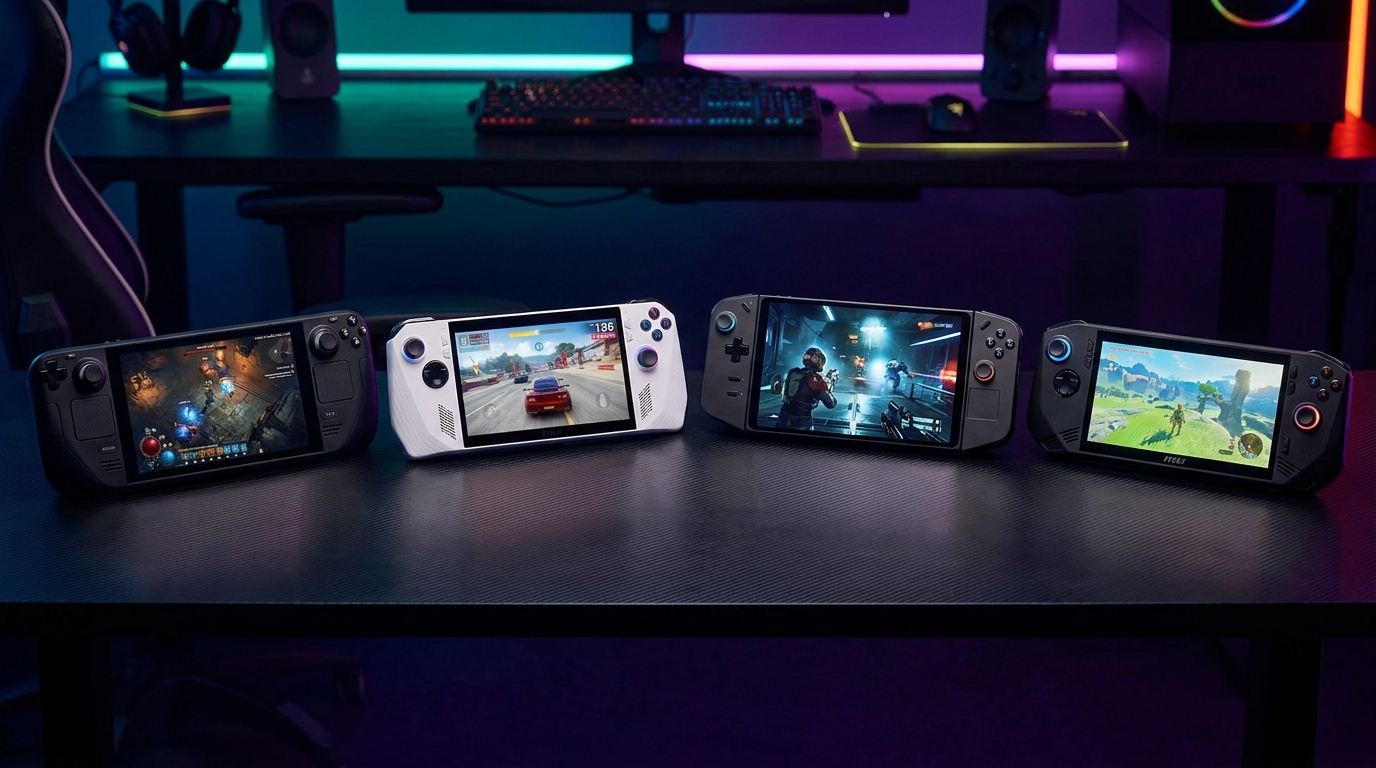
Valve's original Steam Deck launched at $399 in 2022 and made handheld PC gaming real for a mainstream audience. In 2026, that founding price point looks like a different product category. Flagship handhelds are now $1,000–$1,500, powered by processors that rival mid-range gaming laptops, running both Windows and SteamOS, and announcing themselves at Computex alongside discrete GPUs. The category has grown up — and the questions people ask about it have gotten more complicated.
Where the market sits right now
The 2026 handheld gaming PC landscape has effectively stratified into three tiers:
The value anchor: Steam Deck OLED ($549) — Valve stopped production of the LCD models in late 2025, making the OLED the only Steam Deck in current production. The hardware is dated by 2026 standards: an AMD Zen 2 APU and RDNA 2 GPU that can't match the newer AMD Z2 or Intel Arc G3 chips on paper. But SteamOS remains the best operating system ever built for handheld gaming — it's fast, stable, handles suspend-resume flawlessly, and runs the Steam library without friction. The 7.4-inch HDR OLED display with 90Hz refresh and 1,000 nits peak brightness is genuinely excellent. For anyone whose library lives on Steam and who doesn't need to run the latest AAA titles at maximum settings, the Steam Deck OLED remains the most sensible purchase in the category.
The mid-tier: Lenovo Legion Go S SteamOS ($649) — The Legion Go S running SteamOS (unveiled at CES 2026) became a breakout recommendation for buyers who want slightly newer hardware than the Steam Deck but don't want the Windows complexity of the higher-end options. Its 8-inch 1920×1200 IPS display and AMD Ryzen Z1 Extreme processor offer noticeably better performance than the Steam Deck on demanding titles, and the SteamOS experience is identical. It's the upgrade path for Steam Deck owners who've hit the hardware ceiling without jumping to Windows or paying flagship prices.
The flagships ($999–$1,500) — This is where the market is currently complex. The ROG Xbox Ally X (released October 2025, $999) pairs an AMD Ryzen AI Z2 Extreme with 24 GB of LPDDR5X-8000 RAM and runs Windows with a full-screen Xbox Experience layer on top. The Lenovo Legion Go 2 ($1,199 for the SteamOS version) offers an 8.8-inch OLED display at 144Hz with a variable refresh rate — currently the best screen in the category — plus detachable controllers that convert to a mouse-mode for FPS games. The MSI Claw 8 EX AI+, announced at Computex 2026 and priced around $1,500, puts Intel's new Arc G3 Extreme processor in a handheld for the first time, with Intel claiming a 42% performance advantage over the AMD Z2 Extreme.
Why flagships crossed $1,000 and whether it's justified
The RAM crisis — high DRAM prices driven by AI server demand — is a real factor. 24 GB and 32 GB of LPDDR5X in a handheld chassis commands component costs that weren't present two years ago. But the price increase isn't purely component cost: these are also premium devices targeting buyers who want handheld convenience alongside gaming laptop performance, and the market has demonstrated willingness to pay.
The performance gap between a $549 Steam Deck OLED and a $1,199 Legion Go 2 is real and measurable. On demanding titles at native resolution, the Z2 Extreme delivers 40–70% higher frame rates than the Steam Deck's Aerith APU. For games targeting 60 fps at high settings, that difference matters. For games that run well on the Steam Deck at medium settings, it doesn't. The premium is worth paying if your library includes demanding titles released after 2023; it's not clearly worth it if most of what you play was designed for the Steam Deck's performance envelope.
The OS question is still unresolved
SteamOS versus Windows remains the most consequential decision in handheld gaming, and the answer isn't obvious. SteamOS wins on stability, battery efficiency, and the gaming experience specifically. Windows wins on compatibility — Game Pass, Epic, GOG, emulators, and non-Steam titles all work without friction on Windows in ways that require workarounds on SteamOS.
Lenovo's decision to offer the Legion Go 2 in both SteamOS and Windows versions at the same price is telling. They're not betting on one OS winning — they're letting the buyer decide. ASUS's ROG Xbox Ally X runs Windows with an Xbox Experience overlay, which effectively turns Windows into a console-like launcher but keeps full Windows underneath for when you need it.
Valve's influence on the broader ecosystem is significant: by making SteamOS available (and free) to third-party hardware makers, they've created a situation where their operating system runs on competitors' hardware. The Lenovo Legion Go S SteamOS exists because Valve made that possible. Whether Valve benefits from this or whether it commoditizes their platform advantage in software is a longer-term question.
Intel's return to handheld and what it means
The MSI Claw 8 EX AI+ represents Intel's first serious handheld gaming processor that can compete with AMD's Z2 Extreme. Earlier Intel handheld entries (the original MSI Claw with Meteor Lake) were competitive on paper but underdelivered in practice due to driver and thermal management issues. Intel's Arc G3 Extreme is a purpose-built handheld chip with integrated Xe-core graphics, hardware ray tracing, and XeSS upscaling support. The 42% performance claim needs real-world validation, but if it holds, it breaks AMD's near-monopoly on handheld silicon.
Competition at the chip level is good for the category. AMD's Z2 Extreme has been the performance ceiling for most of 2025–2026; an Intel alternative that outperforms it would accelerate the whole market's performance trajectory and likely pressure AMD to accelerate the next Z3 generation.
Who should buy what
If your library is Steam-centric and you mostly play indie games or older titles: Steam Deck OLED at $549. Nothing in the category offers better value for that use case. If you want better performance with the same SteamOS experience and a bigger screen: Legion Go S SteamOS at $649. If you need Windows compatibility and have the budget: ROG Xbox Ally X at $999. If you want the best display available and are comfortable with the price: Legion Go 2 SteamOS at $1,199. If you want to wait for the Intel Arc G3 real-world numbers before deciding: the MSI Claw 8 EX AI+ at $1,500 is interesting but unproven.
The category is healthier and more competitive in 2026 than it's ever been. The $1,000+ flagships are genuinely impressive machines. But the Steam Deck OLED, now four years into its lifecycle with dated hardware, is still the answer for most buyers — which is the best possible endorsement of what Valve built in 2022.