How Cobots Are Bringing Automation to Small Manufacturers — and What a $35K Robot Arm Actually Does
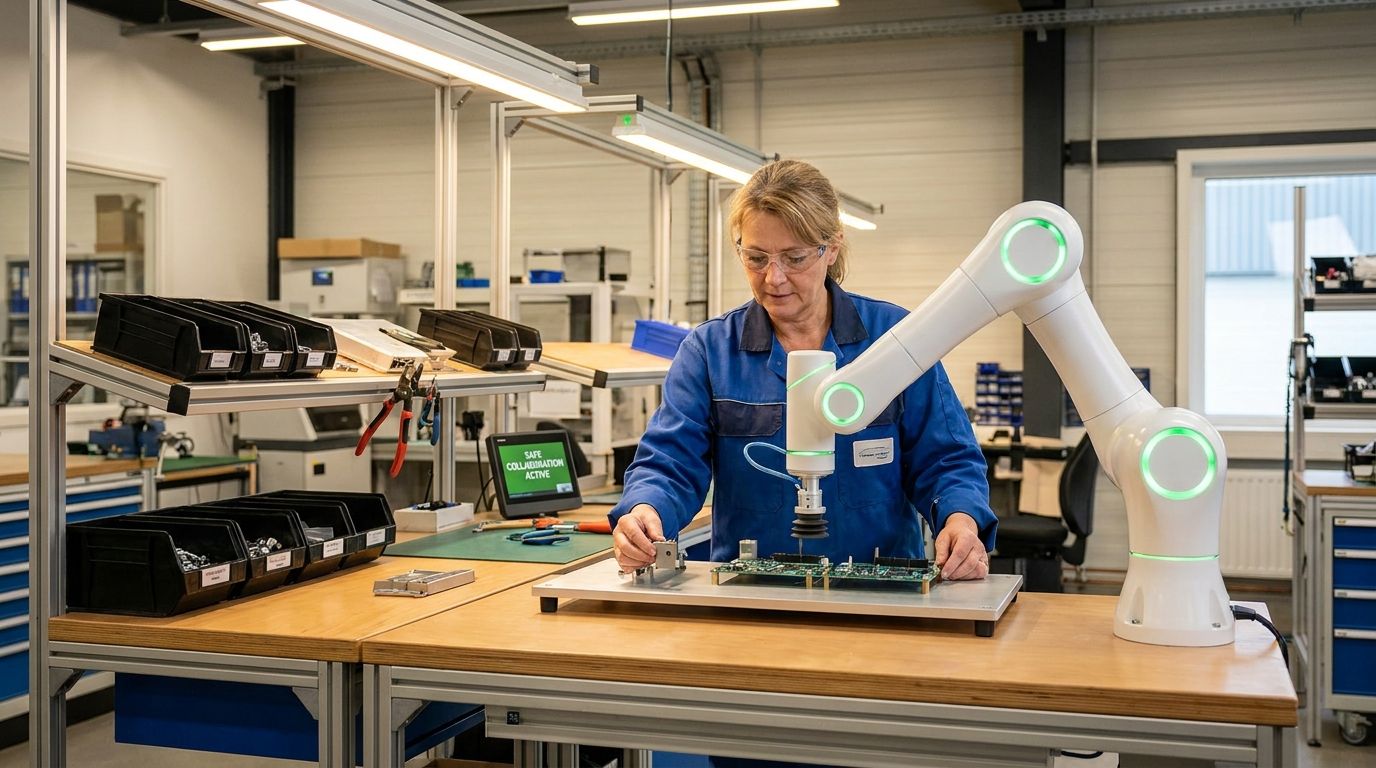
Industrial robots have been around since Unimate arrived on the General Motors assembly line in 1961. For the first fifty years of their existence, they were essentially inaccessible to any company that couldn't afford to dedicate a large, fenced-off workspace, a team of specialized integrators, and months of deployment time. The economics excluded small and medium manufacturers almost entirely.
Collaborative robots — cobots — are changing that calculus. Not by being dramatically better than traditional industrial robots at hard tasks, but by being good enough at a wide range of tasks while being physically safe, programmable without specialist expertise, and priced within reach of manufacturers that previously couldn't justify the investment.
What Makes a Cobot Different
A conventional industrial robot is designed for speed and precision in a space without humans. Its safety mechanism is separation: the robot is behind a cage or safety fence, and when a human enters the workspace, the robot stops. This is why industrial robots in car plants can operate at speeds that would be lethal if a worker got too close — the engineering assumption is that they never will.
A cobot is designed to work alongside or near humans without a physical barrier. This requires fundamentally different engineering. Cobots operate under ISO/TS 15066, the technical specification for collaborative robot safety, which defines power and force limits for safe human contact. They use a combination of torque sensors, current monitoring, and sometimes vision systems to detect unexpected contact and stop immediately. The payload and reach of most cobots are constrained not by technical limitations but by physics: a 10kg payload at 1.3m reach is the approximate range where the kinetic energy of the arm at operational speeds remains below the thresholds that cause injury on unexpected contact.
The practical consequence: a cobot can be installed in an existing production cell, next to a worker, without perimeter fencing — pending a site-specific risk assessment. Installation time for a straightforward application is measured in days, not months.
Universal Robots: The Market Maker
Universal Robots (UR), a Danish company acquired by Teradyne in 2015, effectively created the cobot market and remains its largest player. The UR product line covers payloads from 3kg (UR3e) to 30kg (UR30), reaching up to 1.3m. Pricing for the robot arm alone starts at approximately $35,000–$45,000 for the UR5e and UR10e mid-range models, with the full deployment cost including tooling, integration, and programming typically two to three times the hardware cost.
UR's competitive advantage has as much to do with ecosystem as hardware. The UR+ marketplace lists over 350 certified end-effectors, sensors, and software components from third-party vendors — grippers, vision systems, screwdrivers, force-torque sensors — that integrate directly with UR controller software. This ecosystem substantially reduces the integration burden compared to building a custom solution from scratch.
Universal Robots launched its AI Accelerator programme in 2025, adding on-robot AI inference capabilities through integration with NVIDIA Isaac ROS and certified third-party vision AI providers. The practical application: a UR arm with a vision-AI module can perform bin-picking of unsorted parts — a task that previously required either tedious teaching of specific part geometries or expensive structured part presentation — with acceptable cycle times at SME scale.
The Competitive Landscape
Fanuc, the Japanese robotics giant, entered the cobot market with its CRX series — the green-liveried collaborative robots that handle 4kg to 35kg payloads. Fanuc's CRX-10iA offers drag-and-drop tablet-based programming that requires no code, positioning it explicitly at the operator-programmer rather than the robotics engineer. ABB offers the GoFa (CRB 15000) for higher-payload collaborative work and the dual-arm YuMi for precision assembly tasks where two-hand coordination matters.
Newer entrants have pushed pricing further down. Techman Robot (TM series), a Taiwanese manufacturer, integrates a vision system directly into the arm — eliminating the need for a separate camera mount and simplifying programming for vision-guided tasks. Doosan Robotics, a South Korean manufacturer, offers its DART-Suite software platform with intuitive task-level programming designed for production workers with no robotics background. Kassow Robots, a Danish startup, produces 7-axis cobots that have an additional joint compared to standard 6-axis designs, allowing the arm to reach around obstacles more naturally.
Where Cobots Are Being Deployed
Machine tending is the single largest cobot application. A CNC lathe or milling machine that previously required a machinist to load and unload parts can be tended by a cobot during the machine's cycle, freeing the machinist to operate multiple machines or perform quality checks. The economics close quickly: a $50,000 cobot tending a machine that runs three shifts can replace the labour cost of two to three shift operators per year.
Screwdriving and assembly are the second major category — sequential assembly tasks with consistent cycle times and ergonomically stressful postures that make them natural cobot candidates. Packaging and palletising, quality inspection (with vision systems), and dispensing (adhesives, sealants, lubricants) follow.
The use cases where cobots underperform expectations are instructive: applications with high variability (parts that arrive in different orientations without a vision system), very high-speed requirements that exceed what collaborative force limits allow, and applications with frequent changeovers that exceed the setup savings that cobot programming speed provides.
Programming: From Teach Pendant to Demonstration to Language
One of the most significant changes in cobots over the past three years is programming accessibility. Traditional industrial robots are programmed in vendor-specific languages (ABB's RAPID, FANUC's Karel, KUKA's KRL) that require specialist training. Cobots introduced graphical, tablet-based programming that operators could learn in hours.
The current frontier is programming by demonstration and natural language. In demonstration mode, a human physically moves the cobot arm through a sequence of positions — the robot records the path and key waypoints. Natural language programming, available in preview from several vendors in 2025, allows a production engineer to describe a task in plain language ("pick the part from the bin, move it to the inspection station, if it passes place it in the output tray") and have the robot generate a candidate program. These capabilities don't eliminate the need for validation and tuning, but they substantially lower the technical floor for defining new applications.
The SME Economics
The typical ROI calculation for an SME cobot deployment: a machine-tending application with a $55,000 total deployment cost (arm, gripper, installation, programming) replacing a $45,000/year labour cost pays back in 14–18 months at single-shift operation, considerably faster at two or three shifts. Most cobot projects in SME manufacturing are now modelling payback periods of 12–24 months — a range that makes them fundable as capital expenditure rather than requiring a strategic rationale to justify.
The market reflects this: the global collaborative robot market was approximately $1.8 billion in 2023 and is growing at roughly 15–20% annually, driven primarily by uptake in small and medium manufacturers in Europe and Asia. A technology that was, five years ago, primarily relevant to Tier 1 automotive suppliers and pharmaceutical manufacturers is now a realistic automation option for a 50-person metal fabricator or a contract packager with six production lines.