Inside the Warehouse Robot Revolution: What's Actually Working in Automated Fulfillment
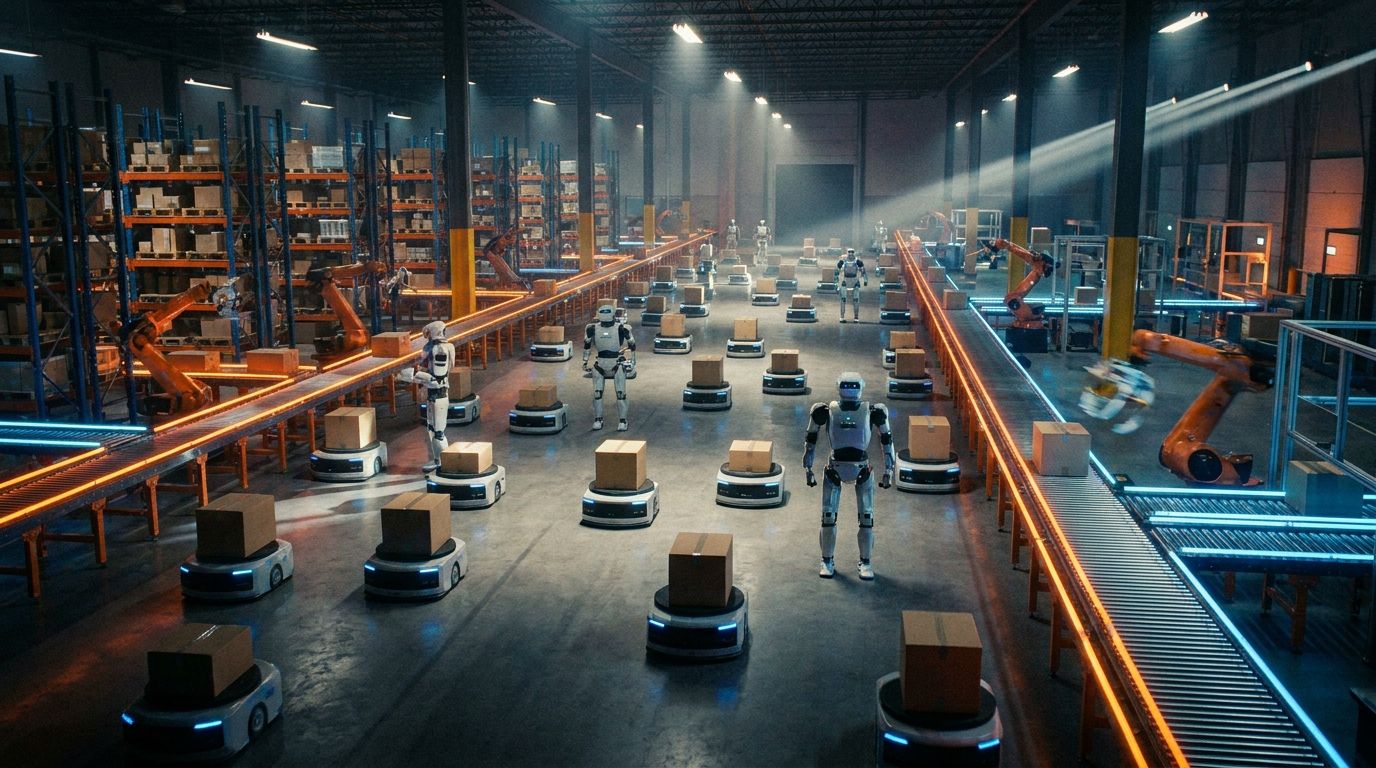
Every time you click "order now" expecting delivery by tomorrow morning, a countdown begins inside a fulfillment center the size of fourteen football fields. The math is unforgiving: millions of items in millions of configurations, ordered at all hours, needing to be picked, packed, sorted, and loaded onto trucks in hours — not days. Human hands alone can no longer keep up. The warehouse robot revolution is not a future event. It is already running three shifts.
The Scale Problem That Created the Opportunity
E-commerce has fundamentally broken the logistics model that sustained retail for a century. When next-day and same-day delivery became the competitive baseline — not a premium perk — it created a demand for speed and accuracy that traditional warehouse operations simply cannot meet at scale. US e-commerce sales now exceed $1 trillion annually. The fulfillment infrastructure required to support that volume has become one of the most capital-intensive and operationally complex systems ever built.
That pressure has turned warehouses into one of the most active proving grounds for robotics in the world. Not because the technology is ready for every task, but because the economics of not automating are becoming untenable.
Amazon Robotics: The Pioneer That Set the Standard
When Amazon acquired Kiva Systems in 2012 for $775 million and rebranded it Amazon Robotics, most of the industry thought it was a defensive move to lock up a good supplier. It turned out to be the opening move in a decade-long transformation. Today, Amazon has deployed more than 750,000 robots across its global fulfillment network — the largest civilian robotics deployment in history.
The current Amazon fleet is not a single product. It is a layered ecosystem of specialized machines:
- Proteus is Amazon's first fully autonomous floor robot, designed to move beneath GoCart material-handling carts without requiring workers to clear the area. It operates safely alongside humans — a harder problem than it sounds.
- Sequoia is a robotic storage and retrieval system that consolidates inventory placement and reduces the time to identify and store inventory by up to 75 percent. It is the backbone of Amazon's newer facility layouts.
- Sparrow is perhaps the most technically ambitious: a robotic arm that uses computer vision and AI to detect, select, and handle individual items from unstructured bins. It can recognize more than 65 percent of Amazon's product catalog. That number sounds impressive — until you think about what falls in the other 35 percent.
The Hard Problem: Picking Is Still Mostly Human
Robotic picking — grasping arbitrary objects from cluttered bins and placing them precisely — remains one of the hardest unsolved problems in applied robotics. Humans are extraordinarily good at it. We combine tactile feedback, depth perception, motor control, and rapid reasoning about object physics in ways that current robots cannot match reliably at scale.
Sparrow's 65 percent catalog coverage is a genuine engineering achievement, but it also illustrates the gap. Fresh produce, irregularly shaped items, extremely lightweight packaging, bundled multipacks — these categories routinely defeat current robotic grasping systems. For now, human pickers remain the solution for everything the robots cannot handle, which is still a very large category.
The Humanoid Bet: Agility Robotics' Digit
One proposed solution to the picking problem is to stop designing specialized tools and instead build robots that work in spaces designed for humans. Agility Robotics' Digit — a bipedal humanoid that stands about five feet tall — is the most commercially advanced version of this idea. Amazon has ordered 1,000 units for deployment across its warehouse network.
Digit can carry totes, navigate standard warehouse aisles, use stairs, and operate in environments that were architected around human movement. The commercial case for humanoids is essentially an architectural argument: if the robot fits the facility rather than requiring the facility to be redesigned around the robot, the barrier to deployment drops significantly.
Whether Digit will prove that case at scale remains genuinely open. The units cost roughly $250,000 each. They require maintenance infrastructure, software updates, and operational integration that adds cost beyond the sticker price. At 1,000 units, Amazon is running one of the largest real-world stress tests of humanoid robotics ever attempted.
Boston Dynamics Stretch: Purpose-Built for the Hardest Human Jobs
Not every warehouse robotics company is betting on general-purpose machines. Boston Dynamics took a different path with Stretch — a wheeled robot specifically designed to unload truck trailers and move boxes. Trailer unloading is physically brutal work: heavy boxes, awkward positions, poor ventilation, relentless repetition. It has historically been 100 percent human.
Stretch is now deployed at multiple DHL and Gap logistics centers, handling the unloading work that previously required teams of workers in punishing conditions. The robot uses a combination of computer vision and a highly adaptable suction-based gripper to handle a wide range of box sizes and configurations. It is a narrow solution to a specific problem — and that focus is precisely why it works.
AMRs: The Collaborative Middle Ground
Between the high-capital bets on humanoids and specialized arms, a quieter but more widespread transformation has been happening through Autonomous Mobile Robots — AMRs that work alongside human pickers rather than replacing them.
Companies like Locus Robotics, 6 River Systems (acquired by Shopify and subsequently spun out as an independent company), and Geek+ have deployed collaborative robots in hundreds of warehouses globally. The model is consistent: robots handle the travel, humans handle the picking. By reducing the distance warehouse workers walk per shift — studies show 60 to 80 percent reductions in walking distance — these systems meaningfully increase throughput without requiring the facility redesign or the capital outlay of fully automated systems.
This collaborative model is where most warehouse automation actually lives today. It is less dramatic than a humanoid robot, but it is working at scale right now.
The Economics: Honest Math
The business case for warehouse robotics has become clearer, but it is not simple. A Digit humanoid unit costs approximately $250,000. A human warehouse picker in the United States costs roughly $35,000 per year when you include benefits, training, turnover, and overhead — call it $40,000 fully loaded. The math suggests a five-to-seven year payback period on a robot that works three shifts without breaks, sick days, or overtime premiums.
But that calculation assumes the robot reliably performs the task, requires predictable maintenance costs, and does not become obsolete before the investment is recovered. For mature AMR systems, those assumptions are increasingly defensible. For humanoids and advanced picking arms, they remain speculative. The upfront capital requirement is also a significant barrier for mid-size operators who cannot access the financing that Amazon or DHL can.
What Robots Still Cannot Do Well
Honest coverage of warehouse automation requires naming what is not working alongside what is. Current robotic systems struggle consistently with:
- Irregular and fragile items — fresh produce, glassware, oddly shaped goods, and items with inconsistent packaging defeat grasping systems that work well on standard cartons.
- New SKU onboarding — introducing new products to an automated picking system often requires retraining or manual programming. Human workers learn new items in seconds.
- Human-designed spaces — stairs, tight corners, loading dock ramps, and the general chaos of real warehouse floors remain challenging for robots that perform beautifully in structured environments.
- Contextual judgment — when something unexpected happens — a damaged item, a mislabeled bin, a spill — humans adapt instantly. Robots typically stop and wait for human intervention.
The Workforce Question: Augmentation, Not Replacement (Yet)
The automation-eliminates-jobs narrative is seductive but incomplete for warehousing right now. The logistics labor market in the United States is genuinely short of workers. Turnover rates in large fulfillment centers routinely exceed 100 percent annually. The physical demands of the work accelerate attrition. Robots are being adopted partly because there are not enough humans willing to do the work at prevailing wages — particularly for the most physically demanding tasks.
In most current deployments, automation is reducing the number of workers required per unit of throughput, while simultaneously allowing those workers to focus on tasks that require judgment and dexterity rather than repetitive walking and lifting. Whether that dynamic holds as automation capability improves is the genuinely uncertain question.
The Lights-Out Warehouse: Vision vs. Reality
The "lights-out warehouse" — a fully automated facility with no human workers — is technically achievable today for narrow product categories. Pharmaceutical distribution centers and automotive parts facilities have come close. For general retail fulfillment, it remains aspirational. The product diversity of a modern e-commerce operation — millions of SKUs, wildly varying shapes, weights, and fragility — is exactly the kind of variability that stresses robotic systems.
The realistic near-term trajectory is continued incremental automation: more tasks handled by machines, with humans remaining essential for the long tail of exceptions, for system maintenance, and for the judgment calls that automated systems still cannot make reliably. The revolution is real. It is just moving at engineering speed rather than press release speed.