After 2030, the ISS Goes Down — Axiom Station, Starlab, and Orbital Reef Are Its Replacements
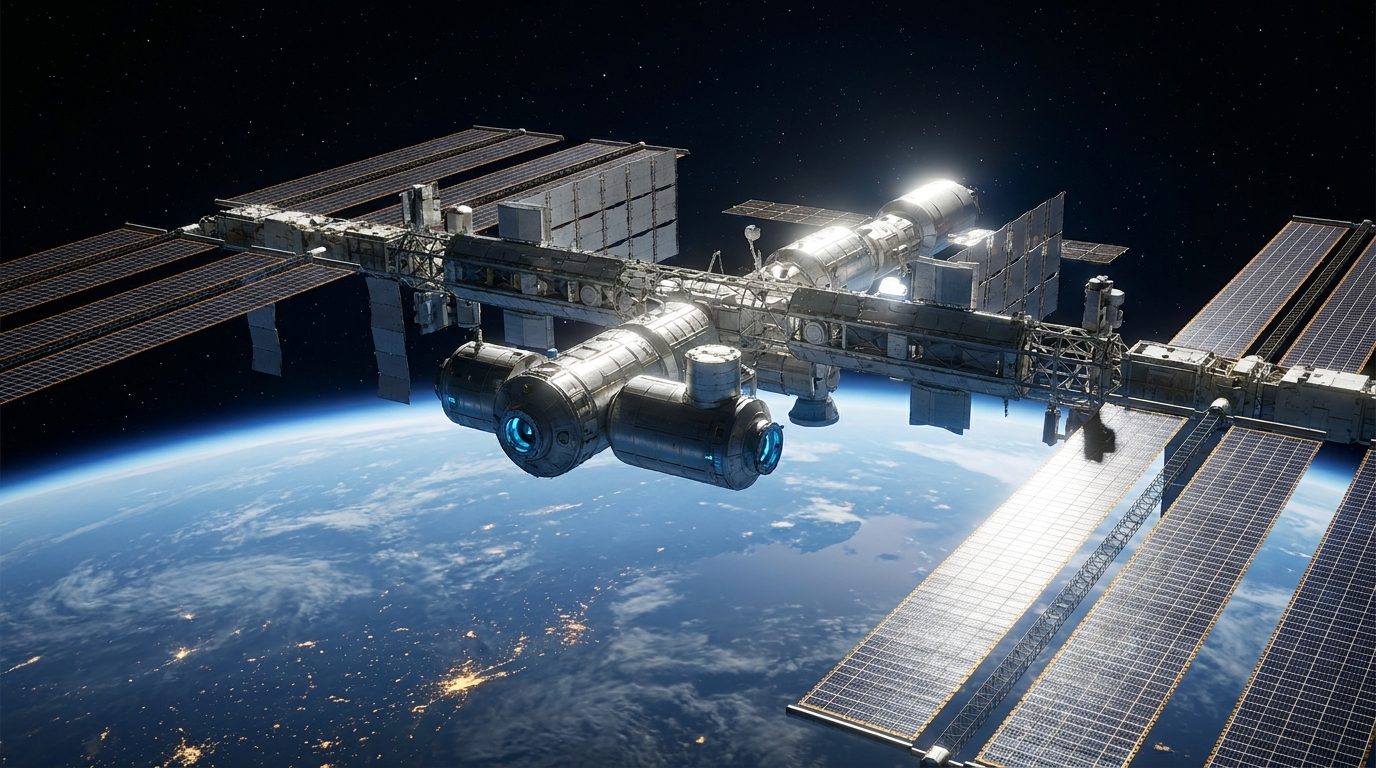
On January 31, 2031, a controlled reentry will send the International Space Station — all 420 tonnes of it — into the South Pacific Ocean's spacecraft cemetery, a remote stretch of sea already home to over 260 deorbited spacecraft. The date has slipped slightly from the original 2030 target, but NASA's commitment has not. After more than 25 years of continuous human presence, the station that hosted astronauts from over 19 nations and generated more than 3,300 research publications is on a countdown clock.
What comes next is less a replacement than a reinvention. Rather than building and operating its own successor, NASA is betting on commercial operators to run low Earth orbit (LEO) infrastructure — buying services the way it might buy launch contracts, freeing its own budget for the Moon and Mars.
Why Commercial, and Why Now
The ISS costs NASA roughly $3–4 billion per year to operate. That's a third of the agency's human spaceflight budget tied up in maintaining aging infrastructure. The Commercial LEO Destinations (CDFF) program, seeded in 2021, shifts the model: NASA awards development contracts to private companies, who must find their own customers — pharmaceutical firms, materials scientists, sovereign space programs, tourists — to make the economics work. NASA then becomes one customer among many, not the sole operator.
It's the same logic that drove the Commercial Crew program: SpaceX and Boeing now fly astronauts to the ISS; NASA stopped operating its own crewed launch vehicles. The next step is to stop operating the station itself.
Axiom Station: The Closest to Reality
Axiom Space has the most concrete path forward. Its first commercial module, Axiom Module 1 (AxM-1), is scheduled to dock to the ISS by late 2026, attaching to the Node 2 forward port. Two more modules — a habitation unit and a research lab — are planned to follow by 2028, at which point the Axiom segment will detach from the ISS and become a free-flying station before the ISS deorbits.
Axiom already has an operational track record: it has flown four private astronaut missions to the ISS since 2022, most recently Axiom Mission 4 (Ax-4), which carried astronauts from Poland, Hungary, and India alongside a NASA commander. The company holds a NASA CDFF Phase 2 contract worth up to $400 million. Its revenue model spans private missions, government crew contracts (including with ESA and international partners), and onboard research leasing.
The key risk: Axiom's timeline depends on the ISS remaining operational through 2028–2029. Any early degradation of the station — and the Russian segment has suffered persistent air leaks since 2019 — could compress the attachment window dangerously.
Starlab: One Big Habitat, One Launch
Where Axiom builds incrementally, Starlab goes big in a single shot. The joint venture between Voyager Space and Airbus is designing a station that launches as one unit: an inflatable habitat module roughly 17.6 meters in diameter when deployed, giving it interior volume comparable to the entire ISS U.S. segment.
Voyager Space brings Nanoracks, the commercial ISS services company it acquired in 2021, along with deep familiarity with on-orbit research operations. Airbus contributes its Columbus module experience and European manufacturing capability. Starlab holds a NASA CDFF Phase 2 contract, with a target launch date of 2028 on a yet-to-be-confirmed heavy-lift vehicle.
The station is designed to host four astronauts permanently and support a research agenda anchored in life sciences, materials science, and pharmaceutical development. A George Washington University partnership announced in 2023 positions it as an academic research platform — a deliberate pitch to the universities and research hospitals that currently rely on ISS access.
Orbital Reef: Blue Origin's Modular Vision
Orbital Reef is the most architecturally ambitious of the three. Led by Blue Origin in partnership with Sierra Space, the station uses a modular design: a core module for power and propulsion, Sierra Space's inflatable LIFE (Large Integrated Flexible Environment) habitat modules, and expandable research bays. The design allows the station to grow over time as commercial demand increases.
Sierra Space's LIFE module has undergone destructive pressure testing — the module survived beyond its design burst pressure, a necessary qualification milestone. Blue Origin's New Glenn rocket, now operational after its January 2024 debut flight, provides the launch vehicle pathway. Target operational date is 2029–2030, making Orbital Reef the last of the three to come online.
In 2026, Orbital Reef holds a NASA CDFF Phase 2 contract. NASA's CDFF Phase 2 awards totaled approximately $415.6 million across all recipients. The station is pitched as a business park in space — mixed-use, multi-customer, with tourism as an explicit revenue line.
The Transition Challenge Nobody Wants to Talk About
Even if every timeline holds — a large assumption in a sector where schedules routinely slip — there is likely to be a 1–2 year gap in continuous U.S. commercial LEO presence. Axiom's free-flying station could be operational by late 2029; Starlab targets 2028 but faces significant development milestones; Orbital Reef comes online close to or after the ISS deorbits.
The scientific cost of a gap is real and underappreciated. Microgravity research doesn't pause neatly. Long-duration pharmaceutical crystallization studies, cell biology experiments running across multiple crew rotations, and materials processing runs that depend on years of baseline data would all face interruption. Research institutions have already begun designing experiments with the gap in mind — some deliberately shortening run times, others moving to suborbital platforms as imperfect substitutes.
NASA's response is to push all three commercial partners toward overlapping readiness dates, but the agency can only fund and incentivize; it cannot force a private company to accelerate faster than engineering allows.
The International Dimension
China's Tiangong station, fully assembled in 2022 and now operating with rotating three-person crews, has changed the strategic framing of the ISS transition. Tiangong is not a commercial competitor but a geopolitical one: it demonstrates that China has achieved the technical capability the ISS represented, without needing Western partnerships. Its research program is accelerating, and several nations excluded from ISS collaboration — by U.S. law under the Wolf Amendment — have indicated interest in Tiangong access.
Russia's situation is less settled. Roscosmos has repeatedly announced plans to leave the ISS partnership and build its own ROSS (Russian Orbital Service Station), with departure dates that have moved from 2024 to 2028 and now appear to be after 2030. Russian cosmonauts continue flying to the ISS, and the station's propulsion — still dependent on Russian Progress vehicles for reboost — remains a structural entanglement. A sudden Russian departure before 2030 would create operational headaches NASA would rather not inherit.
The next five years will determine whether the commercial model works not just as a budget strategy but as a scientific platform. The ISS was built by governments for governments. Its successors are being built by companies for markets that don't yet fully exist — and that is either the most promising or most precarious thing about them.