Three Years of JWST Science: The Discoveries That Changed What We Think We Know
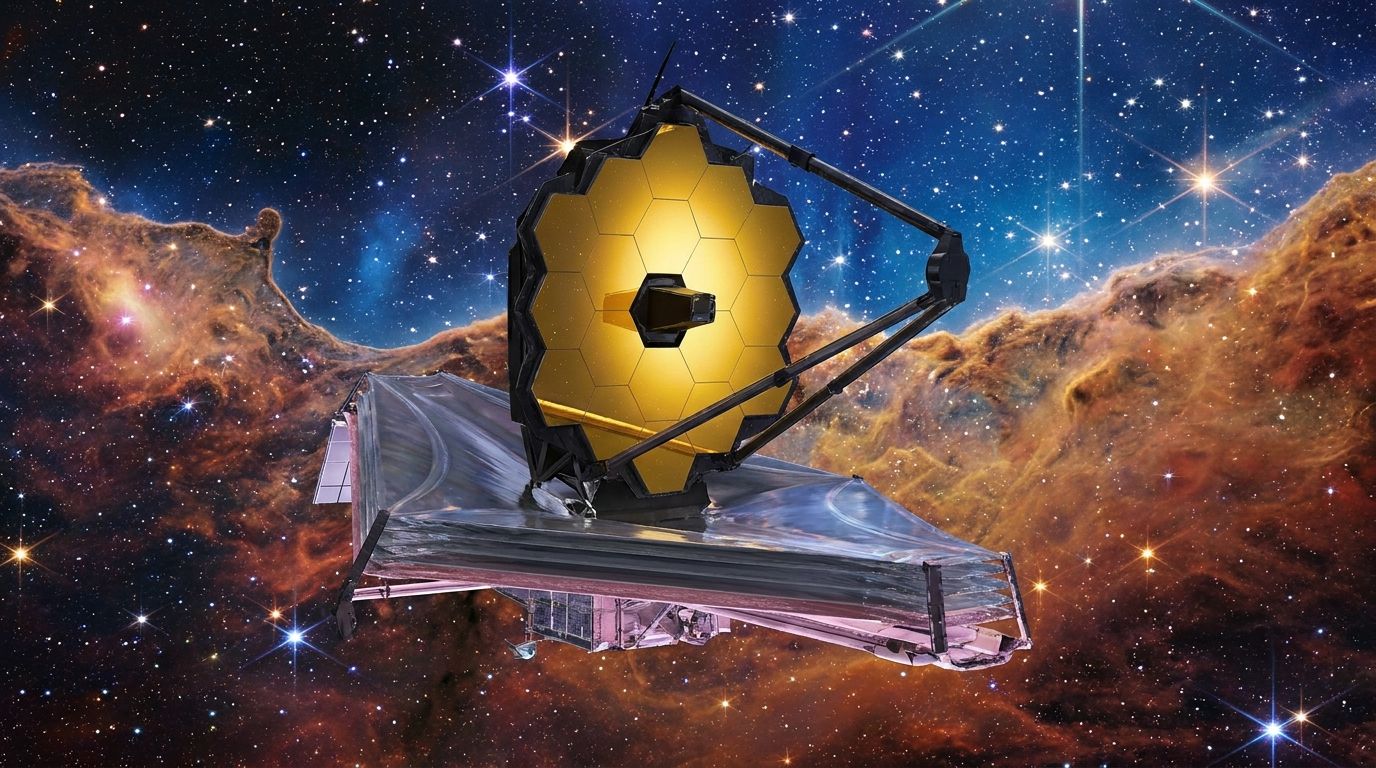
When the James Webb Space Telescope reached its operational orbit around the L2 Lagrange point in January 2022, astronomers knew they were getting a telescope of unprecedented power. What they did not fully anticipate was how consistently it would produce results that complicated rather than confirmed existing models. Three years of science operations later, the gap between prediction and observation has become one of the defining themes of JWST's legacy.
The early galaxy problem
The most discussed JWST finding of its first operating year was the discovery of galaxies that should not, by the standard model of cosmological structure formation, exist at the distances where they were observed. The Lambda-CDM model — the cosmological standard model — predicts that the very early universe should contain only small, irregular proto-galactic structures. Large, massive, disc-shaped galaxies like the Milky Way should take billions of years to assemble.
JWST found what appeared to be well-structured, massive galaxies at redshifts above z=10 — corresponding to an epoch less than 500 million years after the Big Bang. Multiple papers published in 2023 and 2024 confirmed this wasn't a measurement artifact. In 2025, a team using JWST's NIRSpec instrument confirmed the spectroscopic redshifts of six galaxies at z>11, with stellar masses suggesting they had assembled faster than standard models predicted by factors of 10 to 100.
The resolution is still being debated. Proposed explanations include: a higher star formation efficiency in the early universe than models assumed; contributions from active galactic nuclei (AGN) that inflated apparent stellar masses; or modifications to the Lambda-CDM model itself. None of these explanations is yet settled, which is precisely what makes the result significant — it is anomalous enough to demand explanation.
Exoplanet atmospheres: what's breathable, what isn't, and what's uncertain
JWST was designed in part to characterise exoplanet atmospheres by observing the spectrum of starlight filtered through a planet's atmosphere during a transit. The telescope has delivered on this capability beyond most optimistic projections, producing detailed transmission spectra for dozens of exoplanets.
The K2-18b results have generated the most public discussion. In September 2023, a Cambridge team announced the detection of dimethyl sulphide (DMS) in the atmosphere of K2-18b, a sub-Neptune planet in the habitable zone of its star 120 light-years away. DMS on Earth is produced almost exclusively by marine phytoplankton, making it a candidate biosignature. The detection was at the 3-sigma level — suggestive but not statistically definitive — and subsequent analysis has been contentious, with alternative abiotic pathways for DMS production proposed. In 2025, additional JWST observations increased the confidence in the spectral feature while leaving the biosignature interpretation debated.
More unambiguous results have come from closer-in planets. JWST confirmed the presence of carbon dioxide in WASP-39b's atmosphere in 2022 — the first direct detection of CO₂ in an exoplanet atmosphere. It has since detected sulphur dioxide (SO₂) produced by photochemical reactions in multiple hot Jupiter atmospheres, water vapour and methane in a range of sub-Neptune and super-Earth atmospheres, and characterised temperature-pressure profiles in detail that was previously impossible.
The TRAPPIST-1 system — seven roughly Earth-sized planets orbiting a nearby red dwarf, with three in the habitable zone — has been a major observation target. JWST's thermal emission measurements of TRAPPIST-1b and TRAPPIST-1c have shown no evidence of substantial atmospheres on the inner planets, consistent with stellar radiation stripping. Results on the habitable zone planets TRAPPIST-1e, f, and g are still accumulating; the telescope time required is substantial given the system's geometry.
The cosmic dawn
JWST has directly observed the epoch of reionisation — the period roughly 400 million to 1 billion years after the Big Bang when the first stars and galaxies ionised the neutral hydrogen that had filled the universe since recombination. This epoch was theoretically predicted but observationally murky before JWST.
Using its NIRCam instrument, JWST has detected individual star-forming clumps within galaxies from this epoch, characterised the UV luminosity function of reionisation-era galaxies, and found evidence for AGN activity at higher redshifts and lower luminosities than previous surveys detected. A 2024 paper described the detection of a galaxy at z=14.32 — the most distant spectroscopically confirmed galaxy as of that publication, corresponding to a time just 290 million years after the Big Bang.
Stellar nurseries and death in unprecedented detail
JWST's infrared capabilities allow it to peer through the dust clouds that obscure star formation regions in optical telescopes. The Carina Nebula and Orion Nebula images released in the telescope's first year showed stellar nurseries in a detail and three-dimensionality that genuinely surprised astronomers. Protostars, Herbig-Haro jets, and the erosion of molecular pillars by radiation pressure from massive stars are now observable processes rather than inferred ones.
The Ring Nebula — the remnant of a Sun-like star that ejected its outer layers — was reimaged by JWST in 2023, revealing previously unseen concentric ring structures in the nebula's shells that indicate episodic mass loss events during the star's death. The observation raises questions about whether mass loss in asymptotic giant branch stars is a continuous or pulsed process that are now tractable to answer.
Solar system science: an unexpected contribution
JWST was primarily designed for deep field and exoplanet work, but it has produced unexpected results in the solar system. Its observations of Neptune's rings captured detail not seen since Voyager 2's 1989 flyby. Jupiter's aurora was imaged with sensitivity that revealed new features in its structure. And in 2024, JWST confirmed the presence of carbon dioxide ice on Ariel, one of Uranus's moons — the first direct detection of CO₂ ice on an outer solar system moon, raising questions about its origin (endogenic outgassing or solar radiation processing of organic material).
The telescope's remaining life
JWST's consumable limitation is the cold gas used to adjust its orbit around L2. Launch accuracy was so good that far less thruster fuel was used than budgeted, extending the telescope's projected operational life from the guaranteed 10 years to an estimated 20 years or more. Current projections put nominal science operations continuing well into the 2040s, barring mechanical failure.
The next major decision point for the space science community is the proposed Habitable Worlds Observatory — a mission concept recommended by the Astro2020 decadal survey as the highest priority large space telescope for the 2030s, designed specifically to directly image and characterise Earth-like exoplanets around sun-like stars in the habitable zone. JWST laid the technical and scientific groundwork; the next telescope builds on it.