Low Earth Orbit Has a Garbage Crisis, and the Window to Fix It Is Closing
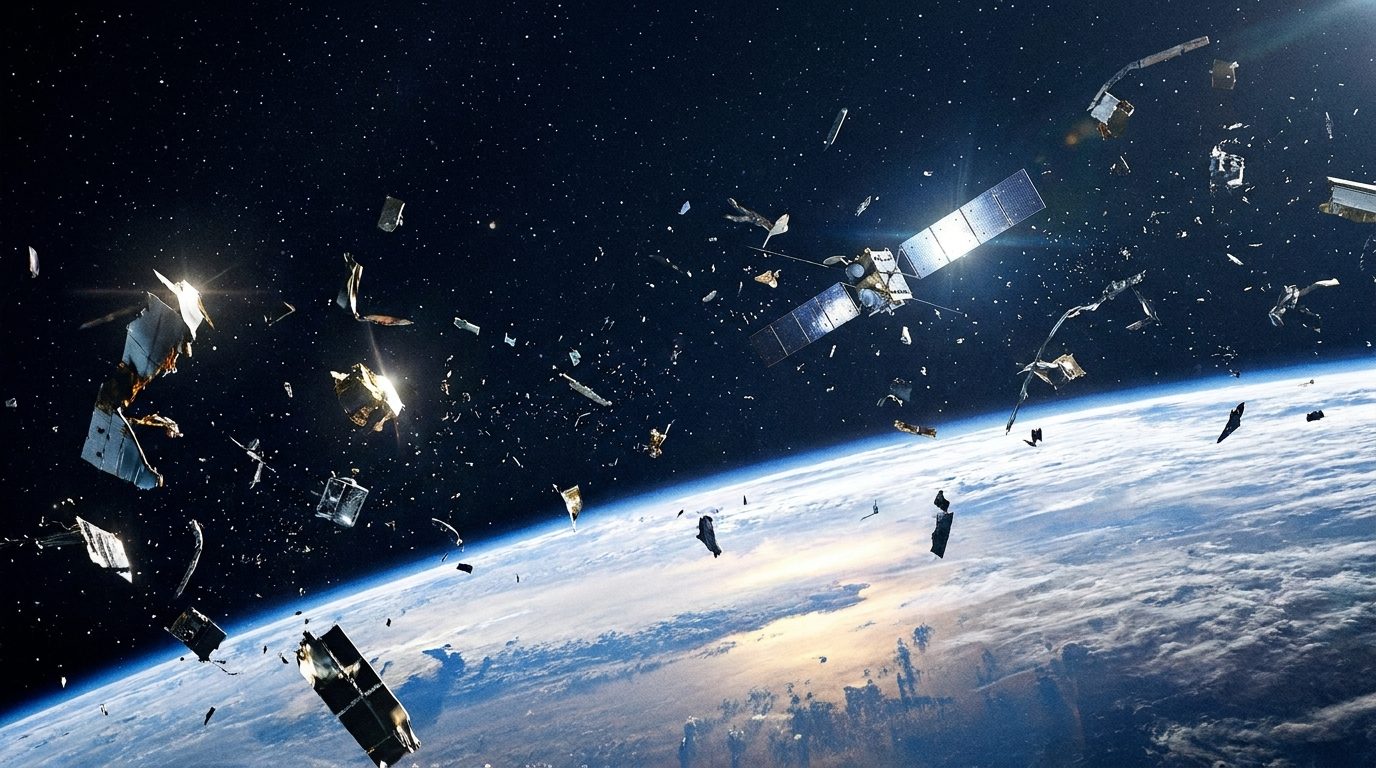
In February 2009, a decommissioned Russian Cosmos satellite collided with an active Iridium communications satellite 790 kilometers above Siberia. The impact generated roughly 2,000 new trackable debris fragments. It was the first accidental collision between two intact satellites in history — and it demonstrated that orbital crowding was no longer theoretical.
Fifteen years later, the problem is categorically worse. The US Space Surveillance Network tracks over 35,000 objects larger than 10 cm in low Earth orbit. NASA estimates there are approximately 500,000 marble-sized fragments between 1 and 10 cm, and over 100 million sub-centimeter pieces moving at speeds between 7 and 8 km/s. At those velocities, a 1-cm paint chip carries the kinetic energy of a bowling ball dropped from a building. None of those 100 million pieces are trackable. All of them can destroy a satellite.
The Kessler Cascade Is Not Science Fiction
In 1978, NASA scientist Donald Kessler described a threshold scenario: if orbital debris density reaches a critical point, each collision generates more debris than was involved in the original impact, triggering a self-reinforcing cascade that makes entire orbital bands unusable for centuries. This became known as the Kessler Syndrome.
Kessler's original model focused on altitudes between 900 and 1,000 km — a band that has since become particularly crowded with defunct satellites and rocket bodies. More recent modeling by researchers at MIT and the ESA suggests that in some altitude bands, we may already have passed the critical threshold for slow-onset cascade. The timeline is decades, not centuries, if the debris accumulation rate continues unchanged.
What makes this especially urgent is the SpaceX effect. Starlink alone has placed over 6,500 satellites in orbit as of mid-2025, with FCC authorization for up to 42,000. Amazon's Project Kuiper launched its first 27 production satellites in April 2024. OneWeb, Telesat, and Chinese competitors are adding hundreds more. The International Telecommunication Union received applications for over 1 million new satellite authorizations between 2020 and 2023. The majority of those won't be built, but the ones that are will operate in the same corridors as thousands of inert derelicts left there over 60 years of spaceflight.
What Active Debris Removal Actually Costs
Several companies are now pursuing active debris removal (ADR) contracts. The most advanced is Astroscale, a Japanese company that completed its ELSA-d mission in 2023, demonstrating magnetic capture of a cooperative debris object. Its follow-on ELSA-M vehicle, designed to service multiple objects per mission, is scheduled for a commercial demonstration in 2026 with OneWeb as its first paying customer.
ClearSpace, a Swiss startup backed by ESA, is targeting a derelict Vega rocket body (VESPA) for capture and deorbit on its ClearSpace-1 mission, currently planned for 2026. The contract value is approximately €120 million — for a single piece of debris. ESA estimates there are roughly 8,600 objects in orbit that collectively pose significant collision risk.
If €120 million per object is anywhere near the actual cost floor, cleaning up just the highest-priority debris field would require more than €1 trillion. That figure explains why the industry is betting heavily on two things: economies of scale through reusable capture vehicles, and prevention through better end-of-life disposal.
The 5-Year Rule and Its Enforcement Gap
The FCC updated its orbital debris mitigation rules in 2022, reducing the required deorbit timeline for LEO satellites from 25 years post-mission to 5 years. On paper, this is a meaningful improvement. In practice, compliance is inconsistent and enforcement is largely toothless.
A 2023 analysis by the Aerospace Corporation found that roughly 30% of satellites launched between 2020 and 2022 failed to meet even the previous 25-year deorbit requirement. Operators in non-US jurisdictions face even less regulatory pressure. Russia, China, and several emerging space nations have no equivalent mandatory deorbit requirement.
The FCC can revoke US operating licenses, but it has no jurisdiction over foreign-registered satellites operating in international orbital slots. The ITU, the body that allocates spectrum and orbital slots internationally, has no enforcement mechanism — it operates by consensus among member states. The result is a regulatory landscape where the most responsible operators are also the most disadvantaged: they spend fuel on deorbit maneuvers that their competitors simply skip.
Collision Avoidance as a Hidden Tax
Every active satellite operator already lives with the debris problem as an operational cost. SpaceX reported performing over 25,000 collision avoidance maneuvers across the Starlink constellation in 2023. Each maneuver consumes propellant, disrupts coverage geometry, and requires ground team coordination. For a constellation of thousands of satellites, this is a significant ongoing expense.
The International Space Station averages roughly three debris avoidance maneuvers per year. In October 2023, a maneuver was required with only 30 minutes of warning — far outside the nominal planning window of several hours. As debris density increases, these events will become more frequent, and the warning windows will shrink because there are more untracked objects creating uncertainty in conjunction assessments.
LeoLabs, a commercial space situational awareness company, operates a network of phased-array radar systems capable of tracking objects as small as 2 cm in low Earth orbit. Its catalog now includes over 20,000 objects and it processes millions of conjunction assessments per day for paying customers. The fact that a company built a profitable business entirely around debris tracking illustrates how serious the problem has already become.
The Economics of Prevention vs. Remediation
The cheapest solution to space debris is producing less of it. This means several things in practice: designing satellites with passivation systems (releasing residual propellant and battery charge to prevent post-mission explosions), attaching deorbit devices (drag sails, electrodynamic tethers) that work passively without requiring functional propulsion, and building satellites that fail safely rather than becoming uncontrolled derelicts.
D-Orbit, an Italian space logistics company, sells a product called ION that deorbits entire groups of satellites after deployment. Exolaunch and Enpulsion market propulsion kits for small satellites that were previously launched without any deorbit capability. These are growing markets, but adoption remains voluntary and incentives are weak.
The underlying economic problem is a classic tragedy of the commons. Each operator individually benefits from launching without spending on deorbit systems, while collectively all operators bear the cost of the resulting debris. Without a credible price signal — a debris fee, a mandatory insurance requirement, or a regulatory framework with real teeth — the rational choice for each individual company is to externalize the cost.
What to Watch in 2025-2026
Three developments will determine whether the debris situation gets meaningfully better or continues to deteriorate. First, the Astroscale ELSA-M demonstration in 2026: if it succeeds and demonstrates scalable ADR economics, it creates a template for a commercial debris removal industry. Second, US Space Force's ongoing development of its Commercial Space Operations Center (CSpOC), which is transitioning space traffic management from a government function to a public-private partnership — the quality of that handoff will determine how well the conjunction assessment system scales with the growing debris population. Third, international regulatory pressure: the UN Committee on the Peaceful Uses of Outer Space is working on updated debris mitigation guidelines, but progress is slow and any agreement will be non-binding.
The window to prevent a Kessler cascade in the most crowded orbital bands is not indefinitely open. Every year of inaction adds more objects and reduces the margin for error. The technology to address debris removal exists. The business models are emerging. What's missing is the regulatory architecture that makes responsible behavior the financially rational choice.
Actionable Takeaways
- If you invest in or evaluate satellite operators, deorbit compliance and propellant reserves for end-of-life disposal are now material risk factors — the FCC has signaled willingness to deny license renewals for non-compliant operators.
- Astroscale (TYO: 186A) and ClearSpace (private, ESA-backed) are the two ADR companies closest to commercial service. Their 2026 demonstration missions are the next major data points for the viability of the sector.
- LeoLabs and ExoAnalytic Solutions offer commercial space situational awareness services that are increasingly used by constellation operators as a regulatory hedge and insurance underwriting input.
- The 5-year deorbit rule is the current baseline for US-licensed operators. Operators consistently launching into orbits above 500 km without adequate deorbit propellant are assuming regulatory and reputational risk that is growing, not shrinking.