LPCAMM2 brings upgradeable memory back to thin-and-light laptops
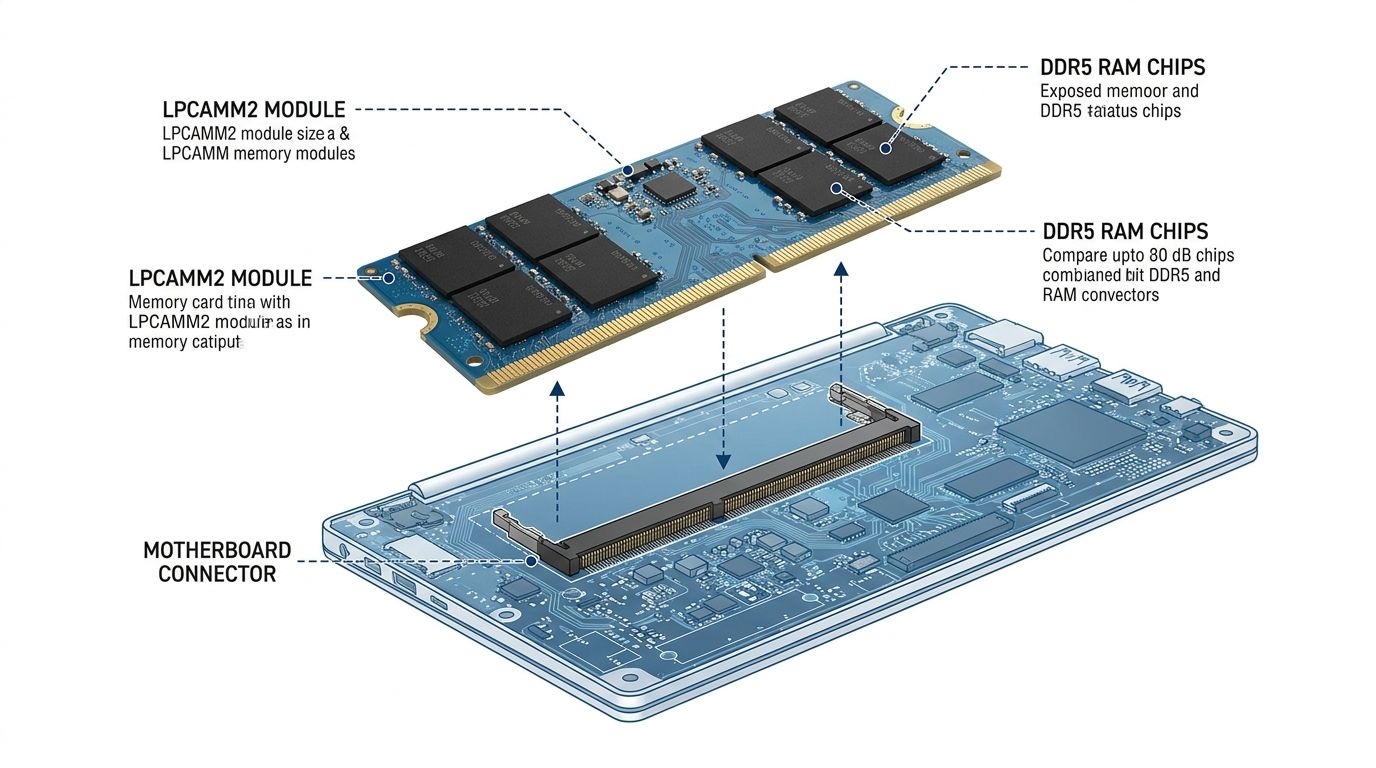
LPCAMM2 is a new memory module standard that does something the laptop industry has spent years making impossible: it lets you upgrade the RAM in a thin, light laptop. After nearly a decade of manufacturers soldering memory directly to motherboards and calling it a thermal necessity, JEDEC's LPCAMM2 specification offers a socketed alternative that matches soldered LPDDR5x in speed and beats it in bandwidth — while fitting inside the same chassis constraints.
Why soldered RAM became the default — and the problem with it
Starting around 2015, laptop makers began replacing socketed SO-DIMM slots with LPDDR memory soldered directly to the motherboard. The justification was real: soldering eliminated the connector overhead, reduced height, and improved signal integrity for high-speed LPDDR4 and LPDDR5 signaling. Apple's MacBooks, Dell's XPS line, and eventually most ultrabooks followed this path.
The consequence was equally real. A laptop sold with 16 GB of RAM stayed at 16 GB forever. When memory prices dropped a year after purchase, you couldn't benefit. When 16 GB became inadequate for your workload, you replaced the whole machine. Right-to-repair advocates identified soldered RAM as one of the clearest examples of design choices that shorten product lifespans and increase electronic waste — not because soldering is inherently wrong, but because it was applied universally to components users had always been able to upgrade.
Enterprise IT departments faced a related problem: field serviceability. A failed memory cell on a soldered board means replacing the entire logic board, a repair that costs more than the machine's residual value and generates unnecessary waste.
What LPCAMM2 actually is
LPCAMM2 (Low Power Compression Attached Memory Module, version 2) is a JEDEC-standardized module format published as JESD318. The physical module is roughly 60% smaller than a standard SO-DIMM. It connects via a low-profile compression connector — no latching arms, no insertion force mechanism — that sits flat against the board. A single screw or retention clip holds the module in place.
The critical engineering achievement is the signal architecture. Conventional SO-DIMMs use a parallel bus where each memory chip connects independently to the host — a design that doesn't scale cleanly to LPDDR5x speeds (up to 8533 MT/s) at the wire lengths a removable connector requires. LPCAMM2 moves the signal termination and routing onto the module itself, so the connector only carries a short stub. This is why previous attempts at removable LPDDR failed: the connector stub introduced enough signal degradation to limit speeds.
Bandwidth figures: a single LPCAMM2 module running LPDDR5x-8533 delivers up to 136 GB/s of memory bandwidth. By comparison, two channels of soldered LPDDR5x-8533 on a typical ultrabook motherboard also peak around 136 GB/s — meaning LPCAMM2 achieves parity in a removable form factor. Some implementations using dual-rank LPCAMM2 modules can exceed soldered configurations by operating both ranks simultaneously.
Physical dimensions: current LPCAMM2 modules are available in 32 GB and 64 GB capacities. The module measures approximately 78.5 mm × 26.65 mm × under 2 mm thick in the standard profile, thin enough for laptops with a 15–18 mm total chassis depth.
Which laptops support it now
The Lenovo ThinkPad X1 Carbon Gen 13 (2025) was among the first enterprise ultrabooks to ship with an LPCAMM2 slot, configurable with 32 GB or 64 GB modules. Lenovo's engineering team published documentation confirming field replaceability with standard tools — a notable commitment from a manufacturer whose previous X1 Carbon generations were fully soldered.
Framework Laptop 16 supports LPCAMM2 via an expansion bay design, consistent with Framework's explicit repairability charter. Framework sells replacement LPCAMM2 modules directly, and the modules are available from third-party vendors including Crucial and Kingston.
Dell has announced LPCAMM2 support in select Latitude and Precision workstation laptops. Samsung, Micron, and SK Hynix are all producing modules, which is important: single-supplier ecosystems tend to keep prices elevated and module availability thin.
What this means for repairability and longevity
iFixit revised its repairability scores for devices with LPCAMM2 slots upward, citing the socketed memory as a meaningful durability factor. For a device that's otherwise well-designed — replaceable battery, accessible SSD — an LPCAMM2 slot removes one of the last reasons to retire a laptop early.
The environmental math is straightforward. A laptop upgraded from 32 GB to 64 GB at year three produces roughly 15–20 kg less CO₂-equivalent than manufacturing a replacement device — based on lifecycle analysis data from Fairphone and similar teardown studies applied to thin-laptop manufacturing profiles. The old 32 GB module can be reused or recycled separately rather than being embedded in a board headed for smelting.
For enterprise IT, LPCAMM2 restores a repair tier that soldered RAM eliminated. Memory failures — rare but real — become a part replacement rather than a board replacement. Procurement teams can buy a base SKU and upgrade memory in-house as needs change, rather than overpaying for high-memory configurations at purchase time.
Performance tradeoffs worth knowing
LPCAMM2 is not without compromise. The compression connector adds a small but measurable latency penalty compared to direct-soldered traces — typically 1–3 ns additional memory latency in published benchmarks. For general computing workloads, this is imperceptible. For latency-sensitive workloads like real-time audio processing or certain database operations, it may be a consideration.
Thermal performance is the other variable. Soldered RAM benefits from direct thermal coupling to the PCB and, in some designs, to the chassis. LPCAMM2 modules rely on thermal pads to the module's own heat spreader. In sustained workloads that push memory bandwidth, temperatures may run slightly higher — though Lenovo's ThinkPad implementation includes a copper heat spreader on the module that performs comparably in most tests.
What to watch and when to expect wider adoption
LPCAMM2 adoption is currently concentrated in the enterprise and enthusiast segments where buyers pay a premium for serviceability. Expect the ThinkPad X1 Carbon, Framework 16, and Dell Latitude lines to expand LPCAMM2 coverage through 2025–2026. Consumer ultrabooks from HP, ASUS, and Acer have not announced LPCAMM2 timelines, though component availability is no longer the barrier — design commitment is.
Module pricing at launch ran approximately $120–$180 for 32 GB and $220–$300 for 64 GB from Crucial and Kingston, a premium over soldered equivalent configurations but consistent with early-adopter pricing for new form factors. Prices will compress as volume increases.
If you're buying a laptop in 2025 and expect to own it for five or more years, an LPCAMM2 slot belongs on your checklist alongside battery replaceability and SSD access. It's not available everywhere yet, but the manufacturers who've committed to it have made a concrete engineering investment in the machines lasting longer than their initial configuration.