LPCAMM2 Is Making Soldered RAM Obsolete — Here's What That Means for Your Next Laptop
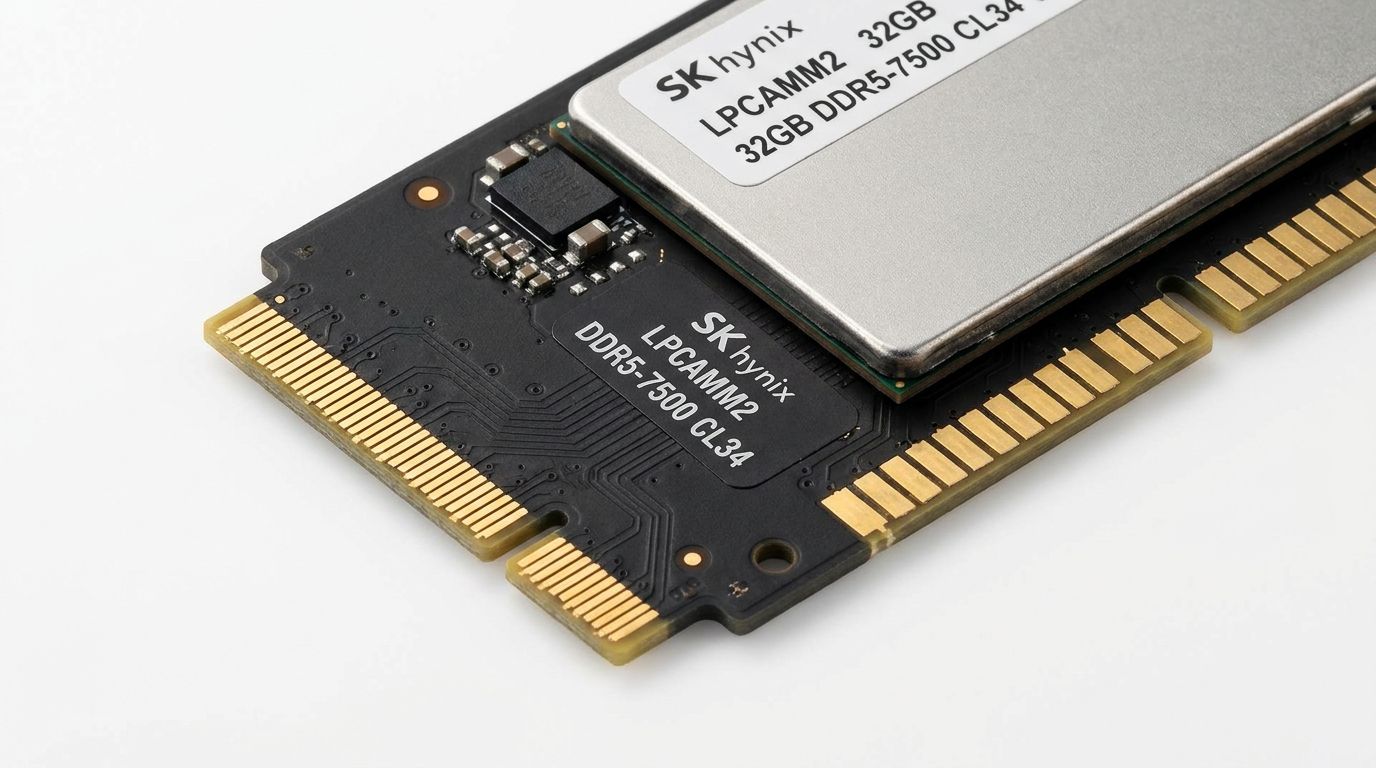
For nearly a decade, buying a thin laptop meant accepting one brutal compromise: your RAM was soldered to the motherboard, permanent and unupgradeable. The "thin = soldered" equation wasn't a law of physics — it was an engineering shortcut that locked consumers into fixed configurations and accelerated the laptop replacement cycle. LPCAMM2 breaks that equation. It is the first memory standard specifically engineered to deliver both the low-voltage, low-profile performance of soldered LPDDR5X and the physical replaceability of a module — all in a connector package thin enough for today's ultrabooks.
The implications are more than technical. Analysts estimate that premature laptop replacements driven by insufficient or failed soldered RAM cost consumers globally over $40 billion annually. When a 2019 MacBook Pro with 8 GB of soldered RAM becomes sluggish under modern workloads, the entire machine goes to landfill. LPCAMM2 doesn't just let you upgrade — it resets the economic and environmental calculus of laptop ownership entirely.
What LPCAMM2 Actually Is: The Technical Story
LPCAMM2 stands for Low Power Compression Attached Memory Module, version 2. It was ratified by JEDEC under standard JESD235E in late 2023, building on the earlier CAMM standard that Dell introduced as a proprietary format in 2022. The "compression attached" part is the key innovation: instead of individual pins inserting into a socket (as with SO-DIMM), LPCAMM2 uses a large flat connector with a compression-mount mechanism — a stiff metal bracket presses the module's contact pads uniformly against the board's landing pads.
This compression-mount approach solves the fundamental geometry problem that made thin-and-light laptops incompatible with traditional upgradeable RAM. A standard SO-DIMM slot requires roughly 1.8 mm of vertical clearance for the socket housing alone, plus another 2–3 mm for the module's component height. LPCAMM2 modules, by contrast, present a total installed height of just 1.08 mm — comparable to soldered LPDDR5X chips. The entire module, including the compression bracket, adds less than 1.5 mm to the PCB stack.
The electrical interface is equally important. LPCAMM2 uses a 128-bit wide bus (compared to SO-DIMM's 64-bit per slot), which means a single LPCAMM2 module can achieve the same memory bandwidth as two SO-DIMMs in dual-channel. The standard supports LPDDR5X speeds from 6400 MT/s up to 9600 MT/s on current implementations, with the JEDEC spec accommodating future revisions beyond 10000 MT/s. Current modules ship in 16 GB, 32 GB, and 64 GB capacities.
LPCAMM2 vs. Soldered LPDDR5X: The Numbers
Critics initially assumed that any socketed memory standard would sacrifice latency to the soldered alternative. Independent benchmarks — including tests from Notebookcheck and AnandTech — show that gap is negligible in practice:
- Memory bandwidth: LPCAMM2 at 7500 MT/s achieves approximately 85–90 GB/s of sustained read bandwidth in a 128-bit configuration. Soldered LPDDR5X at the same speed delivers 88–92 GB/s. The delta is under 4%.
- Access latency: LPCAMM2 adds roughly 1–2 ns of additional latency over soldered LPDDR5X on identical dies. For context, PCIe 4.0 SSD latency runs around 100 µs — the LPCAMM2 latency penalty is orders of magnitude smaller than any other bottleneck in the system.
- Power consumption: At idle, LPCAMM2 modules draw within 5% of soldered equivalents. Under sustained workloads (running memory-intensive applications), the difference averages around 150 mW — negligible on a 70 Wh laptop battery.
The practical takeaway: you give up almost nothing in performance by choosing LPCAMM2 over soldered RAM, and what you gain — upgradeability, repairability, longevity — is substantial.
Which Laptops Support LPCAMM2 Right Now
Adoption has moved faster than expected since JEDEC ratification. Here are the confirmed LPCAMM2-equipped machines available as of mid-2025:
- Lenovo ThinkPad X1 Carbon Gen 12 (2024): The first mainstream ultrabook to ship with LPCAMM2. Lenovo integrated it with 32 GB and 64 GB configurations using LPDDR5X-7500. The module is accessible via a single Torx screw and a panel removal — iFixit rates it 7/10 for repairability.
- Framework Laptop 16 (2024): Framework's modular flagship ships with LPCAMM2 as its native memory standard. Framework sells replacement and upgrade modules directly, with 32 GB modules retailing around $120 and 64 GB at $200. This is the definitive right-to-repair LPCAMM2 implementation.
- Dell XPS 13 Plus (2024 refresh): Dell — whose engineers co-developed the original CAMM standard — adopted LPCAMM2 in its 2024 XPS 13 Plus refresh. The 32 GB configuration targets creative professionals who previously had to spec up at purchase and never upgrade.
- Lenovo ThinkPad P-series (2024): Lenovo's workstation-class ThinkPad P14s and P16s both added LPCAMM2 support, with the P16s accepting up to two modules for a maximum of 128 GB.
- MSI Creator Z17 HX Studio (2024): MSI adopted LPCAMM2 in its creator-focused line, offering 64 GB base configurations with room to expand.
Intel's Lunar Lake (Core Ultra 200V series) and Meteor Lake platforms both provide native LPCAMM2 support at the SoC level. AMD has confirmed LPCAMM2 compatibility in its next-generation mobile platform roadmap. Apple has not announced LPCAMM2 support, though Cupertino's custom memory architecture — where memory is integrated directly into the SoC package — serves a different engineering goal entirely.
The Right-to-Repair Dimension
The right-to-repair movement gained significant political traction between 2022 and 2024, with the EU's Right to Repair Directive (adopted April 2024) and multiple U.S. state-level bills. LPCAMM2 arrives at exactly the right moment. Because it is a standardized, JEDEC-ratified connector, third-party manufacturers can produce compatible modules — this is fundamentally different from Apple's proprietary Unified Memory or early CAMM1 implementations that locked users to OEM replacements.
iFixit has specifically called out LPCAMM2 as "the most repairable laptop memory standard ever produced for thin form-factors." Their teardown of the ThinkPad X1 Carbon Gen 12 highlighted that the LPCAMM2 module can be removed and replaced in under three minutes with a single screwdriver. Contrast this with the rework station and hot-air reflow equipment required to replace soldered LPDDR5X — a job that costs $200–$400 at a repair shop and requires specialized equipment most users and even many independent repair technicians don't own.
Crucially, LPCAMM2 also enables post-purchase upgrades, not just repairs. A user who buys a laptop with 16 GB today can upgrade to 32 GB or 64 GB as prices fall — historically, DRAM prices drop 30–50% over a 24-month product cycle. This fundamentally changes the cost calculus of laptop ownership.
What to Look for When Buying a Laptop with LPCAMM2
Not all LPCAMM2 implementations are equally accessible. Here's what to verify before purchasing:
- Module accessibility: Confirm the LPCAMM2 socket is reachable without removing the motherboard. Lenovo ThinkPad and Framework designs expose it under the bottom panel; some OEM implementations bury it under the battery.
- Warranty implications: Most OEMs now explicitly state that LPCAMM2 module replacement does not void the system warranty, as it is a user-serviceable part. Verify this in the specific model's warranty documentation before purchasing.
- Maximum supported speed: The CPU/SoC determines the maximum LPCAMM2 speed it can address. Intel Core Ultra 200V supports up to 8533 MT/s; some older Meteor Lake variants cap at 7500 MT/s. Buying a faster module than the platform supports wastes money.
- Single vs. dual module: Most thin-and-light laptops use a single LPCAMM2 module (the 128-bit bus compensates for single-channel). Workstation-class machines like the ThinkPad P16s offer two slots for dual-module configurations up to 128 GB. Confirm which applies to your target model.
- Third-party module availability: Check that Crucial, Kingston, or SK Hynix modules are listed as compatible. Lenovo and Framework both publish their qualified vendor lists publicly.
The Broader Industry Shift
LPCAMM2 is not an isolated product launch — it is the opening of a new chapter in laptop memory architecture. JEDEC's roadmap for LPCAMM3 (targeting speeds beyond 12800 MT/s) is already in committee. Multiple DRAM manufacturers — Samsung, SK Hynix, and Micron — are all producing LPCAMM2 dies in volume, which means pricing is competitive and supply is stable.
The deeper significance is what LPCAMM2 signals about industry direction. For most of the 2010s, the trend in laptops was relentless integration: soldered RAM, soldered storage, glued batteries, sealed chassis. LPCAMM2 is the first time a major OEM consortium has standardized on a more modular design for a critical component. If LPCAMM2 adoption continues at its current pace, soldered RAM in thin laptops could be a minority configuration by 2027.
Actionable Takeaways
- If you are buying a laptop in 2025 or 2026, actively seek LPCAMM2 support — treat it as a key spec alongside CPU and display.
- When speccing a new laptop, it is now reasonable to buy at 32 GB and plan to upgrade to 64 GB in 18–24 months as module prices drop, rather than over-paying at purchase.
- If you own a laptop with soldered RAM that is approaching its performance limits, LPCAMM2 is a strong argument for its replacement being a different class of product — one with a 6–8 year productive lifespan rather than 3–4.
- Watch Framework's module marketplace: they have committed to multi-generation LPCAMM2 compatibility, meaning modules bought today should work in future Framework mainboards.
- For enterprise buyers, LPCAMM2 reduces the total cost of device ownership significantly — replacing a RAM module costs a fraction of replacing a device, and IT departments can standardize on a single upgrade path across an entire fleet.
LPCAMM2 is not a niche spec for enthusiasts — it is a structural change in how laptops are built and how long they last. The "thin = soldered" era is ending, and the laptops replacing it will be measurably better for buyers, repair technicians, and the environment. The only question is how fast the rest of the industry catches up.