LPCAMM2 Brings Upgradeable RAM Back to Thin Laptops — and the Industry Is Finally Listening
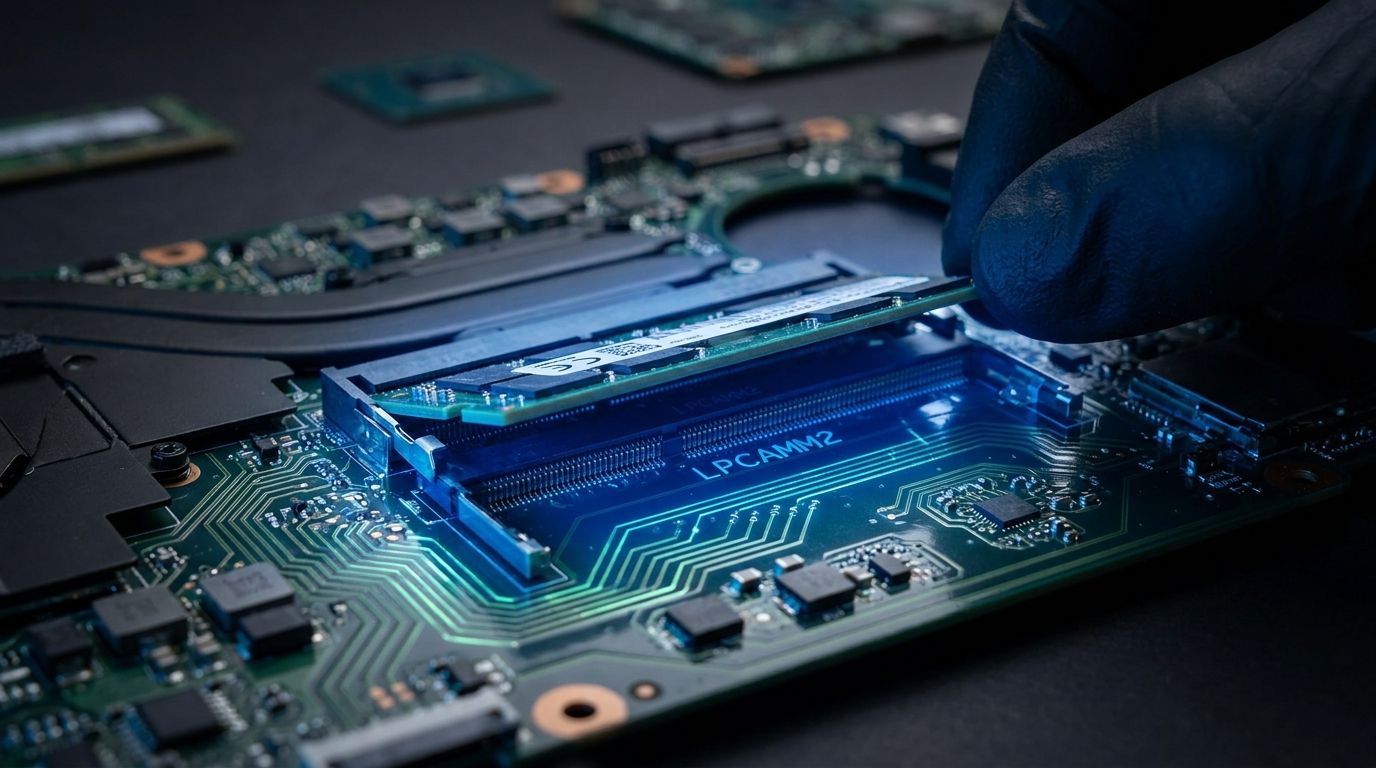
The case for soldering RAM to a laptop motherboard was always partly about engineering and partly about margins. On the engineering side: soldered LPDDR memory runs faster, consumes less power, and occupies less physical space than a socketed alternative. On the margin side: it locks customers into the configuration they bought and prevents the upgrade that extends a laptop's useful life by two or three years. The industry leaned heavily into the engineering story.
LPCAMM2 (Low Power Compression Attached Memory Module 2) challenges the core engineering premise. Developed by Micron and standardised by JEDEC, LPCAMM2 is a modular memory format that uses the same LPDDR5X memory that goes into soldered designs — same speed, similar power characteristics — in a slot-based module that occupies roughly 60% of the footprint of a traditional SO-DIMM. Dell shipped the first laptop to use it in the XPS 15 9530 in late 2023. By mid-2026, it has appeared in machines from Lenovo, HP, Asus, and Framework, with Samsung and SK Hynix now supplying modules alongside Micron.
What LPCAMM2 actually offers
The headline capability is upgradeability. A laptop with LPCAMM2 can have its memory swapped out by the user, in the field, without special tools — the module uses a standard slot that accepts any LPCAMM2-compatible stick. Current modules top out at 64GB for a single-slot design. Two-slot boards (as seen in some Lenovo ThinkPad configurations) can reach 128GB.
The performance numbers are meaningful. LPCAMM2 running LPDDR5X-9600 delivers approximately 77 GB/s of bandwidth per module — comparable to what soldered LPDDR5X achieves, and around 50% more than DDR5 SO-DIMM at equivalent speeds. Power consumption is similarly close to soldered LPDDR: idle power draw on a Micron LPCAMM2 module is within 5% of an equivalent soldered implementation. The "soldered RAM is faster and more efficient" argument has not disappeared, but it has shrunk considerably.
Latency is the one area where soldered memory retains a clear advantage. The physical distance added by the connector contributes a small but measurable latency penalty — in the range of 1 to 3 nanoseconds per access. For most workloads this is imperceptible. For latency-sensitive applications like high-frequency trading or certain real-time audio processing, it may matter. For the vast majority of laptop users, it does not.
The right-to-repair angle
LPCAMM2 arrived amid accelerating momentum in the right-to-repair movement. The EU's Right to Repair Directive, which came into force in 2025, covers smartphones and tablets but explicitly excludes laptops — a gap that advocates are already lobbying to close. Several US states, including California and Minnesota, passed their own laptop repair provisions in 2025. LPCAMM2 gives manufacturers a technically credible answer to repairability requirements that doesn't require them to ship a heavier, thicker product.
Framework has been the most aggressive: the Framework 16 ships with two LPCAMM2 slots and a publicly documented upgrade path. The Framework approach goes further than most — the memory, storage, and display are all designed for field replacement — but the market response has encouraged other OEMs to at least make memory upgradeable even when other components are not.
Which laptops support it in 2026
The current list of LPCAMM2-equipped laptops is not comprehensive, but it covers enough of the mainstream to represent a real choice. Dell's XPS 15 and XPS 16 both ship with LPCAMM2 slots. The Lenovo ThinkPad X1 Carbon Gen 13 added LPCAMM2 support in its CTO configurations. HP's EliteBook 840 G12 and the Asus ProArt Studiobook 16 also ship LPCAMM2. Framework laptops ship it as standard.
Apple has not adopted LPCAMM2. Apple Silicon's Unified Memory Architecture integrates memory directly into the SoC package in a design that is fundamentally different from anything JEDEC has standardised. Unified Memory will remain soldered as long as Apple controls both silicon and system design, which is to say indefinitely.
On the consumer side, LPCAMM2 is notably absent from gaming laptops and most budget lines, where DDR5 SO-DIMM remains dominant for cost reasons. The module price premium over soldered LPDDR5X runs around 20 to 30% at comparable capacities, making it a harder sell at lower price points.
Why this matters beyond the spec sheet
The practical impact of LPCAMM2 is easiest to understand in terms of purchasing decisions. A laptop with LPCAMM2 is one you can configure at the base memory tier and upgrade later when prices fall or your needs change. It is also a laptop you can own for longer — a machine that was "just barely enough" at purchase can be upgraded rather than replaced.
The economics of this change over the life of a device. A professional-grade laptop with 32GB of LPCAMM2 today can be upgraded to 64GB in two years when 64GB modules commoditise. The alternative — buying 64GB at purchase because soldering means you can't upgrade later — costs more upfront and carries the risk of paying for capacity you may not immediately need.
None of this requires LPCAMM2 to displace soldered memory across the market. What it needs to do is establish enough presence in the mainstream that the option to upgrade is a real expectation, not a rare exception. The trajectory from 2023 to 2026 — from a single Dell model to a multi-vendor ecosystem — suggests it is doing exactly that.