LPCAMM2 Brings Upgradeable RAM Back to Thin Laptops — and It's Faster Too
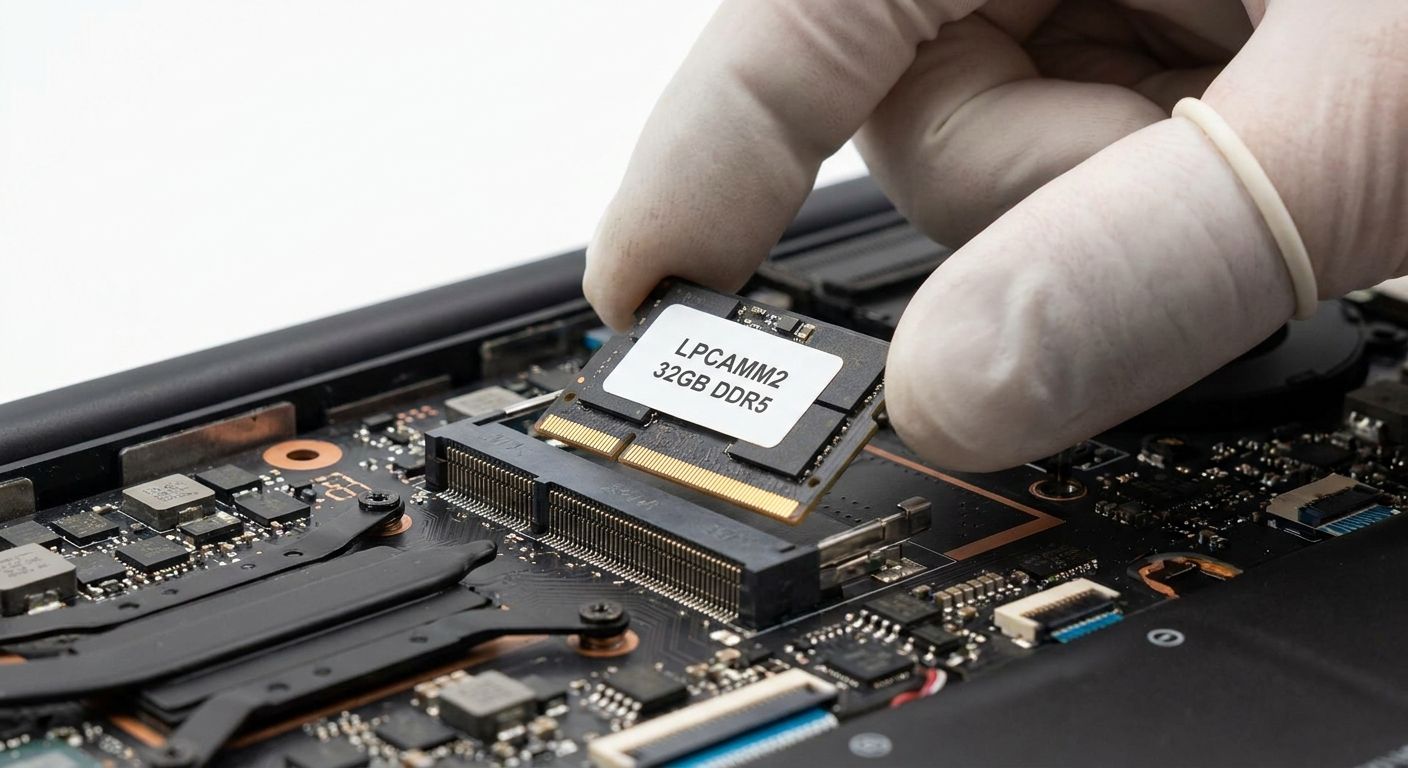
For roughly a decade, buying a thin-and-light laptop meant accepting a deal you never explicitly agreed to: the RAM was soldered to the motherboard, permanent and non-negotiable. Manufacturers sold this as a feature — better power efficiency, thinner chassis, faster memory buses. It was also enormously convenient for their margins. LPCAMM2, the Low Power Compression Attached Memory Module 2 standard, breaks that deal. It delivers LPDDR5X speed and power characteristics in a physically removable module — and the first mainstream laptops shipping it prove that "thin means soldered" was never an engineering necessity.
How LPCAMM2 Works
LPCAMM2 is defined by JEDEC standard JESD318 and uses a compression contact mechanism rather than edge-finger soldering. The module sits in a retention bracket and makes electrical contact through a dense array of spring-loaded pads — similar in concept to a CPU socket, but far thinner. The entire assembly adds roughly 1.5 mm to the motherboard stack height, which is negligible in modern thin-and-light designs running 14–16 mm total chassis depth.
Unlike SO-DIMM, which routes signals through a long PCB trace from the DIMM edge connector to the memory chips, LPCAMM2 places the memory dies directly above their controller connections. The bus path is dramatically shorter, which is the same physical reason soldered LPDDR outperformed SO-DIMM on signal integrity. LPCAMM2 reproduces that short-path advantage in a removable format. The module itself carries the LPDDR memory dies, a small controller, and SPD (Serial Presence Detect) configuration data, all within a footprint smaller than a SO-DIMM — approximately 75% of the SO-DIMM board area.
The Speed Numbers
LPCAMM2 supports LPDDR5X memory at speeds up to 10667 MT/s. To contextualize that figure: Apple's M3 MacBook Pro ships with soldered LPDDR5 running at 6400 MT/s. Standard DDR5 SO-DIMM — used in mainstream Intel and AMD laptops — starts at 5600 MT/s and practically tops out around 7200 MT/s before signal integrity degrades on the longer bus. LPCAMM2 at 10667 MT/s is not just competitive with soldered LPDDR5X; it matches it outright.
The Lenovo ThinkPad X1 Carbon Gen 13 is the first mainstream laptop to ship with LPCAMM2, launching in early 2025 with Intel Core Ultra 200V series processors and a single LPCAMM2 slot supporting up to 64 GB of LPDDR5X-7467. Lenovo's own benchmarks show memory bandwidth within 2% of equivalent soldered configurations — the compression contact interface introduces no meaningful latency or throughput penalty.
Bandwidth matters most in unified memory architectures, where CPU and integrated GPU share the same memory pool. The gap between 6400 MT/s and 8533 MT/s (a common LPCAMM2 shipping speed) translates directly to GPU frame rates in integrated graphics workloads. Users running games, video editing, or local AI inference on integrated graphics will notice the difference.
Why Soldered RAM Became the Norm
LPDDR memory has been soldered into thin laptops since approximately 2015–2016, when Intel's fanless Core M platform and Apple's 12-inch MacBook demonstrated that soldered LPDDR3 could enable chassis designs impossible with SO-DIMM. Three engineering arguments justified the transition: power, space, and signal integrity.
Power: LPDDR is engineered for lower operating voltage (typically 1.1 V vs. 1.1–1.35 V for DDR5) and supports fine-grained power states including partial array self-refresh. Soldered placement eliminated the connector's parasitic capacitance and resistance, preserving those power advantages fully.
Space: A SO-DIMM slot, including its ZIF connector mechanism and the clearance for module insertion, occupies significant PCB real estate and height. Soldered LPDDR chips, placed directly on the motherboard, eliminated both.
Signal integrity: Longer PCB traces introduce noise, crosstalk, and impedance discontinuities that cap practical memory clock speeds. Soldered LPDDR, with its sub-10 mm trace lengths, could reach speeds that SO-DIMM connectors couldn't reliably support.
LPCAMM2 addresses all three. The compression contact introduces less parasitic impedance than a traditional DIMM edge connector. The module footprint is smaller than SO-DIMM. The short internal bus paths within the LPCAMM2 module replicate the signal integrity of soldered placement. OEMs retained the power and performance benefits while giving up the "permanent" part of permanent soldering.
Repairability and Longevity
The repairability implications of LPCAMM2 extend beyond simple upgrades. A soldered RAM failure — caused by manufacturing defect, electrostatic discharge, or physical damage — currently means replacing the entire motherboard, which typically costs $400–$900 for a premium thin-and-light. With LPCAMM2, a failed memory module is a $80–$150 replacement part. That changes the total cost of ownership calculation substantially for enterprise IT departments managing fleets of ThinkPads.
iFixit, which scores products on repairability and has been a vocal advocate in Right to Repair legislative campaigns in the US and EU, highlighted LPCAMM2 as a meaningful inflection point. Their position: soldered RAM was the single largest driver of laptop non-repairability scores over the last decade. Removing it from the equation doesn't just help individual users — it changes how insurers, corporate IT, and independent repair shops can service devices.
The EU's 2025 ecodesign repairability scoring framework, which took effect for laptops sold in EU member states starting in March 2025, explicitly penalizes soldered RAM. Manufacturers lose points in the "disassembly and reassembly" scoring category when critical components — including RAM and storage — cannot be replaced without destroying the device. OEMs selling into the EU market now have a regulatory incentive, not just a consumer-relations one, to ship upgradeable memory.
Which Laptops Support It
The Lenovo ThinkPad X1 Carbon Gen 13 (2025) was the first widely available commercial laptop with LPCAMM2, shipping with one module slot and configurations from 32 GB to 64 GB LPDDR5X. Lenovo also announced LPCAMM2 support for the ThinkPad T14s Gen 6 and ThinkPad X1 Yoga Gen 10.
Dell announced the XPS 13 Plus (2026 model) will include LPCAMM2, marking the standard's first appearance in a consumer-focused ultrabook rather than a business line. This is significant: Dell's XPS 13 Plus has historically been one of the thinnest mainstream Intel laptops, and its inclusion of LPCAMM2 confirms the form factor penalty is negligible.
Samsung announced the Galaxy Book5 Pro with LPCAMM2 support, targeting the premium Windows productivity segment. Samsung Semiconductor is also one of the module manufacturers, which likely accelerates its adoption across Samsung's device portfolio.
Apple remains the most significant holdout. The M3 and M4 families continue to use soldered LPDDR5X, and Apple has not publicly commented on LPCAMM2. However, industry analysts note that the M5 Pro and M5 Max chips, expected in late 2025 or early 2026, would be natural candidates for LPCAMM2 adoption given the EU regulatory pressure and the competitive positioning. Apple's unified memory architecture benefits most from high-bandwidth LPDDR, making LPCAMM2's 10667 MT/s ceiling directly relevant to their GPU performance narrative.
Framework Laptop has committed to LPCAMM2 support in future motherboard generations, consistent with their design philosophy of user-serviceable components. Given that Framework's modular architecture already supports RAM upgrades via SO-DIMM in current models, the transition to LPCAMM2 would represent a performance upgrade rather than a repairability trade-off.
Should You Wait for It?
If you are purchasing a thin-and-light laptop in the second half of 2026, LPCAMM2 availability should be on your checklist — not because soldered LPDDR5X performs worse today, but because it forecloses future options. A laptop purchased with 16 GB LPCAMM2 can become a 64 GB laptop in 2028 when prices drop. The same laptop with 16 GB soldered cannot.
Verify slot count before buying. Most current LPCAMM2 implementations ship with a single module slot, which limits maximum capacity to whatever the largest available module supports — currently 64 GB. Dual-slot designs will offer higher ceilings as the standard matures. Also verify that the OEM sells or will sell upgrade modules directly or through authorized channels; a slot is useless without a compatible module available for purchase.
If you need a laptop now and LPCAMM2 isn't yet available in your target form factor, buy the highest RAM configuration you can afford. The upgrade path is coming, but it isn't universal yet. Budget and mid-range laptops will likely remain on SO-DIMM DDR5 through 2026–2027 before LPCAMM2 volumes drive costs down.
The Soldered RAM Excuse Is Dead
LPCAMM2 makes the engineering case definitively: thin, light, power-efficient, and high-speed laptop memory does not require permanent soldering. The excuse lasted a decade because no viable standard existed to replace it. That gap is now closed. The ThinkPad X1 Carbon Gen 13 ships at 14.9 mm thin with a removable LPCAMM2 module and LPDDR5X-7467 bandwidth. Dell is putting it in the XPS 13 Plus. The EU is scoring OEMs on it.
When you evaluate your next laptop purchase, treat soldered RAM as a red flag rather than a neutral spec. LPCAMM2-compatible designs exist across price points and will only become more common through 2026. The era of "take it or leave it" memory configurations in portable computers is ending — because the engineering obstacles that justified it have been solved.