The Moon Is Getting Busy: Artemis, Commercial Landers, and the Race to Build a Lunar Economy
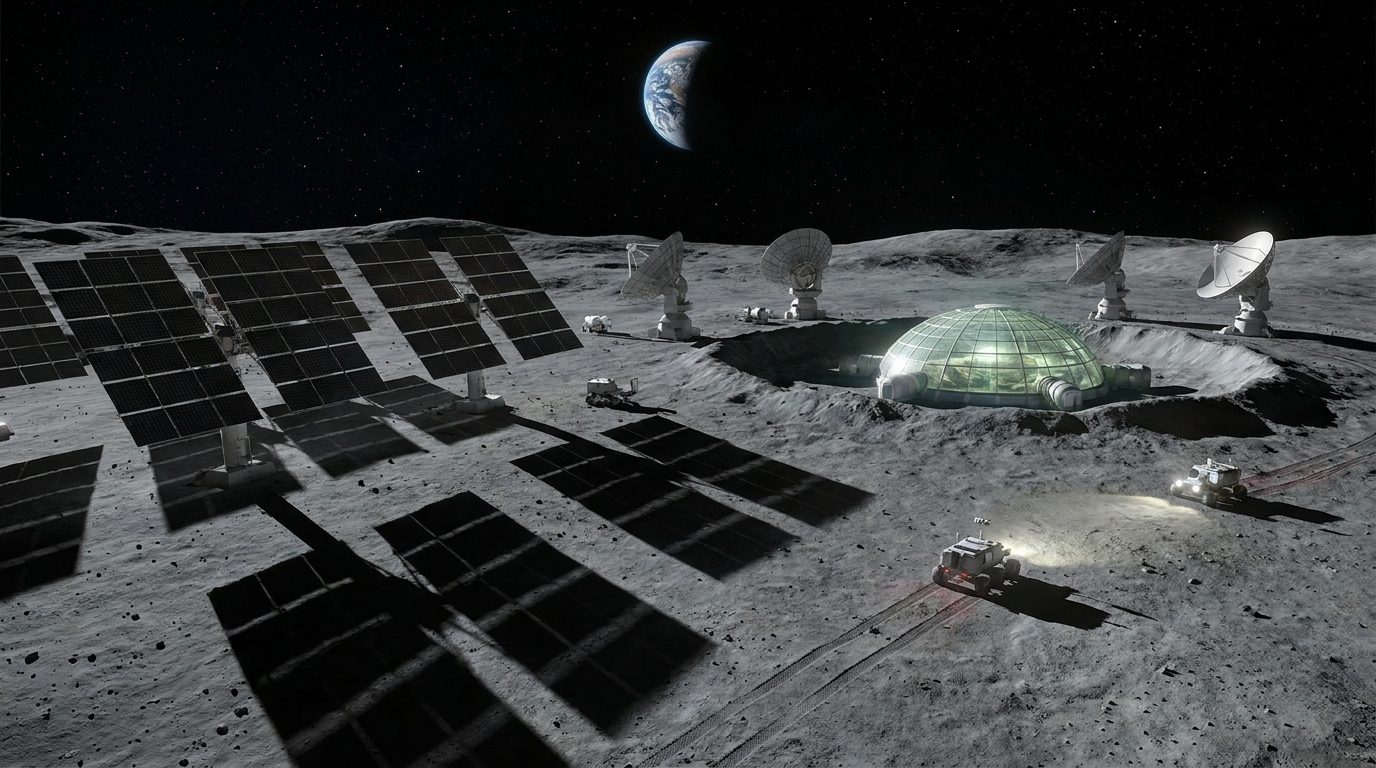
For the first time since Apollo 17 in 1972, humans are preparing to return to the Moon — not for flags and footprints, but for a sustained presence. NASA's Artemis program, commercial lunar landers from Intuitive Machines and Firefly, and plans for the Lunar Gateway station are converging into something that looks less like a space program and more like the early stages of an industry. The Moon isn't just a destination anymore. It's becoming a place people are building for.
Where Artemis Actually Stands in 2026
Artemis I flew in November 2022 — an uncrewed test of the Space Launch System (SLS) and Orion capsule that sent the spacecraft on a 25-day mission around the Moon and back. It worked. The heat shield held. The navigation and communication systems performed. That success unlocked the next step.
Artemis II is the crewed lunar flyby, currently targeted for 2026. The crew: Commander Reid Wiseman, Pilot Victor Glover, Mission Specialist Christina Koch, and Canadian Space Agency astronaut Jeremy Hansen — the first Canadian to leave low Earth orbit. They won't land. The mission is a high-speed loop around the Moon to stress-test Orion with humans aboard. But it puts American and Canadian astronauts in deep space for the first time since the Apollo era.
Artemis III — the actual crewed lunar landing — is targeted for 2027. The plan uses SpaceX's Starship as the Human Landing System (HLS): Orion docks with Starship in lunar orbit, two astronauts transfer to Starship and descend to the surface near the south pole, conduct surface operations, then ascend and return to Orion for the trip home. The south pole target isn't arbitrary — it's about water ice.
The Lunar Gateway is the long-term architecture. A small modular space station in near-rectilinear halo orbit (NRHO) around the Moon, Gateway serves as a staging point for repeated surface missions without needing to bring all propellant from Earth each time. The Power and Propulsion Element (PPE) — the first Gateway module — is scheduled for launch on a Falcon Heavy in 2027. Once operational, Gateway significantly reduces the cost per surface mission by allowing propellant storage and crew transfer in lunar orbit.
Commercial Lunar Payload Services (CLPS)
Parallel to Artemis, NASA's CLPS program pays private companies to deliver science instruments and technology demonstrators to the Moon. The philosophy: treat lunar delivery as a commercial service, not a government megaproject. The results have been mixed but real.
Astrobotic's Peregrine was the first CLPS attempt, launching in January 2024. A propellant leak on the way to the Moon made landing impossible. Peregrine burned up on reentry. A failure — but an informative one.
Intuitive Machines' IM-1 mission followed in February 2024. The Odysseus lander reached the lunar south pole region — the first US soft landing on the Moon since 1972. But it landed on its side, snapping one of its legs on a rock. It survived for several days before its solar panels lost sunlight angle and the mission ended. Imperfect, but historic.
Firefly Aerospace's Blue Ghost mission launched in January 2026 and successfully soft-landed near Mare Crisium. It operated for over 14 days, delivered all 10 NASA payloads, and executed a planned lunar night shutdown. The most successful CLPS mission to date. It demonstrated that commercial lunar delivery is becoming reliable.
The pattern across CLPS: each mission teaches hard lessons, costs drop with each iteration, and the baseline of operational knowledge compounds. Commercial lunar access is real. It's still risky. But it's getting better fast.
The South Pole and Water Ice
The lunar south pole is the most contested piece of real estate in the solar system right now — and it's because of water. Permanently shadowed craters near the poles never see sunlight. NASA's LCROSS mission in 2009 deliberately crashed an upper stage into one of these craters and confirmed water ice in the plume. SOFIA, the airborne observatory, later quantified ice concentrations in multiple craters.
Water ice matters because it's not just water. Electrolysis splits it into hydrogen and oxygen — the two components of the most efficient chemical rocket propellant. A lunar fuel depot stocked with locally-produced propellant changes the entire economics of deep space exploration. Missions to Mars, the asteroid belt, and beyond could refuel at the Moon rather than launching everything from Earth's deep gravity well. The propellant cost savings are enormous.
NASA's VIPER rover (Volatiles Investigating Polar Exploration Rover) was designed to map the ice deposits in detail — which craters, what concentrations, how accessible. It was cancelled in 2024 due to budget cuts, a significant setback for ice characterization. The scientific community pushed back hard. The commercial sector is now looking at whether private prospecting missions can fill that gap.
Who Else Is Going
China's Chang'e program has been quietly achieving milestones. Chang'e 6 in 2024 returned samples from the lunar far side — a first in history, requiring a relay satellite to maintain communications with Earth from the Moon's permanently Earth-facing blind spot. The samples are being analyzed. Chang'e 7, targeting the south pole, is planned for 2026. China has announced its intent to establish a permanent lunar research station by 2035, in cooperation with Russia.
The geopolitical dimension is real. Two distinct blocs are now building toward permanent Moon presence with incompatible technical standards and governance frameworks. This is why the Artemis Accords matter.
The Artemis Accords, now signed by 47 nations as of 2026, establish a set of norms for responsible behavior in space — including a critical provision: nations can own resources they extract from the Moon (or asteroids), but cannot claim territory. This is the legal framework that makes a lunar economy possible. Without it, any company extracting water ice or regolith has no property rights to what it pulls out of the ground. With the Accords, there's a pathway — imperfect and untested in courts, but increasingly the international standard.
Lunar Resource Economics
What would actually get extracted and why?
- Water ice → rocket propellant: The core economic thesis of the lunar economy. A propellant depot at the Moon, fed by locally-extracted water ice converted to liquid hydrogen and liquid oxygen, makes every outbound mission from Earth to deep space cheaper. The fuel doesn't need to be launched from Earth's surface. The economics improve dramatically at scale.
- Helium-3: Rare on Earth, present in the lunar regolith from billions of years of solar wind bombardment. Theoretically a fuel for fusion reactors. The caveat: commercially viable fusion power is still decades away, and Helium-3 mining only makes sense once that technology exists. It's a long-horizon play.
- Rare earth elements and platinum group metals: Present in lunar regolith. The challenge is that extraction and return to Earth costs far more than terrestrial mining at current launch prices. This only makes sense if launch costs drop by another order of magnitude, or if the materials are used in space rather than returned.
- Regolith as construction material: The most near-term viable resource use. NASA and ESA are actively researching 3D-printed lunar construction using sintered regolith. Building habitat structures, landing pads, and radiation shielding from local material rather than launching it from Earth could make permanent surface bases economically viable.
The key economic insight threading through all of this: the Moon's value is highest as an enabler of other space activities, not as an end destination. Propellant production, in-orbit construction, and staging infrastructure for deeper missions — that's the near-term economic case.
The Private Sector Bet
A cohort of companies is positioning for the lunar economy before it becomes obviously profitable — betting that sustained government commitment creates a market worth getting into early.
- Astrolab won NASA's Lunar Terrain Vehicle (LTV) contract for Artemis — the pressurized rover that will give astronauts extended surface mobility beyond the immediate landing zone.
- ispace, the Japanese commercial lunar company, is developing rovers for resource prospecting. Their first mission failed in 2023, but Mission 2 is in development. They're building the exploration infrastructure that precedes extraction.
- Lunar Outpost is focused on surface mobility and in-situ resource utilization (ISRU) — the hardware and systems needed to actually process lunar resources into usable commodities.
- Axiom Space is building the extravehicular activity (EVA) suits for Artemis III. The first lunar surface suits not made by NASA. A small but significant privatization of a critical system.
The investment thesis across this sector: infrastructure in place before the economics are proven, positioned to capture the market when it materializes. It's a long-duration bet — the kind that requires patient capital and sustained government anchor contracts.
The Long Build
The lunar economy isn't a near-term business case. It's a 20-to-30-year infrastructure build. The water ice is there. The technology to extract and use it is being developed. The legal framework — imperfect as it is — is taking shape through the Artemis Accords. The commercial delivery infrastructure is being proven mission by mission through CLPS.
The decisions being made in 2024-2026 — the orbit chosen for Gateway, the CLPS contracts awarded, the Artemis Accords norms established, the propellant depot architectures being studied — will determine who has the technical and legal advantage when lunar resource extraction crosses the threshold from research project to commercial operation. That threshold is probably in the 2040s. But you can't win a race in the 2040s if you're not building in the 2020s.
The Moon is getting busy precisely because everyone understands this.