Mars Sample Return Has 23 Samples Waiting in Jezero — and a Mission That Needs a Complete Redesign
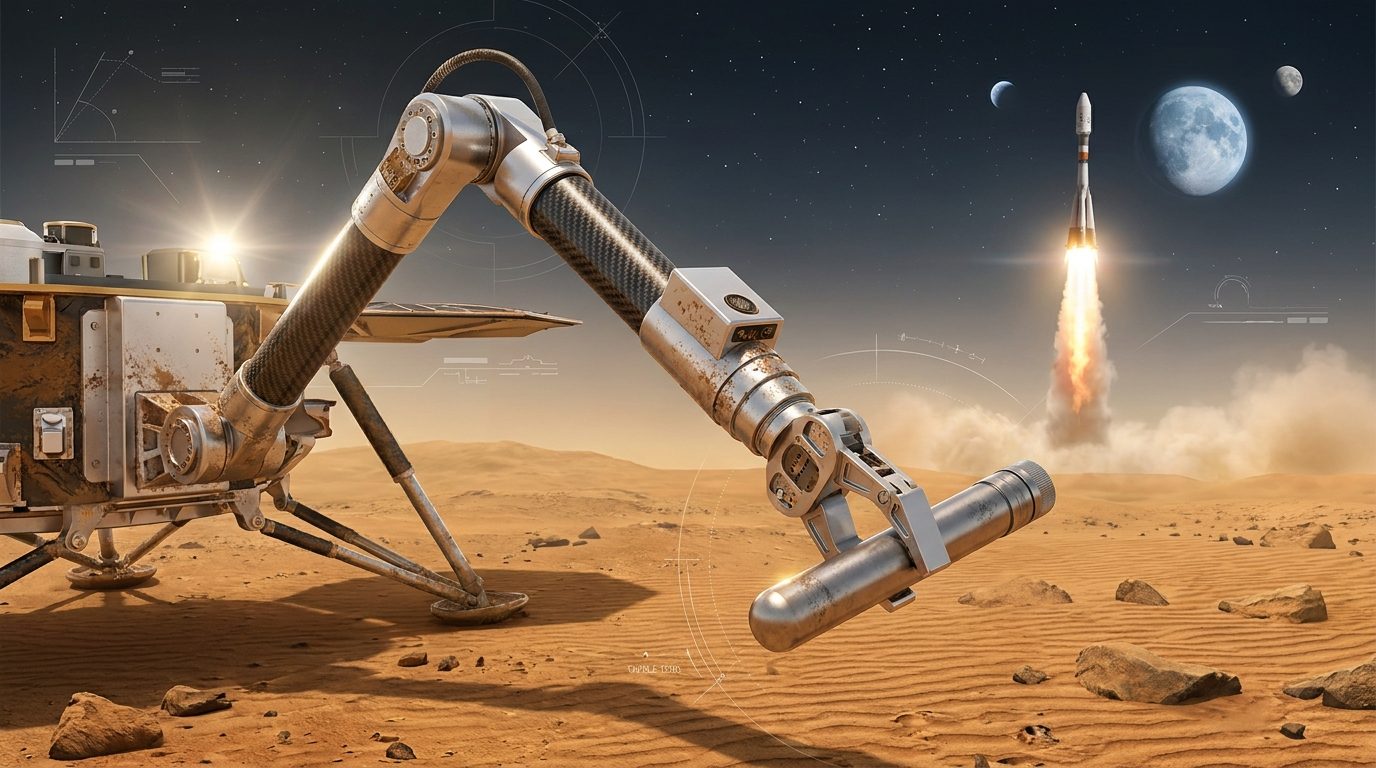
Twenty-three sealed titanium tubes sit in Jezero Crater right now, each containing a core of Martian rock or regolith drilled and cached by the Perseverance rover. Some of those samples came from an ancient river delta — exactly the kind of depositional environment where, on Earth, microbial life leaves chemical and physical signatures in rock. Getting them back to Earth is the highest-priority goal in planetary science. It is also, currently, a mission in serious trouble.
Mars Sample Return (MSR) — the joint NASA/ESA effort to retrieve Perseverance's cache and bring it to Earth — has spent the last three years reckoning with a cost estimate that ballooned past any defensible budget, a schedule that kept slipping toward 2040, and an independent review that essentially said the current architecture would not work as planned. The response has been a fundamental redesign rather than incremental fixes.
What the Original Plan Was
The baseline MSR architecture had three main pieces. A Sample Retrieval Lander would touch down near Perseverance, deploy a small rover to fetch the cached tubes and load them into a Mars Ascent Vehicle (MAV). The MAV — a two-stage rocket small enough to fit inside the lander — would launch the samples into Mars orbit inside a basketball-sized container. ESA's Earth Return Orbiter (ERO), already en route by that point, would rendezvous with the container in orbit, capture it, and carry it back to Earth for a precision parachute landing and strict containment processing.
The engineering challenge at every step is extraordinary. The MAV has to be the first rocket ever launched from another planet. The orbital rendezvous has to happen autonomously 225 million kilometers from the nearest ground station. The sample containment has to be unbreached on landing, because the planetary protection protocols for Martian material are among the strictest ever applied to a returned sample.
Through the early 2020s, this architecture was mature and well-funded. Then the costs started climbing.
How the Budget Broke It
In September 2023, an independent review board convened by NASA concluded that the mission as designed could cost between $8 billion and $11 billion, with the earliest sample return date of 2040. NASA's original estimates had been in the $5–7 billion range, with a return around 2033. The board's assessment was direct: the program lacked a credible budget profile, had insufficient reserves, and was pursuing too many parallel development tracks simultaneously. It recommended NASA either restructure the program substantially or consider whether proceeding was justified.
The political fallout was immediate. Several members of Congress questioned why a single planetary science mission was consuming a budget that threatened other agency priorities. JPL — which leads the mission on the NASA side — carried out significant workforce reductions in early 2024, partly attributable to MSR budget pressures. The program entered a formal restructuring phase.
The New Architecture
In 2024, NASA issued a competitive call for alternative MSR architectures, inviting proposals that could reduce cost and schedule while preserving the core science objective: returning the Perseverance samples intact. The direction that emerged by 2025 centers on two significant changes.
First, the Sample Retrieval Lander is being redesigned to land closer to Perseverance itself, potentially allowing the rover to drive its own cached tubes to the lander rather than relying on a separate retrieval rover. This removes one of the most complex robotic elements from the architecture. Perseverance is in good health as of 2026 — it has outlasted its primary mission design life and remains operational — making this a viable simplification.
Second, NASA has been studying the use of commercial heavy-lift capabilities, including SpaceX's Starship, as an alternative or supplement to the traditional MSR lander approach. Starship's payload capacity to Mars orbit would allow a significantly larger MAV — reducing the engineering challenge of the planetary ascent, which has been one of the hardest problems in the architecture.
ESA's Earth Return Orbiter program has continued largely on schedule and remains the least-changed element of the mission. The ERO's launch window is tied to the Mars departure trajectory, and its development timeline has given ESA leverage in the redesign discussions — the orbiter is already being built.
What Is Actually at Stake
The scientific case for MSR is not in dispute. Perseverance has drilled from sedimentary rock at the Jezero delta — rock laid down in standing water approximately 3.5 billion years ago. These samples contain organic compounds detectable by Perseverance's SHERLOC instrument. Whether those organics are biotic (produced by ancient life) or abiotic (formed through chemistry alone) cannot be resolved by any instrument that has flown to Mars. Only Earth-based analysis — mass spectrometry, isotopic analysis, microscopy at nanometer resolution — can answer the question definitively.
The astrobiological stakes are high enough that the Planetary Science Decadal Survey, which represents the consensus view of the US planetary science community, rated MSR as the top priority for large strategic missions in the 2023–2032 decade. That ranking has not changed despite the cost and schedule problems.
What has changed is the timeline. The current working estimate places a sample return no earlier than 2035, and realistically 2037–2040 depending on how the architectural redesign proceeds. Each additional year extends the gap between collection and analysis — during which the samples sit in Jezero, unanalyzed. The tubes are sealed and the preservation environment is controlled, so degradation is not a concern, but the scientific community's patience is finite.
The Contamination Protocol
One aspect of MSR that receives less attention but is technically demanding: the returned Martian samples must be treated as potentially hazardous biological material until proven otherwise. The Sample Receiving Facility (SRF) — a dedicated biocontainment laboratory that would be purpose-built to handle the samples — has been a contested element of the mission's Earth-side infrastructure.
The containment requirements are stricter than BSL-4 (the highest biosafety level used for Ebola and similar pathogens). The samples must be handled in an inward-leak-only environment that prevents any Martian material from reaching Earth's biosphere, while also preventing Earth contamination from reaching the samples. No existing facility meets these specifications. Building one is part of the mission scope — and part of the cost.
What Comes Next
The architectural review process is expected to produce a final selected approach by late 2026, with formal mission confirmation expected in 2027. The ESA Earth Return Orbiter launch remains the near-term forcing function — its trajectory constrains when the Sample Retrieval Lander must arrive at Mars, which in turn determines the development timeline for the lander and MAV.
For the scientists watching Perseverance's sample cache, the question is whether the mission's institutional difficulties represent a temporary crisis or a permanent downgrade. The samples exist, the rover is healthy, and the science case is undiminished. What MSR needs now is a budget and timeline that can survive contact with political reality.