MCP Is Becoming the Standard API Layer for AI Tool Integration — Here's What Developers Need to Know
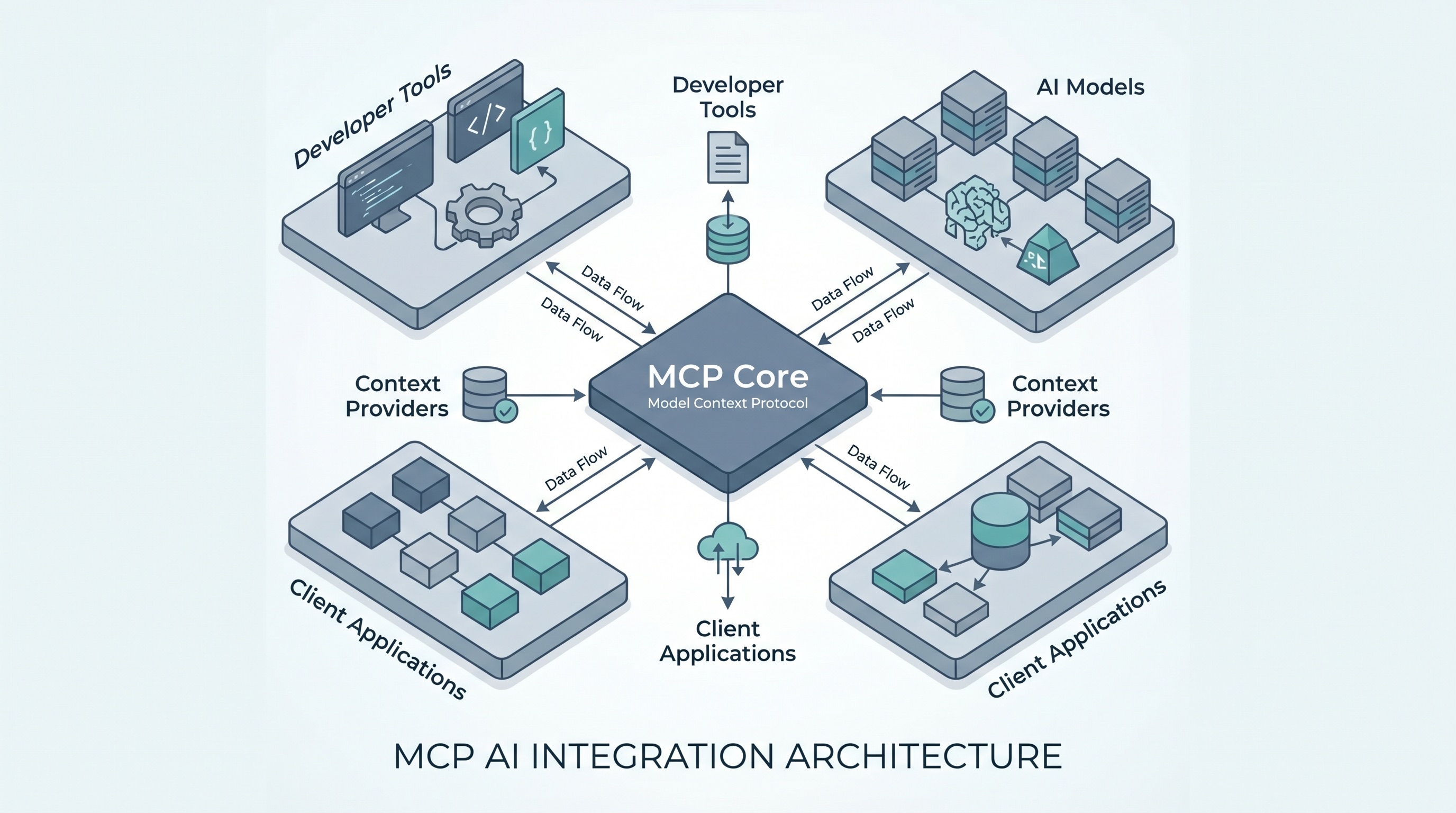
In November 2024, Anthropic released the Model Context Protocol (MCP) as an open standard for connecting AI models to external tools, data sources, and services. At the time, adoption was cautious — a handful of open-source integrations and some early enterprise experiments. By mid-2026, the picture is different. MCP servers now exist for GitHub, Slack, Postgres, Jira, Salesforce, and dozens of other platforms. Claude, Cursor, Windsurf, and several other AI-powered IDEs ship with built-in MCP client support. Microsoft has added MCP compatibility to Azure AI Foundry. The protocol has not killed every competing approach to AI tool integration, but it has established a center of gravity that competing standards must now contend with.
For developers building AI-powered applications, MCP represents a meaningful architectural shift. Rather than writing bespoke integrations for each AI model you want to connect to each data source, you write one MCP server and expose it to any compliant client. The promise is similar to what REST did for web APIs — a shared protocol that lets components interoperate without tight coupling. Whether MCP fully delivers on that promise depends on implementation details that are still being worked out, but the protocol is far enough along that understanding it has become professionally necessary for anyone building in the AI application layer.
What MCP Actually Does
MCP defines three core primitives: tools, resources, and prompts. Tools are functions that an AI model can call — think "search the database" or "create a GitHub issue." Resources are data objects that the model can read — files, database records, API responses. Prompts are reusable templates that the server exposes to the client for common tasks.
The client-server architecture separates concerns cleanly. The MCP server knows about the underlying system (your database schema, your API authentication, your business logic). The MCP client — typically an AI model or IDE — knows nothing about those details; it just knows how to speak the protocol. When the model wants to query your database, it asks the MCP server for the tools available, gets back a schema describing what those tools accept, calls the tool, and gets a structured response.
Transport is handled via either stdio (for local servers) or HTTP with Server-Sent Events (for remote servers). The JSON-RPC 2.0 message format keeps the wire protocol simple and debuggable. One of MCP's underappreciated strengths is that a developer can test an MCP server with a basic curl command or a standard JSON-RPC client before connecting it to any AI model.
The Adoption Curve: From Experiment to Infrastructure
The velocity of MCP adoption has surprised even its creators. The MCP GitHub repository has over 30,000 stars and more than 2,000 community-contributed server implementations as of June 2026. The MCP registry maintained by Anthropic lists over 400 verified servers. This is not organic adoption — it reflects deliberate choices by major platforms to standardize on MCP rather than build proprietary integration layers.
The turning point was probably Cursor's decision in early 2025 to make MCP its primary mechanism for IDE-to-tool integration. Cursor has approximately 500,000 active developers as of 2026, and when Cursor ships a protocol, the ecosystem builds for it. GitHub Copilot followed with MCP support later in 2025. At that point, MCP stopped being "the protocol Anthropic made" and became "the protocol that IDEs support," which is a qualitatively different category.
Enterprise adoption has followed a different path. Large companies are using MCP to give their internal AI assistants access to internal systems without exposing those systems to public APIs. A company might deploy a private MCP server that wraps their internal CRM, their ERP system, and their document management platform, then connect that server to Claude or GPT-4 running in a private cloud. MCP's scoping mechanisms — which let server administrators control exactly which tools are exposed to which clients — make this a reasonable security architecture.
Where MCP Falls Short
MCP is not a solved problem. Several friction points are actively limiting adoption in production environments.
Authentication is the most discussed gap. MCP's current specification has limited standardization around OAuth flows, API key management, and permission scoping. Each server implementation handles auth differently, which means client applications cannot assume a consistent authentication experience. Anthropic and the MCP working group have published a draft authentication extension, but it is not yet ratified or widely implemented.
Streaming support for long-running tools is another open area. If a tool call triggers a process that takes 30 seconds — running a test suite, executing a database migration, processing a large file — the current protocol requires the client to wait for a complete response. Server-Sent Events help with some scenarios, but the protocol's model is fundamentally request-response for tool calls, which creates latency problems for genuinely long operations.
Discovery is also immature. There is no standardized way for a client to find available MCP servers, evaluate their capabilities, or assess their trustworthiness. The community is discussing a registry-based approach with signed manifests, but this infrastructure does not yet exist at scale.
Competing Approaches: OpenAI, LangChain, and Others
MCP is not the only approach to AI tool integration. OpenAI's function calling specification, LangChain's tool interface, and various vendor-specific plugin architectures all address similar problems. The key difference is that MCP is designed as an open, transport-agnostic, client-server protocol rather than a model-specific function calling convention or a framework-level abstraction.
OpenAI has not adopted MCP and continues to develop its own tools API. This creates a fragmentation problem for developers who want to support both Claude and GPT-4 through the same tool server. Some projects have built compatibility shims, but there is no clean solution yet. If OpenAI eventually adopts MCP or publishes a compatible standard, the fragmentation problem largely goes away; if not, developers may end up maintaining parallel implementations.
Practical Recommendations for Developers
- Start with the official MCP SDK. Anthropic maintains TypeScript and Python SDKs that handle protocol serialization, transport management, and error handling. Building on these is substantially faster than implementing the protocol from scratch.
- Design your tools around atomic operations. MCP tools work best when each tool does one well-defined thing. Avoid building tools that have complex side effects or require multi-step orchestration within a single call.
- Use resources for read-only data access. If you are exposing read-only data (configuration, reference data, documents), MCP resources are cleaner than tools — they have better caching semantics and clearer intent.
- Implement structured error responses. AI models handle errors better when tool responses include structured error information rather than just exception text. Define error schemas for your tools and return them consistently.
- Test with multiple clients. An MCP server that works perfectly with Claude may behave differently with Cursor or other clients. Test against at least two clients before treating your server as production-ready.
MCP's trajectory suggests it will be a durable part of the AI development stack, not a temporary solution. The protocol's design is sound enough to handle the common cases, the ecosystem is large enough to provide network effects, and the alternative — every platform building its own integration layer — is painful enough that consolidation around a shared standard makes economic sense. Developers who invest in understanding MCP now are building skills that will compound over the next several years of the AI application layer buildout.