MCP Has Become the Standard for AI Tool Integration: What It Is and Why It Spread So Fast
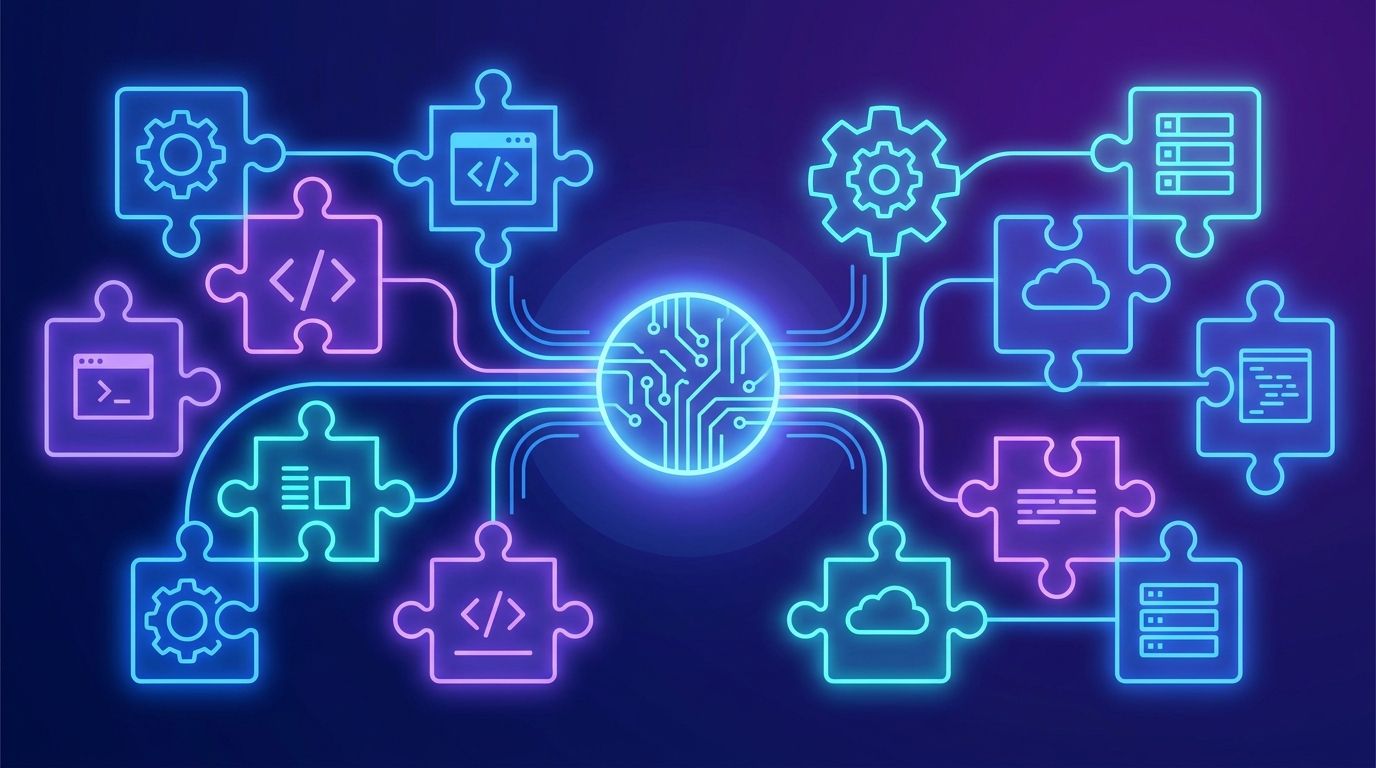
In November 2024, Anthropic released a specification called the Model Context Protocol. Eighteen months later, MCP has 97 million monthly SDK downloads, 17,000 active public servers, and support from OpenAI, Google, Microsoft, GitHub, and AWS. Anthropic donated the protocol to the Linux Foundation in December 2025, forming the Agentic AI Foundation with OpenAI and Block as co-founders. MCP is now the closest thing the AI tooling ecosystem has to a universal standard.
What MCP Actually Is
MCP is a protocol that standardizes how AI models connect to external data sources and tools. Before MCP, each AI application built its own bespoke integration layer -- custom code to connect the model to a database, a calendar, a code repository, or an API. Every integration was one-off, fragile, and non-transferable. MCP solves this by defining a standard interface: any MCP-compatible model can communicate with any MCP server, and any MCP server works with any compatible model without modification.
The architecture has three components. An MCP host is the application running the AI model -- Cursor, Claude Desktop, VS Code with Copilot, or a custom application. An MCP client handles communication with servers. An MCP server exposes resources (readable data), tools (callable functions), and prompts (reusable templates) to the client. The protocol runs over stdio for local connections and HTTP with server-sent events for remote servers.
Why Adoption Happened So Fast
The 97 million monthly downloads figure is structurally surprising -- protocol adoption typically takes years and requires a dominant platform to force it. MCP achieved critical mass in about 13 months for three reasons. The timing was right: developers were experiencing the integration problem firsthand. The design was pragmatic: MCP defined a narrow, clear interface for the most common patterns and left everything else out. And the governance move was decisive: donating to the Linux Foundation removed the vendor lock-in concern that would have stalled enterprise adoption. When OpenAI, Google, Microsoft, GitHub, Cloudflare, and Bloomberg joined as foundation members rather than as Anthropic licensees, architects made the adoption decision instead of waiting for a competing standard.
The Production Reality in 2026
41% of software organizations are running MCP servers in production. The most common use cases are connecting AI tools to documentation and knowledge bases, API integrations, and developer tooling like Git repositories. Approximately 80% of frequently searched MCP servers offer remote deployment -- preferred over local stdio connections for maintainability at scale. FastMCP (42%) and Anthropic's SDK (38%) dominate the server-building toolchain.
The Known Problems
The most discussed critique is token bloat. When an MCP server returns context to a model, that context consumes tokens in the context window. For complex integrations pulling in large amounts of context, the overhead increases inference costs and can crowd out the actual conversation content. The solution involves layering: using a lightweight retrieval step to identify the most relevant context before sending it to the model, rather than dumping everything available. Teams handling this well treat MCP servers like APIs -- returning only what the current query requires, not everything that might conceivably be relevant.
Where It Goes Next
The protocol roadmap focuses on stateless streamable HTTP, stronger authentication for remote server access, and governance tooling for auditing which tools a model called and what data it accessed. As AI agents become more autonomous, the audit trail for their external tool use becomes a compliance requirement. MCP's architecture is well-positioned to provide that trail if the governance tooling matures appropriately.