NASA and ESA Lock In the Artemis Lunar Base Camp Design — First Crewed Surface Stay Planned for 2030
From Flags and Footprints to a Permanent Outpost
The Apollo program gave humanity 12 men on the Moon and 382 kilograms of samples. Then nothing for 52 years. Artemis was always supposed to be different — not a one-shot sprint but a sustained presence. After multiple schedule slips and a redesign of the lunar lander program following SpaceX's Starship HLS selection, NASA and ESA finalized the Artemis Base Camp architecture in April 2026, with a target of the first crewed surface stay of 30+ days in 2030.
The finalized design is more austere than the 2022 concept renders suggested, but it is also more realistic. Understanding what changed and why matters for anyone following the commercial space industry — because this program is now deeply entangled with SpaceX, Axiom, Northrop Grumman, and a dozen other contractors.
What the Base Camp Actually Consists Of
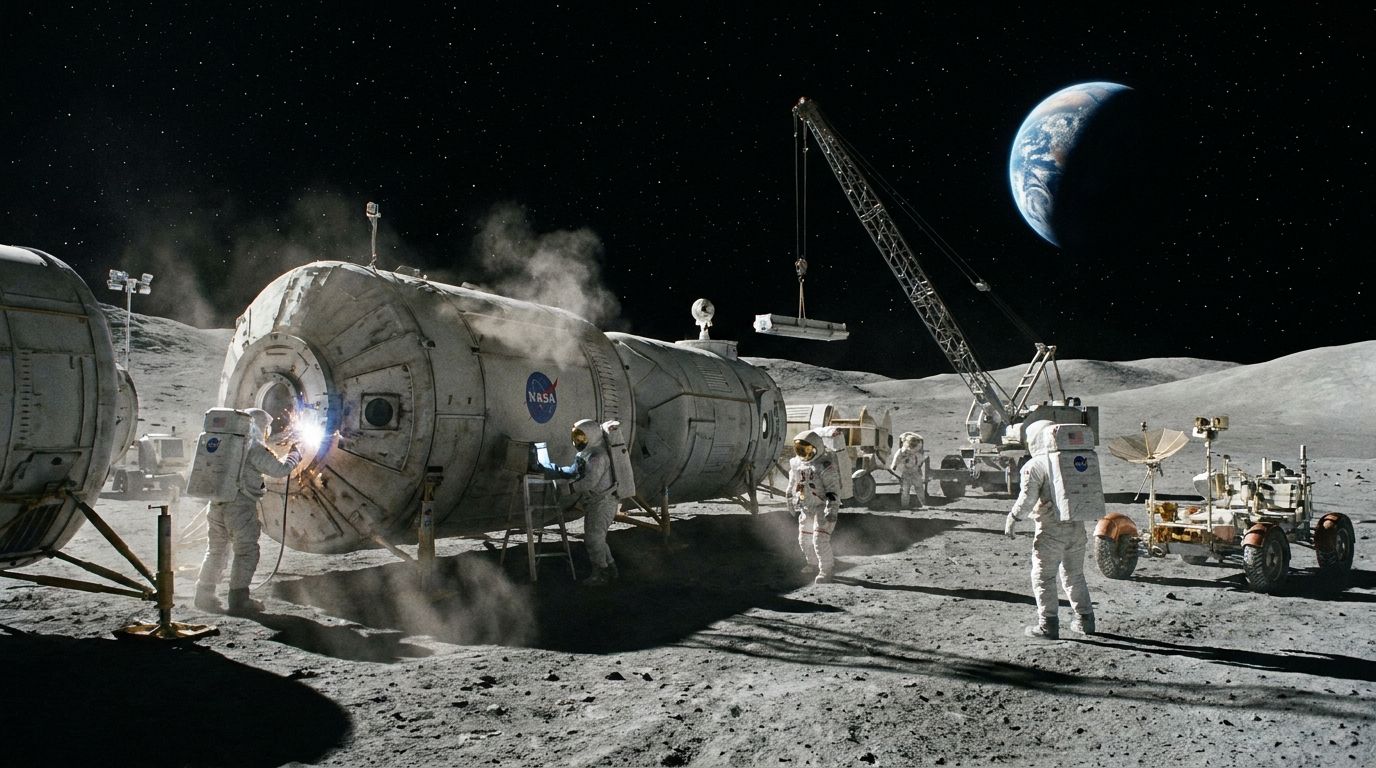
The Artemis Base Camp is not a single structure. It is a modular system of four main components designed to be delivered separately by Starship HLS over three cargo missions before any crew arrives:
- Habitation module: A pressurized cylinder rated for 4 crew members for up to 60 days. Built by Northrop Grumman under a $2.1 billion contract awarded in March 2025. Roughly the same internal volume as the ISS Columbus module.
- Lunar Terrain Vehicle (LTV): An unpressurized rover for surface EVA operations up to 20 km from camp. Three competing teams (Intuitive Machines/Boeing, Lunar Outpost, and Venturi Astrolab) are building prototypes; downselect is scheduled for Q3 2026.
- Power and Communications Relay: A 40 kW fission surface power unit developed by NASA Glenn Research Center in partnership with Westinghouse. This is what makes extended stays viable — solar alone cannot maintain the south pole habitat through the 14-day lunar nights.
- ISRU pilot plant: An in-situ resource utilization demonstration unit designed to extract water ice from regolith and electrolyze it into liquid oxygen and hydrogen. Built by Air Products and ESA. This is explicitly a pilot — it will not supply the full mission oxygen budget in 2030, but it is intended to prove the extraction rate and purity targets.
Why the South Pole — and Which Exact Site
The south pole has been the target since 2019 for three converging reasons: confirmed water ice (LCROSS impact data, confirmed by Chandrayaan-3 LIBS instrument in 2023), near-continuous solar illumination on certain ridge peaks, and radio silence from Earth interference at the shielded interior craters. The selected site is the Shackleton-de Gerlache Ridge, a 4.2 km elevated feature that modeling shows receives around 89% solar illumination averaged over the year.
This site was chosen over Malapert Massif — the other finalist — primarily because it offers better line-of-sight communications with Earth relay satellites in Near-Rectilinear Halo Orbit (NRHO) and easier terrain access to the confirmed ice deposits 11 km away in the permanently shadowed Shackleton Crater interior.
The 2030 Target: What Makes It Credible (and What Does Not)
The critical path to 2030 runs through Starship HLS. SpaceX has completed three uncrewed Starship test flights with successful booster catch, and the HLS-specific variant with the lunar descent stage is on track for an uncrewed cargo demonstration to the Moon in late 2027. That leaves a margin of roughly two years for the three cargo pre-deployment missions before the first crewed landing.
What makes 2030 less certain: the Axiom Space lunar spacesuit (AxEMU) has slipped its critical design review twice and is now scheduled for CDR in September 2026. The suit must be certified before any crewed surface EVA occurs. Additionally, the fission power unit has never operated in a vacuum environment at full power — the first ground test in lunar thermal conditions is planned for mid-2027 at NASA Glenn.
ESA's contribution — the European Large Logistics Lander (EL3) — is not on the critical path for 2030, but it is intended to supply cargo resupply missions from 2031 onward. ESA member states confirmed EL3 funding at the November 2025 ministerial meeting, at 1.4 billion euros through 2033.
Commercial Competition and Geopolitical Context
China's CNSA and ROSCOSMOS published their International Lunar Research Station (ILRS) architecture in January 2026, targeting 2035 for a crewed surface stay. The ILRS site selection also converged on the south pole — specifically Amundsen Crater. This creates a real question about resource claim overlap that the Artemis Accords, signed by 47 nations as of May 2026, do not fully resolve. The Accords establish safety zones around operations but do not establish property rights or first-mover claim mechanisms.
This ambiguity is not abstract — it has already influenced Base Camp site selection. The Shackleton-de Gerlache Ridge location was partly preferred because it is farther from the Amundsen Crater area CNSA has publicly targeted, reducing the probability of overlapping operations zones.
What to Watch in the Next 18 Months
Three milestones will signal whether 2030 is real or wishful thinking:
- September 2026: Axiom AxEMU Critical Design Review. A second slip here would push the crewed surface timeline to 2031 at minimum.
- Late 2027: SpaceX Starship HLS uncrewed lunar cargo delivery. This is the single most important milestone in the program. Success validates the entire cargo architecture; failure would require a fundamental redesign.
- Mid-2027: NASA Glenn fission power ground test. Failure modes here are manageable (the unit could be redesigned), but they would affect the on-surface power timeline.
The Artemis Base Camp is the most ambitious sustained human spaceflight program since the ISS. Unlike the ISS, it is being built in an environment where launch costs have dropped 90% and private companies are doing the heavy lifting. That combination of serious institutional goals and genuinely cheaper access to space is what gives the 2030 target credibility that no previous lunar architecture proposal has had.