NASA cancelled the Lunar Gateway — and is betting on Moon bases instead
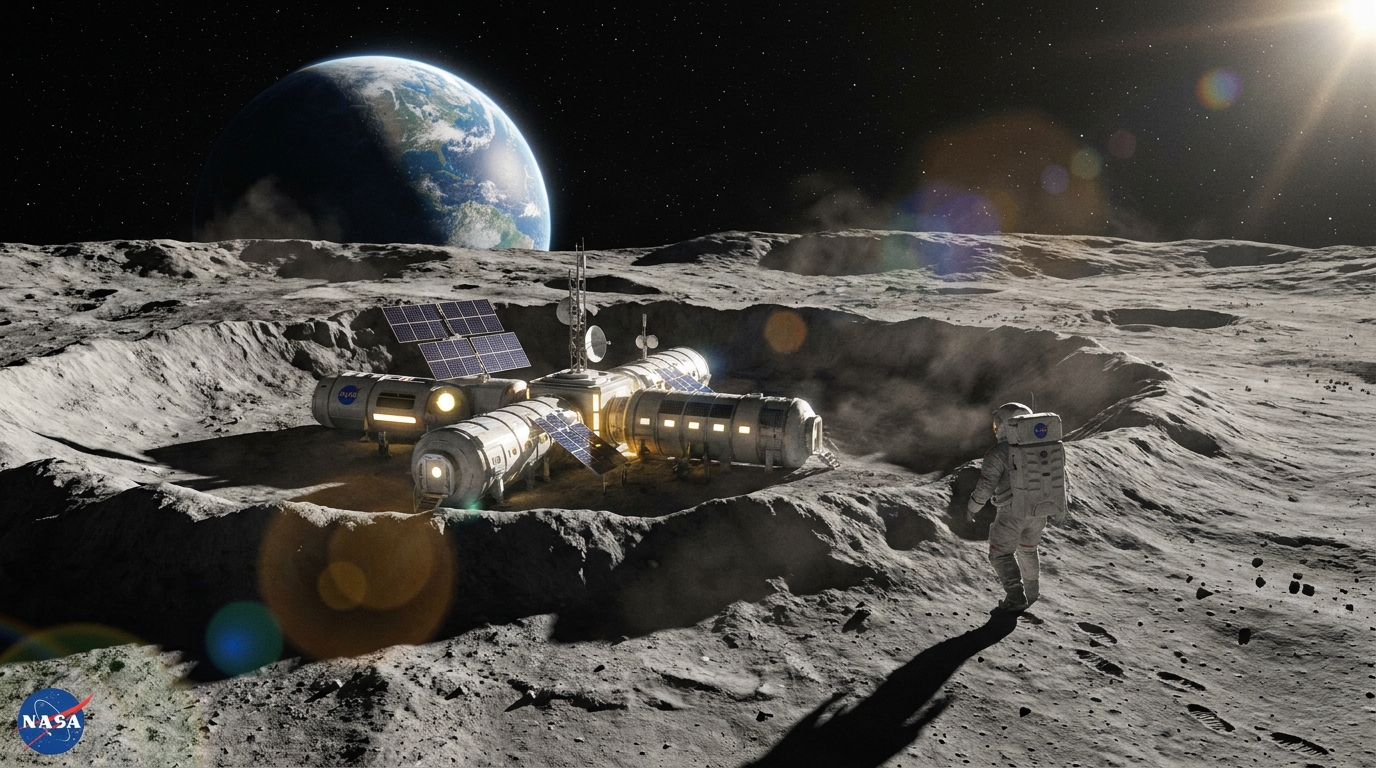
The Lunar Gateway is effectively dead. In March 2026, NASA announced it was pausing the Gateway program "in its current form" — bureaucratic language that translates, in practice, to cancellation. The cislunar space station that international partners had been building toward for five years, and that was supposed to serve as humanity's first outpost in the Moon's orbital neighborhood, has been set aside in favor of something more direct: going straight to the surface and staying there.
The decision carries real consequences — for international partnerships, for contracts already awarded, for hardware already in fabrication. But it also reflects a genuine strategic reassessment of what lunar exploration actually requires and what the US space program can afford to prioritize.
What the Gateway was supposed to be
The Lunar Gateway was conceived as a small space station in a near-rectilinear halo orbit (NRHO) around the Moon — a highly elliptical orbit that brings the station as close as 3,000 km to the lunar surface at its nearest point. Unlike the ISS in low-Earth orbit, the Gateway would have operated in a regime where direct communication with Earth requires significant signal delay and where the radiation environment is substantially more intense.
The architecture centered on two initial elements. The Power and Propulsion Element (PPE) — a solar-electric propulsion system that would serve as the station's primary mover — and the Habitation and Logistics Outpost (HALO), a pressurized module where astronauts would live during Gateway operations. Both were contracted to Maxar Technologies and Northrop Grumman respectively, with a planned joint launch on a SpaceX Falcon Heavy targeted for 2027. International partners — ESA, JAXA, and the Canadian Space Agency — had committed modules, robotic systems, and crew time.
The Gateway's role in Artemis was to serve as a staging point between Earth and the lunar surface. Rather than launching directly from Earth to the Moon's surface (the Apollo approach), Artemis astronauts would rendezvous with Gateway in NRHO, transfer to a lunar lander, descend to the surface, return to Gateway, and then fly home. Gateway added complexity and transfer time but was supposed to provide long-term operational benefits: a place to store equipment, a base for long-duration stays, a staging point for Mars-preparation missions.
Why it was cancelled
The strategic review that led to the March 2026 announcement identified several compounding problems. Cost growth was the proximate cause — the Gateway's budget projections had escalated substantially from original estimates, and the per-mission cost of the Gateway-reliant architecture was significantly higher than direct-to-surface profiles. The HALO module's mass had grown during development to the point where the Gateway system would have been overweight relative to Falcon Heavy's lift capacity to NRHO, requiring either a different launcher or a redesign.
The schedule was also slipping badly. Gateway was intended to support Artemis IV, which has itself been delayed repeatedly. By 2026, the realistic Gateway operational date had shifted toward 2030 or later, meaning a decade of Artemis missions would have needed to operate without it. NASA concluded that an architecture optimized around hardware that doesn't exist yet, targeting a launch date that keeps moving right, wasn't a rational operational foundation.
The political context mattered too. The Trump administration's broader posture toward NASA has emphasized commercial partnerships, rapid results, and skepticism of programs that require sustained multi-year international coordination without near-term deliverables. The Gateway's complexity — coordinating hardware from four space agencies, operating in a challenging orbital regime, maintaining international logistics across mission cycles — made it politically vulnerable in a way that a simpler "go to the Moon and stay" narrative is not.
What replaces it: direct surface presence
NASA's updated lunar architecture skips the orbital staging point and targets the surface directly. The agency is developing what it calls "sustained lunar surface presence" — a series of missions that establish progressively more capable infrastructure on the Moon itself, with initial Moon Base missions outlined for 2026 onward.
The direct architecture uses SpaceX's Starship HLS (Human Landing System) as the primary means of getting from Earth orbit to the lunar surface. Starship's lift capacity — far greater than what Gateway-era hardware assumed — makes a direct Earth-to-Moon-surface mission architecture feasible in a way it wasn't during Apollo. An Orion capsule carries crew to an elliptical orbit; Starship HLS, refueled in low-Earth orbit, meets them there and takes them to the surface.
The hardware being redirected from Gateway is significant. The PPE — which contains advanced solar-electric propulsion technology — is being repurposed as a standalone nuclear-electric propulsion demonstrator. The technology remains valuable for deep space applications even if the Gateway station it was designed for is no longer being built. The HALO contract's future is less clear; Northrop Grumman and NASA are negotiating what, if anything, HALO hardware might be adapted for.
What this means for international partners
The Gateway's cancellation is a diplomatic complication that NASA has been managing carefully. ESA had committed the International Habitation Module (I-HAB) and the ESPRIT refueling and communications module. JAXA had committed the JEM Exposed Facility for scientific research. Canada had committed the Canadarm3 robotic system. These are not trivial contributions — they represent billions of dollars in partner investment and years of engineering work.
NASA's position is that international partnership remains a priority and that partner hardware and expertise will be redirected to surface missions and other lunar infrastructure. The specifics are still being worked out. Some partner hardware may be adaptable to surface habitats or lunar orbital demonstration missions that don't require Gateway's full architecture. The Canadarm3 robotic system, for instance, has potential applications in lunar surface operations independent of any orbital station.
The harder conversation is about governance. The Gateway was structured as a genuinely multilateral program, with partners having formal roles in operations, scheduling, and crew access. Surface missions run by NASA and commercial partners have a different power dynamic — international partners as customers or contributors rather than co-operators. How that transition negotiates the expectations set over the last decade of Gateway planning is a diplomatic challenge that goes well beyond the technical architecture question.
The case that this is the right call
Set aside the sunk costs and diplomatic friction, and the strategic logic of the Gateway cancellation is not hard to follow. A Moon base that provides a physical foothold on the lunar surface — power infrastructure, landing pads, habitat, resource extraction equipment — is more durable and more useful than a small station in a distant orbit that can only be reached by purpose-built spacecraft. Apollo's lesson was that you can get to the Moon and back without permanent infrastructure; the missing capability isn't an orbital way station, it's the ability to stay.
The resources and timeline that would have gone into Gateway can instead go into surface infrastructure that supports longer stays, more science, and a credible path to the kind of lunar economy that commercial space advocates have been projecting for the 2030s. The Moon base is harder to cancel politically once it exists as hardware on the surface — a strategic consideration not lost on anyone who remembers Gateway's own vulnerability.