NASA's Lunar Gateway Is 3 Years Behind Schedule — And Commercial Stations Are Catching Up
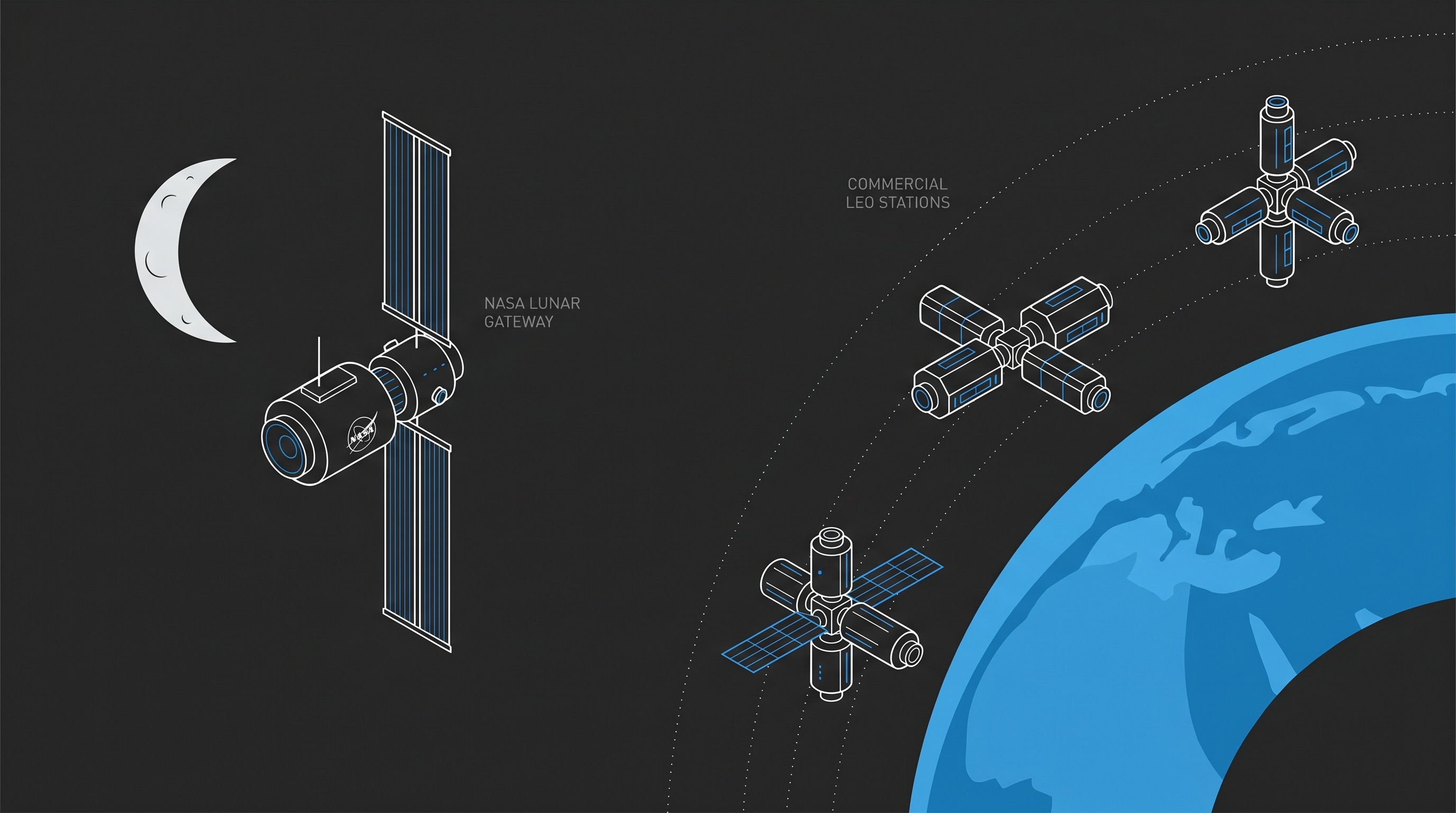
When NASA selected Northrop Grumman and other contractors to build the Gateway lunar orbiting station in 2021, the plan was to have the first modules docked in cislunar orbit by 2027. That timeline has quietly collapsed. As of early 2026, the agency's own internal audits place the first crewed Gateway mission no earlier than 2031 — a four-year slip driven by contractor delays, budget uncertainty from continuing resolutions, and a post-Artemis III reprioritization of resources.
The delay matters for reasons beyond the obvious schedule embarrassment. Gateway was supposed to serve as a staging point for sustained lunar surface operations — the hub through which astronauts would transfer to the Human Landing System before descending to the South Pole. Without it, NASA's architecture for repeated lunar access after Artemis III is incomplete. But while Gateway stumbles, the commercial space station sector is accelerating in ways that complicate NASA's narrative about what a "permanent human presence in space" actually requires.
What Caused the Slippage
The Gateway program has faced three compounding problems since 2022. First, the Power and Propulsion Element (PPE) — the solar-electric propulsion module being built by Maxar Technologies — ran into hardware integration issues that pushed its launch from 2024 to 2026, and now to 2027. Second, the Habitation and Logistics Outpost (HALO) module, built by Northrop Grumman, has had structural and welding rework that added 18 months to the schedule. Third, the entire program has been operating under flat or reduced appropriations since fiscal year 2024, meaning contractors cannot hire or buy long-lead materials at the rate the original schedule assumed.
A March 2026 Government Accountability Office report flagged Gateway as a "high schedule risk" program and noted that NASA has not yet baselined a realistic integrated master schedule for the full station. That is a significant admission for a program that is, on paper, central to the Artemis campaign.
Axiom Space: Module by Module on the ISS
Axiom Space is taking a different approach. Rather than building a standalone station from scratch, Axiom has attached its first module — Axiom Module 1 (AxM-1) — to the International Space Station as a stepping stone. AxM-1 launched in 2024 and serves as a commercial node on the ISS. Axiom Modules 2 and 3 are scheduled to follow before the ISS is deorbited, at which point the Axiom cluster detaches and operates as an independent station.
This incremental strategy has real advantages. Axiom is generating revenue from private astronaut missions — including the Ax-3 and Ax-4 missions — while building out its hardware. Each mission to the ISS earns the company operational experience and cash that funds the next module. By the time the ISS retires (currently planned for 2030), Axiom intends to have a functional, crewed station in low Earth orbit without the political and budget vulnerabilities that plague government programs.
Starlab: The Clean-Sheet Commercial Station
Voyager Space and Airbus are developing Starlab, a single-launch station that packages a large habitation module, a docking hub, and a laboratory into one vehicle — scheduled for launch on a Starship rocket in 2028. Unlike Gateway's multi-launch assembly approach, Starlab's design philosophy prioritizes simplicity. One launch, one pressurized volume of approximately 340 cubic meters, designed from the outset for commercial research and private crew rotations.
Starlab received $400 million in NASA Commercial Low Earth Orbit Destinations (CLD) funding, and Airbus's involvement as a manufacturing partner gives the program industrial depth that other commercial station proposals lack. The partnership with Starship for launch is both a technical bet and a financial one — SpaceX's pricing for Starship payloads is expected to undercut any alternative, but the vehicle is still in test campaign as of 2026.
What This Means for NASA's Architecture
The divergence between Gateway's delays and commercial station progress creates a structural question for NASA's human spaceflight strategy. Gateway was justified partly on the grounds that it would support lunar operations while also serving as a waypoint for eventual Mars missions. But if commercial stations in LEO are operational and generating scientific data by 2029-2030, the rationale for Gateway's cost — currently estimated at $8-10 billion for the initial configuration — becomes harder to defend to Congress.
There is also the ISS retirement factor. The station is scheduled to deorbit in 2030, which means NASA is paying for both ISS operations and Gateway development simultaneously, with commercial stations also in the mix. The agency needs at least one commercial successor to the ISS operational in LEO before the ISS goes down; otherwise there is a gap in US human spaceflight capability in low Earth orbit while resources are focused on the Moon.
SpaceX Starship and the Direct-to-Moon Question
One option that has gained traction in internal NASA discussions is a "Gateway-lite" approach: using Starship's deep-space transport capability to deliver crew and cargo directly to lunar orbit or the surface without a permanent cislunar station. SpaceX's Human Landing System contract already envisions Starship delivering crew to the lunar surface; extending that to a point-to-point architecture that skips Gateway would save money and complexity at the cost of Gateway's long-term value as a reusable hub.
As of 2026, NASA has not officially endorsed the Gateway-lite path, but neither has it fought hard for Gateway's budget in recent appropriations cycles. The program continues to exist, but with a lower political urgency than it had in 2021-2022.
Key Takeaways
- Gateway's first crewed mission has slipped to 2031 at the earliest, four years behind the original plan, due to hardware delays and flat budgets.
- Axiom Space's incremental ISS-attachment strategy gives it a path to operational independence by 2030 without needing a clean-sheet development program.
- Starlab, launching on Starship in 2028, aims to be the primary commercial successor to the ISS in low Earth orbit with a single-launch design.
- The case for Gateway's $8-10 billion price tag is weakening as commercial alternatives mature and SpaceX's direct-to-Moon capabilities expand.
- NASA faces a decision point by 2027: recommit fully to Gateway or accept a commercial-led cislunar architecture and redirect resources to lunar surface infrastructure.
The fundamental shift is not that Gateway is failing — it is that the rest of the commercial space ecosystem is succeeding faster than NASA's schedule-driven acquisition model can accommodate. The question for the next two budget cycles is whether Congress and the White House are willing to make that tradeoff explicit rather than letting schedule slippage make the decision by default.