NASA's Lunar Gateway Is Behind Schedule, Over Budget, and Still the Best Plan to Stay on the Moon
A Station That Never Touches the Moon
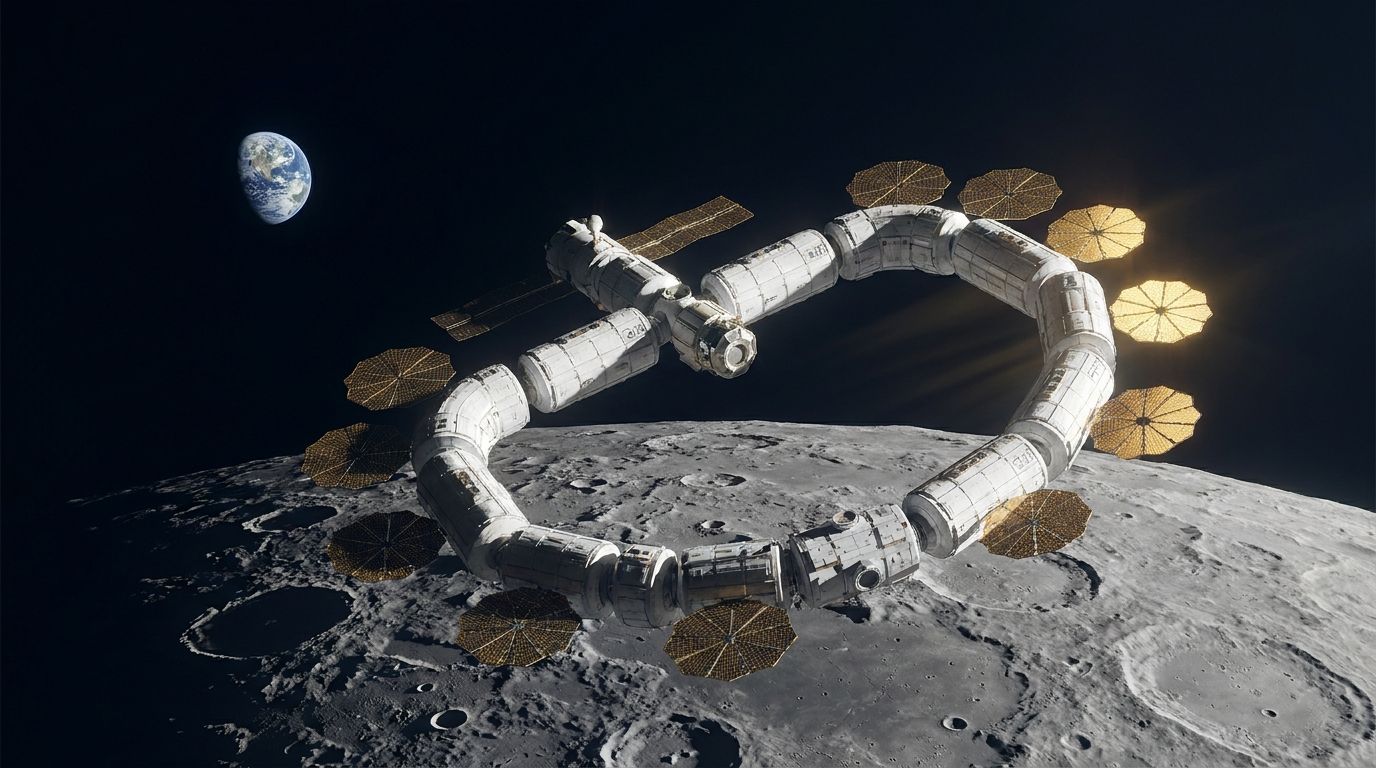
The Lunar Gateway is not a lunar base. It will not sit on a crater rim or bore into regolith. It is a small modular space station planned for a near-rectilinear halo orbit around the Moon — a highly elliptical path that swings within 3,000 kilometers of the lunar surface at its closest point and reaches roughly 70,000 kilometers at its farthest. At roughly one-sixth the pressurized volume of the International Space Station, it is a staging post, not a settlement.
That distinction matters for understanding what Gateway is designed to do. It will serve as a communications relay, a refueling depot, a shelter during solar particle events, and most critically, a docking hub from which Artemis crews will depart for the surface aboard a commercial lander. The engineering logic is real: an orbiting platform covers both polar and equatorial landing sites without relocating, something a fixed surface base cannot offer.
Where It Stands in 2026
The original plan called for launching the first Gateway elements in 2024. That date has slipped to no earlier than 2028. The two founding modules — NASA's Power and Propulsion Element (PPE), which provides solar electric propulsion and power, and the Habitation and Logistics Outpost (HALO), which provides crew living quarters and docking ports — will fly together on a SpaceX Falcon Heavy. The launch has been pushed twice, first from 2024 to 2025, then into 2028 as integration work and funding gaps mounted.
Cost has tracked the delays upward. The US contribution to Gateway — primarily PPE and HALO, contracted to Maxar Technologies and Northrop Grumman respectively — was originally estimated at $4.3 billion. Current projections have that figure exceeding $8 billion, and the program has not yet finalized cost estimates for follow-on elements. For context, the entire Apollo program cost roughly $25 billion in 1960s dollars; Gateway is approaching Apollo-class expenditure for a single orbital outpost that accommodates four crew members on short rotational stays.
A Coalition That Complicates Cancellation
One reason Gateway survives budget reviews that would have killed a purely domestic program is its international structure. The partnerships woven into the program are now load-bearing:
- ESA is contributing ESPRIT (a refueling and communications module) and, in partnership with other European space agencies, the International Habitat (I-Hab) — a second crew module that significantly expands Gateway's operational capacity.
- JAXA (Japan Aerospace Exploration Agency) is contributing logistics resupply through the HTV-X vehicle, extended for lunar-distance operations.
- CSA (Canadian Space Agency) is providing Canadarm3, a next-generation robotic system capable of autonomous maintenance operations on the station exterior.
Withdrawing from Gateway now would not just cancel a program — it would invalidate treaty-level commitments and hand adversaries a geopolitical narrative about American reliability in space. That is not an engineering argument, but it is a real one in Washington budget discussions.
The Commercial Lander Question
Gateway's role as an operations hub only makes sense if there are reliable human landing systems using it. Right now, that means SpaceX's Starship Human Landing System (HLS), which won NASA's initial lander contract in 2021. The architecture has astronauts traveling from Earth to Gateway aboard NASA's Orion capsule, then transferring to a waiting Starship HLS for descent to the surface. Blue Origin's Blue Moon lander — selected as a second provider — is still in development and serves as the backup to reduce single-vendor dependency.
Starship's own development timeline has had well-documented turbulence, though recent integrated flight tests have demonstrated significant progress. Whether Starship HLS will be ready to support crewed lunar surface missions on schedule is a question with real operational implications for Gateway's first years of service.
The Tollbooth Criticism
Not everyone finds this architecture compelling. Robert Zubrin, aerospace engineer and founder of the Mars Society — and architect of the Mars Direct mission concept — has been among Gateway's most persistent critics, famously describing it as a "tollbooth to nowhere" that adds mass, cost, and risk to lunar surface access without commensurate benefit. The argument is that Orion and a lander could fly direct to lunar orbit and descend without the Gateway intermediary, saving mission complexity and years of schedule.
The counterargument from Gateway's proponents centers on redundancy and flexibility. A persistent orbital platform means crew members have a safe harbor if a lander develops a fault before descent. It means pre-positioned supplies and equipment for back-to-back missions. It means the surface access architecture is not rebuilt from scratch for every flight. Whether that flexibility justifies the cost delta depends heavily on assumptions about mission cadence — if Artemis lands twice a decade, Gateway's overhead is hard to justify. If it enables a dozen missions, the economics shift.
The Budget Environment
NASA entered 2025 and 2026 in a difficult fiscal position. Multiple major programs — including SLS, Orion, and Gateway — are simultaneously in cost-growth phases, and the current administration has been less enthusiastic about civil space spending than its predecessors. Gateway has survived these reviews, but not without pain: staffing freezes, restructured contracts, and delayed milestones have become a recurring theme.
The program's industrial footprint — work spread across Maxar (now acquired by Advent International), Northrop Grumman, Honeybee Robotics, and dozens of subcontractors — provides some political insulation. But it also makes cost control harder. Large aerospace programs with geographically distributed workforces have a structural tendency toward schedule growth, and Gateway is not immune.
What the Engineering Gets Right
Amid the schedule slips and budget headlines, it is worth noting what Gateway's design does well. Unlike ISS — assembled piece by piece in orbit over 13 years using shuttle missions — Gateway's modules are being built and tested on Earth and launched largely pre-integrated. PPE and HALO launch mated together. This substantially reduces on-orbit assembly risk, one of the ISS program's most significant operational challenges.
The PPE's solar electric propulsion system deserves particular attention. Instead of chemical rockets burning large quantities of propellant to maneuver, PPE uses a Hall-effect thruster system — high-efficiency ion propulsion that slowly but efficiently repositions the station in lunar orbit. This dramatically reduces the propellant mass that must be launched to lunar distance, which is one of the most expensive line items in deep space operations. The tradeoff is low thrust, meaning maneuvers take weeks rather than hours, but for a station that does not need to change orbits quickly, that is an acceptable constraint.
What Success Looks Like
If the 2028 launch holds, and PPE/HALO reach their operational orbit and check out successfully, Gateway will become humanity's first crewed outpost beyond low Earth orbit since Apollo 17 departed the lunar surface in December 1972 — a gap of more than 55 years. That milestone deserves to be named clearly, without public-affairs softening.
The program's challenges are real: costs that have doubled, schedules that have slipped by years, a budget environment that has grown more hostile, and a fundamental architectural debate about whether a lunar-orbit station is necessary or merely expensive. But the engineering case for a persistent cislunar platform — one that can shelter crews, stage logistics, and adapt to multiple landing sites — has not weakened. The case for patience with a program that has real international obligations and real engineering advantages is, on balance, still sound. Whether the political and fiscal environment allows for that patience is the question Gateway has not yet answered.