Neuromorphic Chips Reach Commercial Deployment — Intel's Hala Point Processes 20 Quadrillion Operations Per Watt
What Neuromorphic Computing Actually Is — and Isn't
Neuromorphic computing gets described imprecisely in most coverage, so a clear baseline matters. Conventional computers — CPUs, GPUs, even AI accelerators like Google's TPUs — use the von Neumann architecture: a processor and memory are separate components, data shuttles between them continuously. This "von Neumann bottleneck" consumes energy proportional to data movement regardless of whether the computation itself is complex or simple.
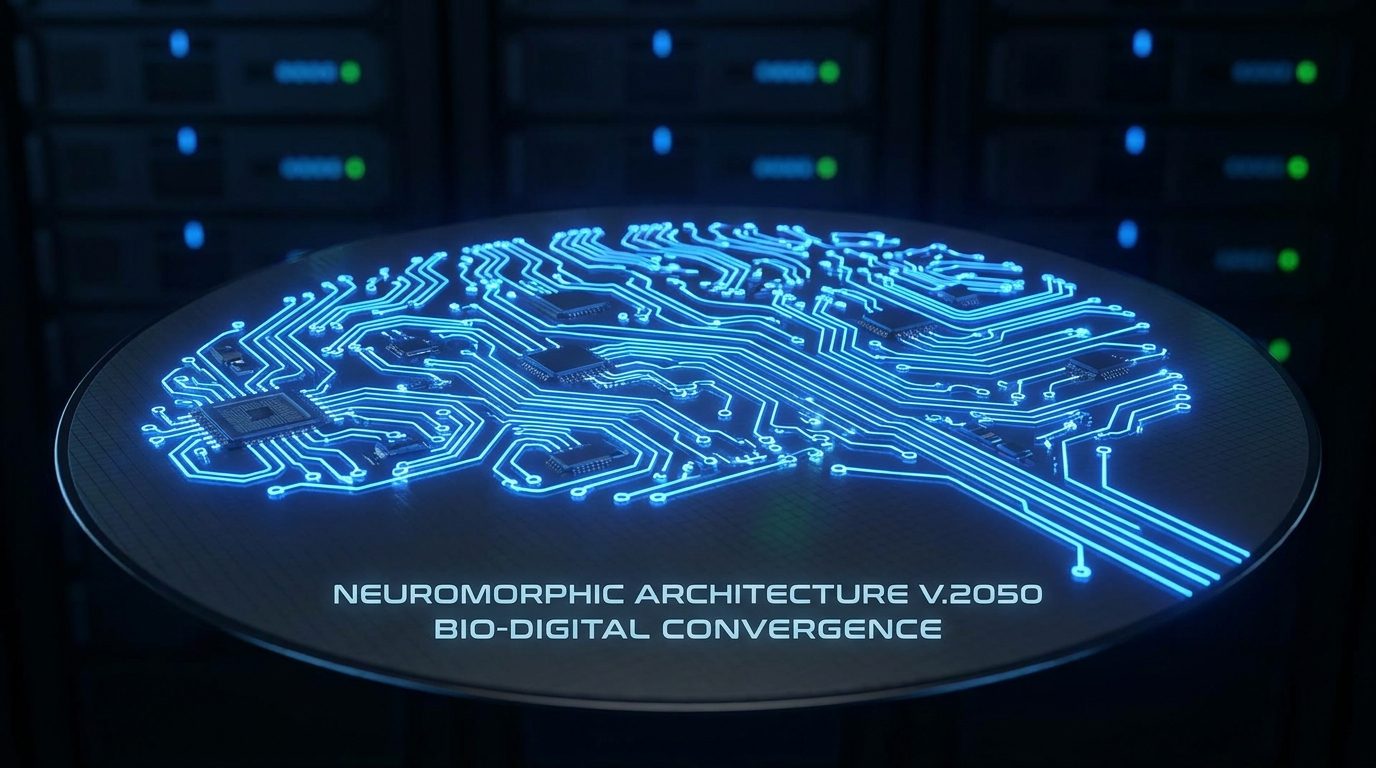
Neuromorphic chips redesign this at the silicon level, inspired by how biological neural networks operate. Instead of clock-driven processing of dense matrix multiplications, neuromorphic processors use event-driven computation: artificial "neurons" fire asynchronously only when they receive sufficient input signals. Memory and processing co-locate in the same physical structure. The result is that computation requires energy only when something actually happens — idle neurons consume near-zero power.
This is not a general-purpose computing paradigm. Its advantages concentrate in sparse, real-time inference tasks: detecting anomalies in sensor streams, processing edge AI on battery-powered devices, running spiking neural networks trained on time-series data. The efficiency gains are extraordinary in those specific contexts; the hardware is essentially useless for dense matrix math that GPUs excel at.
Hala Point: What Intel Actually Built
Intel's Hala Point, unveiled at Hot Chips in April 2024 and now being delivered to research and commercial partners, consists of 1,152 Loihi 2 neuromorphic chips, collectively containing 1.15 billion artificial neurons and approximately 128 billion synaptic connections. That neuron count roughly matches a small mammalian brain.
The published performance figure — up to 20 quadrillion (20 × 10^15) synaptic operations per second per watt — requires context. Intel is measuring on tasks specifically suited to neuromorphic architecture: sparse spiking workloads where most neurons are inactive most of the time. On those tasks, the efficiency advantage over GPU inference is approximately 2,500–3,000× better than equivalent Nvidia A100-class GPUs running comparable sparse inference workloads. On dense matrix operations, Hala Point has no meaningful advantage.
Intel ships Hala Point as a research cluster, not a consumer product. Intel's Lava framework (open-source, Python-based) provides the primary development environment, but porting existing neural network models to spiking neural network format requires specialized knowledge of spike encoding and temporal dynamics.
The Competitor Landscape in 2026
IBM Research's NorthPole chip places on-chip memory directly alongside each processing unit to eliminate the memory bottleneck. IBM published NorthPole results in Science in October 2023 showing 25× better energy efficiency than comparable GPU inference on image recognition tasks. NorthPole targets datacenter deployment in the 2026–2027 timeframe.
BrainChip Holdings' Akida chip is the most commercially accessible neuromorphic product available today — a production-grade processor shipping in embedded AI applications including security cameras, industrial sensors, and audio event detection, where its ultra-low power consumption (typically under 1 milliwatt for inference) enables battery-powered AI that GPU-based solutions cannot approach. BrainChip reported revenues of AU$4.2 million in H2 2025.
Qualcomm's Research division published work in 2024 on event-driven processing for next-generation sensing SoCs. Given Qualcomm's dominance in mobile processors, any neuromorphic integration into a Snapdragon chip would represent the technology's first mass-market deployment.
Where Neuromorphic Has Concrete Near-Term Advantage
Always-on edge sensing: Detecting wake words, monitoring industrial machinery vibration, processing ECG data in cardiac monitors — workloads that must run continuously on constrained power budgets. A neuromorphic chip drawing 100 microwatts can run continuously for years on a coin battery.
Real-time sparse signal processing: Radar, LiDAR, event cameras (sensors that output data only when pixel brightness changes). Prophesee, a French startup, sells event cameras alongside neuromorphic inference pipelines for autonomous vehicle perception and industrial quality inspection. Their system detects objects at 10,000 frames per equivalent second using under 30 milliwatts.
Scientific simulation at scale: The Australian National University used Loihi 2 clusters to simulate neural dynamics at 1,000× real-time, enabling experiments on brain plasticity that would be impractical on GPU clusters. Intel's research has also demonstrated accelerated solutions to sparse optimization problems where the brain-like architecture provides genuine algorithmic advantages.
The Software Gap: The Real Barrier
The primary obstacle to neuromorphic adoption is programming models. Training neural networks that run efficiently on neuromorphic hardware requires spiking neural network (SNN) architectures, which differ meaningfully from the transformer and CNN architectures that dominate current AI research. Conversion tools exist but the conversion process is imperfect and resulting networks often need fine-tuning.
Intel's Lava framework, IBM's open-source neuromorphic toolkit, and BrainChip's MetaTF SDK are the primary development environments. None has achieved the ubiquity of PyTorch or TensorFlow. The talent pool of engineers who can train and deploy SNNs effectively is genuinely small — probably under 1,000 researchers worldwide with hands-on production experience.
Actionable Takeaways
- For embedded and IoT teams: BrainChip's Akida is production-ready today for always-on audio, vision, and sensor inference. Evaluate it if you're building battery-powered AI applications where current solutions are power-constrained.
- For research and HPC teams: Intel Hala Point access is available through the Intel Neuromorphic Research Community. The Lava framework is open-source at github.com/lava-nc/lava. If your workloads involve sparse optimization problems or real-time SNN simulation, evaluation is worth the engineering investment.
- For enterprise AI architects: Watch IBM NorthPole's datacenter roadmap. Its 25× energy efficiency advantage on inference tasks could meaningfully reduce inference costs at scale when it ships commercially in 2026–2027.
- Don't conflate neuromorphic with general AI efficiency. These chips solve specific problems brilliantly and are not substitutes for GPU compute in LLM inference or training. Match the architecture to the workload.