On-Device AI Is Quietly Changing What Smartphones Can Do — No Internet Required
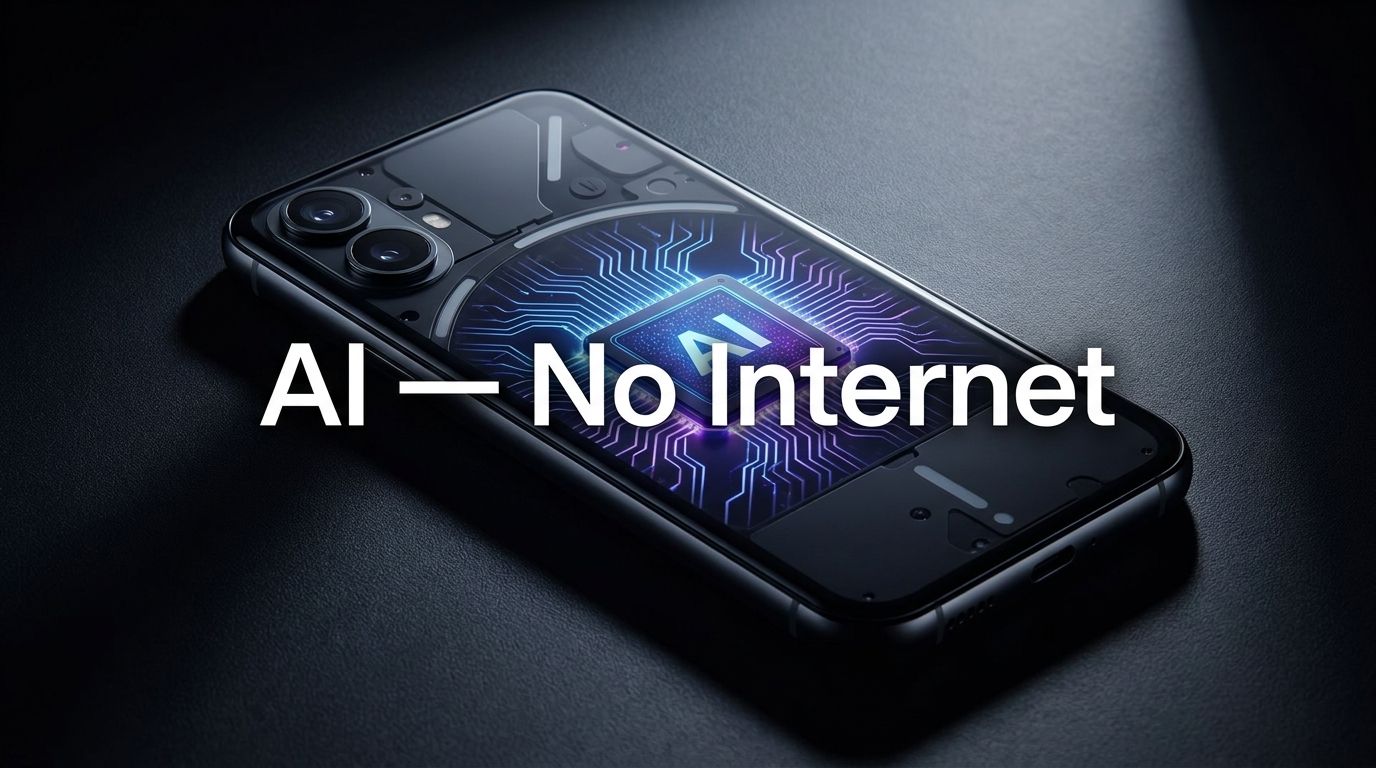
The AI demos that get attention involve cloud servers, billions of parameters, and a fast internet connection. The AI that's actually changing how hundreds of millions of people use their devices is smaller, faster, and running entirely on silicon inside their pockets.
Every flagship smartphone released since 2024 contains a Neural Processing Unit — a dedicated hardware block designed specifically to run matrix operations and neural network inference at high speed and low power. The Apple A18 Pro in the iPhone 16 series, the Qualcomm Snapdragon 8 Elite, and Samsung's Exynos 2500 all ship with NPUs capable of running 10–38 trillion operations per second. These are not general-purpose processors repurposed for AI — they're custom silicon designed from the ground up for the specific computational patterns that neural networks require.
What NPUs Actually Do
Neural processing units are optimized for the matrix multiplication and convolution operations that dominate neural network workloads. A CPU can execute these operations, but inefficiently — it has to load data from memory, perform operations sequentially, and write results back, often leaving most of its computational capacity idle. A GPU parallelizes better but consumes far more power than is sustainable on a battery-powered device. An NPU is purpose-built: it has local memory arrays positioned adjacent to multiply-accumulate units, processes data in tiles that maximize reuse, and operates at a fraction of the power budget of a GPU.
The Apple Neural Engine in the A18 Pro processes 38 trillion operations per second at a power draw that allows sustained inference without throttling. Qualcomm's Hexagon NPU in the Snapdragon 8 Elite reaches 45 TOPS (trillion operations per second) — the highest in any mobile chip as of 2026. Samsung's Exynos 2500 NPU hits 34.4 TOPS. These numbers represent a 3–4x improvement over the same generation two years earlier, following a trajectory that suggests mobile NPU performance is roughly doubling every 18 months.
What Runs On-Device in 2026
The practical applications running locally on flagship phones in 2026 go well beyond the simple speech recognition and photo categorization of previous generations. Live translation now works entirely on-device: the Pixel 9 Pro's interpreter mode translates spoken conversation in real time between 48 language pairs without any network connection, processing audio, converting to text, translating, and synthesizing speech in under 400 milliseconds. Google's on-device translation model is a distilled 1.5 billion parameter model that fits in 600 MB of memory and runs entirely on the Tensor G4's NPU.
Samsung's Galaxy AI suite, running on the Snapdragon 8 Elite, includes on-device photo editing that can remove objects, extend backgrounds, and recompose images using a diffusion model compressed to run within the NPU's memory constraints. The photo editing models are substantially smaller than cloud equivalents — around 500 million parameters versus the 3–8 billion in cloud photo tools — but produce results that are indistinguishable for the majority of use cases.
Apple Intelligence, introduced in iOS 18 and refined through 2025 and 2026, runs a collection of models on-device: a writing assistant, an image generation system called Image Playground, a summarization engine, and the enhanced Siri that can perform multi-step tasks across apps. The on-device models top out at around 3 billion parameters and run on the Neural Engine; tasks requiring larger model capabilities are routed to Apple's Private Cloud Compute, which processes requests on Apple Silicon servers and cryptographically guarantees that data is not retained or logged.
The Privacy Advantage
Processing data locally changes the privacy equation in ways that marketing language often obscures but the technical implications are real. When your phone transcribes a voice note on-device, that audio never leaves the device. When an on-device model summarizes an email, the email content never traverses a network. When photo editing runs locally, the photos aren't uploaded to a third-party server for processing.
This matters in contexts where cloud processing creates legal or practical exposure: medical professionals dictating notes, lawyers discussing client matters, journalists protecting sources, and anyone in a jurisdiction with aggressive data retention laws. The practical benefit is that on-device processing sidesteps the privacy policy questions entirely — there's no data to collect because nothing leaves the device.
The limitation is capability: on-device models are necessarily smaller and less capable than their cloud counterparts. A 3 billion parameter on-device model will write a worse essay than a 70 billion parameter cloud model. The gap has been narrowing — distillation and quantization techniques have improved significantly — but it hasn't closed, and for complex reasoning tasks, cloud models remain substantially better.
The Offline Reliability Case
On-device AI also addresses a reliability problem that is easy to underestimate: cloud dependency. An AI feature that requires a server connection is unavailable on a plane, in a building with poor reception, in a country where the provider's servers are blocked, and during any outage of the provider's infrastructure.
Google learned this lesson with the Allo messaging app in 2016: AI features that required cloud processing were simply absent when users were offline, which limited adoption. The transition to on-device processing for most common features has been a deliberate strategic shift across all three major phone platforms. The goal is that AI features feel like features of the device, not features of a service — predictably available regardless of connectivity.
The Model Compression Race
The capability gap between on-device and cloud AI is closing through a combination of hardware improvements and model compression research. Quantization — reducing the precision of model weights from 32-bit or 16-bit floating point to 8-bit or 4-bit integers — reduces model memory requirements by 4–8x with modest accuracy penalties. Knowledge distillation trains smaller models to mimic the behavior of larger ones. Structured pruning removes neurons and layers that contribute least to model output.
The result is that models designed specifically for on-device deployment in 2026 achieve capabilities that would have required cloud processing in 2023. Qualcomm's AI Model Efficiency Toolkit and Apple's Core ML framework both include tools for taking standard model architectures and optimizing them for on-device deployment. Meta has open-sourced its MobileVision and MobileNLP research specifically targeting on-device inference.
The trajectory points toward a near future where the latency, privacy, and reliability benefits of on-device AI — combined with continued hardware improvements — make it the default for most common tasks, with cloud processing reserved for the demanding cases that genuinely require it. For users, this means AI features that feel instantaneous and work everywhere. The underlying shift is that intelligence is becoming a property of the device, not a service accessed from it.